
Injury Prevention in Jiu-Jitsu: How to Stay Healthy on the Mat

Updated: Jul 30
By: Professor Itay Leibovich | Black Belt | Gracie Jiu Jitsu | April 2026 | Reading time: ~10 min
Categories: beginners guide, BJJ injury prevention, Brazilian Jiu-Jitsu Tel Aviv
Injury prevention in jiu-jitsu: how to stay healthy on the mat
Gal and I were on a squad commanders' course together 26 years ago (Bislach 906. August 2000. Company C. Platoon 2. Squad 2A. Honour and strength).
26 years is a long time. But faces do not fade, at least not for me, and Gal in particular I never forgot. He is the type who trains hardcore even in war zones when the conditions are anything but comfortable. Does not stop. Does not compromise. The body moves, the fitness holds, whatever is going on around him. While most people look for an excuse not to train, Gal finds a reason to train. It is not something he learned, it is who he is.
Six months ago he suddenly turned up at my academy in Tel Aviv for a trial class. I was not surprised that he gave everything in that session. I was surprised, and a little disappointed, when he did not come back for another.
Two weeks ago he messaged me saying he wanted to join regular training. I was surprised again, this time in a good way. After two sessions at the academy he wrote that he thought he had overdone it, and then told me he had not come back after the trial class because he injured his ribs and gave himself six months to rest. He wrote that at the trial class he had pushed too hard, felt it at the time, and felt pain with every sneeze. He waited six months, came back with humility, had a great session on Thursday, rolled with a Brazilian purple belt who weighed 20 kilos less than him but felt like 200 on his chest. And again, the pain.
And then... another surprise. "My fault. I worked too hard."
That kind of self-awareness is rare and welcome. Most people who get injured blame the partner, the floor, "this violent sport". Gal understood exactly what had happened. He was not looking for someone to blame. He looked inward, saw the truth, and came back. That takes courage and honesty few people show.
The problem is that understanding does not heal ribs.
This article is for him. And for anyone starting Brazilian Jiu-Jitsu, at 25 or at 55, who wants to still be on the mat in a year, in two, or in twenty. Particularly for anyone looking for martial arts for adults in Tel Aviv and asking themselves whether their body will hold the pace. The answer is yes, provided you train intelligently. Jiu-jitsu for adults is not a watered-down version of the sport. It is the same sport, with a bit more listening to your body.

Why do injuries happen in jiu-jitsu?
The short answer: the body does not recognize what it is being asked to do.
Jiu-jitsu is full of movements you never make in ordinary life. You do not rotate on your back at home, you do not hold someone between your legs three times a week, you do not try to escape from someone 20 kilos heavier than you under full pressure. Your muscles, tendons and ligaments are not ready for it yet. That is true for beginners of 25, and equally true for beginners of 45 who arrive with a body that has worked hard all its life, but not quite like this. Your body is clever, but it needs time to learn this new language. Jiu-jitsu is a physical language, and it takes months just to spell out its first letters.
And then the survival instinct kicks in.
When somebody puts pressure on you, the body does not stop to think. It just moves. Sharply, forcefully, in whichever direction looks most sensible in a split second. That movement can be exactly what was needed, and it can also be the shortest route to A&E. The body has not yet been trained to move correctly under pressure. That takes time. A lot of time. And until the body learns, it does what it does best: it reacts. Fast, sharp, and not always in the right direction.
Gal's ribs did not know they were supposed to rest either. And to be precise, this is not only a BJJ thing, or even a BJJ-beginner thing. Experienced practitioners fall into exactly the same trap when they move to a new academy, train with a partner they do not know, come back after a break, or simply show up on a day when the body was not cooperating.
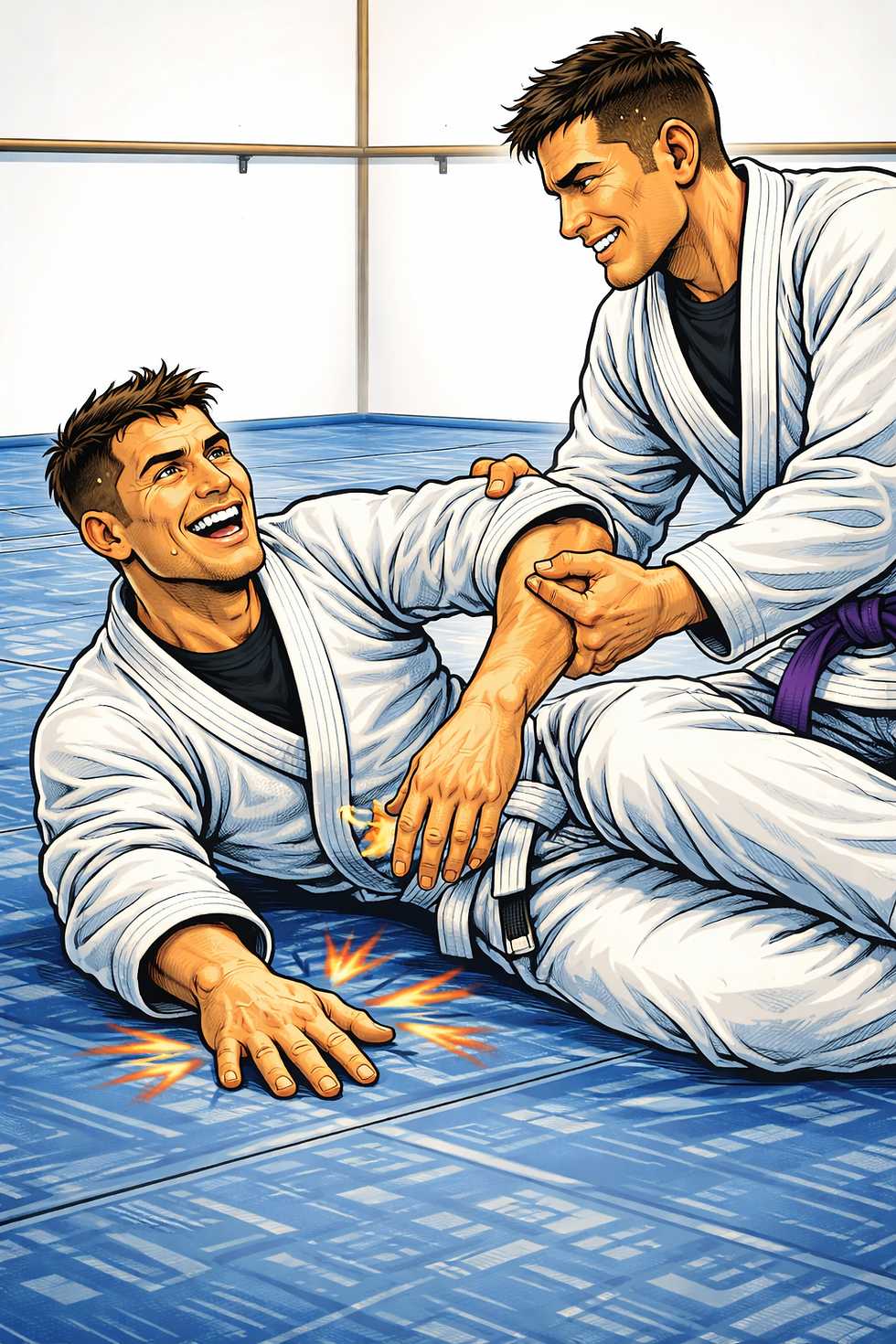
As for the common injury types: joints hurt by locks such as the armbar, shoulder locks like the kimura and americana, and leg locks of every kind. Impact bruising from full contact, mainly to the ribs and knees. Tears and strains from unnatural movements and from overstretching a little past the range of motion. And the single most common situation for injury: the transition from standing to the ground, two bodies on the way down with only partial control. That is a place where people get hurt a lot. Two people falling together, each trying to control the situation, and nobody really in control. The body that reacts too fast pays the price.
Ego: the number one cause of injury
You can talk about warming up, about correct technique, about responsible partners. All of those matter. But if you had to pick one factor responsible for more injuries than anything else, it is ego. Not the sport. Not the partner. Not the floor. Ego.
And no, I am not talking about the "I'm the best one here" version of ego. I am talking about something far deeper. A mechanism that exists in all of us, which says: if I tap, I am weak. And if I am weak, I am worth less. That mechanism does not distinguish between genuine danger to life and an armbar at a Thursday evening session. It knows only one thing: do not submit.
It is not rational. It is also not true. But it is exactly what happens in the split second before you decide not to tap.
"One more second and I'm out." "Not to this." "I'm worth more than this."
And meanwhile the ligament stretches. And then a little more. And a second later, there is damage.

Some numbers. If you do five sparring rounds a session, twice a week, all year, you have over 500 training fights a year. In those hundreds of rounds, 97% of the time somebody will reach a position where they can finish you. The maths is doing you no favours and giving you no discounts.
So the question is not "should I tap?" but "when?"
The answer: early. Very early.
Tapping is not failure. It is the point at which you recognise that you lost this particular exchange, and now you have a chance to learn from it. What did I do to end up there? What did I miss? Where did I lose the position? That is all. Tap, shake hands, get up, start again.
I hear this sometimes: "But if I always tap, how will I develop?" Good question. The answer is that development comes from a body that feels, not from a body that breaks. When you let a submission finish early, you hear your body saying "I've been there." When you wait another three seconds because of ego, your body says "I'm in pain for a week, a month, a year."
There is a price for tapping late. There is no price for tapping early.
Every black belt you have ever seen on a mat has tapped thousands of times. Not because they were weak. Because they understood that the body is not the prize, it is the tool. And you look after your tools. They got there not despite the taps, but because of them. Every early tap is another session they granted themselves. Every refusal to tap that ends in injury is two weeks stolen from the mat. At least. Often more.
Tap often. Tap fast. Live to ta... train another day.
Five injuries worth knowing, and how to avoid them
Fingers and hands
One of the most common injuries in Gi jiu-jitsu. The hands grip fabric all session, again and again and again. Releasing a lapel too late, a finger caught in a sleeve or a fold of cloth, and the finger bends in a direction it is not meant to. It usually happens in a moment of fatigue, when the grip is loose but still holding, and somebody pulls hard in another direction. It does not sound dramatic, and usually it is not. But a finger that gets hurt over and over, without rest, accumulates into damage that affects every future session.
The swollen finger you ignore becomes the finger that bothers you for six months.
What to do: tape, learn to grip correctly, stop the death grip. Release grips, and if the finger bends, stretches or twists, stop. Not "one more round."
Shoulders
Kimura, americana, omoplata. Three attacks all aimed at the same joint, from different angles. The shoulder is the least stable joint in the body, and the most dependent on the surrounding muscles to hold it in place. A shoulder that gets stretched once tends to make repeat visits outside its socket. After shoulder surgery, there is no promise you will get the same range of movement back. I know people for whom a one-second decision not to tap cost surgery and six months of rehabilitation.
What to do: tap before it hurts, not after. Warm the shoulders up before every session. And if the shoulder feels loose the day after training, do not roll.
Elbows
The armbar is one of the iconic and most common locks in BJJ. It is also one of the most dangerous for the person waiting "one more second" before tapping. The ligaments in the elbow do not forgive, and do not forget. An injured elbow comes back to bother you years later, usually exactly when you are not expecting it. The body remembers, even when you would rather forget.
What to do: tap the moment you feel the pressure begin. Not when it hurts. The moment you feel it.
Knees
The knee connects two bones in a way that is not designed to rotate. Jiu-jitsu is full of movements that ask for exactly that, and that is fine, provided the person holding your knee knows what they are doing and knows when to let go. The problem is that beginners do not always know when to let go. They feel resistance and add force, exactly when they should have stopped.
A heel hook applied badly can end a whole year of training. Sometimes more than a year.
What to do: do not drill leg locks with inexperienced partners. When you feel pressure on the knee, tap immediately, not "maybe I'll get out of this." An injured knee takes six months. Sometimes more. Sometimes it simply does not go back to what it was.
Ribs
Gal can tell you about those (so can I, actually, more than once).
Heavy pressure from a dominant position, side control or mount. A sharp movement while pinned, a partner who does not control his bodyweight, a fall. Nothing needs to break or crack for you to end up with pain that stays with you for months. The ribs are a structure protecting internal organs, and repeated pressure on them creates small tears in the tissue. It feels like "a small pain". It behaves like a pain that does not go away. And every change of position, every deep breath, every time somebody makes you laugh, reminds you that you should have stopped earlier.
If there is pain in the ribs, you stop. That is not advice. That is a rule.

The habits that genuinely make a difference
Warming up before training is a baseline, not a bonus. If you arrive five minutes early, stretch for 30 seconds and start drilling, your body is not ready. The muscles are cold, the ligaments are not engaged, and the first time somebody pushes you in an unexpected direction, the body will react sharply. That is where people get hurt. Not through lack of talent or ability. Not because of an aggressive partner. Because of a body that did not get the ten minutes it needed.
Ten minutes of active warm-up before every session, with particular attention to shoulders, neck and knees, makes a difference. Beyond the warm-up, the most important habit I see in the people who get injured least is one simple thing: they talk. They communicate. They do not treat their own difficulty as something that will be read as an excuse.
Before you start rolling, tell your partner what is going on. "I've got pain in my right shoulder." "My left knee is sensitive today." "I want to flow more today, not work at full pressure." One sentence. That is all. A good partner will respect it. And if he does not, that is important information about who you are training with. Jiu-jitsu is built on trust. A partner who does not respect your limits does not understand the art, not just the safety.
And if you feel pain or discomfort in the middle of a roll, you stop. Without apologising. Without "just one more second." This goes straight back to the ego we talked about. The fear of looking weak in front of your partner makes people carry on when they should stop. Your body is worth more than that moment.
And there is one more thing that matters just as much: talk to your coach.
I am not talking about coming to me with every scratch. But when there is recurring pain, when something feels wrong after a session, when you are not sure whether to keep rolling with an injury, come and ask. The coach sees your body in motion. He can help you work out whether it is normal fatigue or a warning you need to listen to. He has also seen that same injury dozens of times, and very probably had it himself more than once, and knows what works and what does not. It is part of his job, and we are here for exactly that.
Train properly from day one: details on Brazilian Jiu-Jitsu training in Tel Aviv on the training page. Classes are taught in Hebrew, but our instructors speak fluent English and a large part of our members are English speakers. On Saturday nights we run a class taught in English by Philip Paul.
FAQ on safety and injury prevention in BJJ
Is jiu-jitsu dangerous for beginners?
Every full-contact sport comes with risk. But BJJ is a system where the basic rule is to tap before you get hurt. Beginners who internalise that, and who train with responsible partners and a coach present, finish sessions tired rather than injured. It is possible. It is the norm at the Israeli Academy of Brazilian Jiu-Jitsu and MMA.
How many times is it "acceptable" to tap in a session?
As many as you need. There is no shameful number. In the first year it is dozens of times a session. Over the years it becomes fewer, not because the ego grows, but because the technique develops.
I took a knock in the middle of a roll. Do I carry on?
No. You stop, drink some water, talk to the coach. An injury caught early is a week off. An injury you ignore is six months.
I'm 45. Is it too late to start?
Gal, 45, came back after an injury and trained last Thursday. He is not exceptional. Well, he is! Obviously! He belongs to the best squad commanders' course in history! But on this particular question he is a completely ordinary, completely typical person. Brazilian Jiu-Jitsu is one of the most accessible sports for the adult age group, precisely because it is based on leverage and technique rather than speed and strength. There is no shortage of martial arts for adults in Tel Aviv, but few of them offer what jiu-jitsu offers: real ability that grows with age, not against it. Age stops nobody. The injury you ignore is what stops you.
Does self-defence for women require physical strength?
Jiu-jitsu is the best system for women's self-defence precisely because it does not require strength, size or weight. It asks for leverage, technique and position. Women who train with us learn to protect themselves without relying on raw strength, and the culture of safe training and sparring makes the difference.
What do you do when a partner does not stop in time?
You stop yourself. Always. And after the session you talk to the coach. A good academy builds a culture where safety is not weakness, it is the standard.
---
If you have read this far and you are looking for BJJ near me in the Tel Aviv area, or looking for martial arts for adults that suit your age and your body, read also:
By the way, if you got here through a search for jujitsu, jiu jitsu, ju jutsu or jujutsu, it is the same sport. Different spellings, same mat. You have come to the right place.
Questions? Send me a message on WhatsApp


Comments