
Gi vs No-Gi in Brazilian Jiu-Jitsu: Which One Is Right for You?

Updated: 5 days ago
By: Professor Itay Leibovich | Gracie Jiu-Jitsu Black Belt | 36 years training, 16 years teaching Date: March 2026 Reading time: ~8 minutes Categories: Beginners Guide, Gi vs No-Gi, Brazilian Jiu-Jitsu Tel Aviv

“Itay, I am confused. I have two friends who train Jiu-Jitsu. One of them trains in a Gi, the other one in a tight rash guard. They both say they do BJJ. What is the story?”
That was Danny, a new student who googled “BJJ near me” and turned up for a trial class at the Israeli Academy in Brazilian Jiu-Jitsu Tel Aviv (BJJ Tel Aviv).
I smile. “Let us sit down for a minute.”
It is one of the most common questions I get. Gi vs No-Gi. With the jacket or without it. With a fight uniform or without one.
Sounds simple, right?
But the truth? This difference changes everything - how you learn, what you learn, and what kind of grappler you end up becoming.
So let us talk about it honestly. No coaching jargon, no telling you that “they are both equally good” (because it depends entirely on what you want), and no dodging the question that actually matters:
Which one is right for you?


What Is a Gi? (And Why Does It Look Like a Judo Uniform?)
Let us start at the beginning.
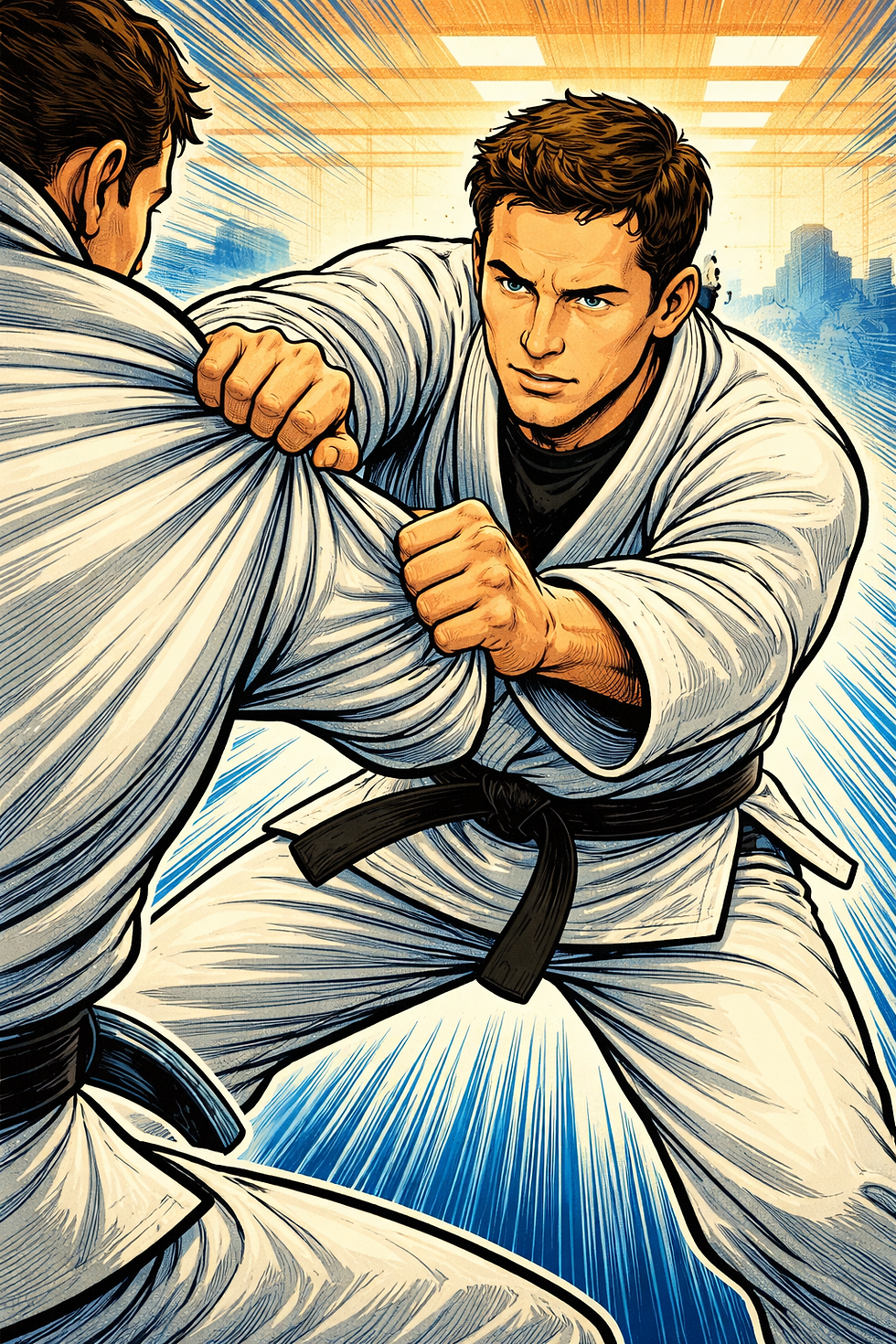
The Gi (Gi) is the kimono, the traditional training uniform. A thick jacket, thick trousers, and a belt that shows your rank.
Why does it look like a Judo uniform?
Because Brazilian Jiu-Jitsu and Judo both grew out of Japanese Jujutsu. When Helio Gracie learned from the Japanese master Mitsuyo Maeda in the 1920s, he kept the traditional uniform. That was never only a matter of respect for tradition - the uniform itself is part of the art.
Why does the Gi matter?
Think about it for a second.
On the street, people wear clothes. Shirts, coats, t-shirts, jackets. Nobody walks around in a sports bra and skin-tight shorts (unless they are at the beach).
When you train in the Gi you learn: - how to grip clothing - how to use his own shirt against him - how to escape when he grabs your shirt - how to choke someone with his own collar
That is realistic.
What Is No-Gi? (And Why Does It Look Like MMA Training?)
Training without the uniform - No-Gi - no fight uniform. Just a tight rash guard and shorts or leggings. Looks like MMA training? That is exactly why. No-Gi can stand on its own as grappling without a uniform, or it can serve as part of MMA training - there too there is no clothing you are allowed to grip. It is faster, more dynamic, and less “technical” in the sense of fabric grips. (By the way, if you are looking for MMA training in Netanya or Tel Aviv - BJJ is the single most important base any MMA competitor can have.)
Why does No-Gi matter?
Because sometimes there is no clothing to grab.
Summer in Israel? Everyone is in short-sleeve t-shirts. At the beach? Swimwear. At home? An old t-shirt and a pair of sweatpants.
If you rely only on Gi grips and you end up in a situation with no uniform - you are missing an important tool.
In No-Gi you learn grips on the body rather than on clothing - control of the joints and the neck - fast movement (less friction) - defence when everything is slippery

The Real Differences (Beyond the Clothing)
Okay, so there is Gi and there is No-Gi. But why does it actually matter?
Let us talk about the part nobody tells you.
1. The Pace of Training
Training in the Gi: Slower, more technical, more strategic. Why? Because you have fabric grips. You can take a collar, a sleeve, a trouser leg. It is like chess - every move needs you thinking three moves ahead. Training in No-Gi: Fast, dynamic, rewards athleticism and forgives nothing. Why? Because there are no fabric grips. Everything is slippery. If you did not grab fast, he is already gone. It is basketball against chess.
2. The Fatigue
Training in the Gi: You get tired from the grips. Holding a hard collar grip for five minutes? Your fingers are dead. That muscle between your thumb and index finger? On fire. Training in No-Gi: You get tired from the cardio. Everything moves fast. There are no fabric grips to slow the pace down. It is sprint intervals on the mat.
3. The Techniques
Gi: More collar chokes, more sweeps using the fabric, more grips and more control.
And in No-Gi: More chokes on the neck with arms and legs instead of fabric, more leg locks, more scrambles.
The Story Nobody Tells You (The Day I Understood the Difference)
It is 2010 and I am at a BJJ competition in Brazil. Semi-final, Gi. My opponent is a huge guy, probably 115 kilos (I am 100). He is strong as an ox.
He takes my collar. I can feel his power. He is trying to choke me. But I have technique. I grab his sleeve, break his balance, turn him, take his back and choke him.
I win.
A month later I am in a No-Gi session in Tel Aviv. The same kind of opponent - big, strong. This time I have no collar to grab. No sleeve. He is slippery.
He takes me down. I struggle. It is fast. It is messy. I have to use completely different techniques.
That is the moment I understood: The Gi teaches you to think slowly, control the clock and use every tool available. No-Gi teaches you to move fast, adapt, and work without most of those tools.
Both matter. But for different reasons.
Which One Is Better for Self Defence? (The Answer Nobody Likes to Give)
Okay, this is the question everybody asks.
“Itay, if I want to defend myself on the street - Gi or No-Gi?”
The honest answer?
Both. But if I have to pick one - Gi.
Why?
1. On the Street, There Are Clothes
90% of the time, someone attacking you is wearing something. A shirt, a jacket, a coat. If you know how to use clothing, you have an advantage.
A real example: one of my students, Ron, was attacked on the street in Tel Aviv. The attacker grabbed his shirt. Ron, who trains in the Gi, knew exactly what to do. He caught the attacker's arm, broke his balance through his own collar grip, and took him to the ground.
The Gi saved him.
2. The Gi Slows the Pace Down - Which Suits Beginners and Anyone Who Is Not Especially Big or Strong
The Gi teaches you to think. Not to panic. To control. No-Gi? It is too fast for beginners. Everything slips away, everything moves, and it is hard to learn anything.
3. But… No-Gi Prepares You for Slippery Situations
Summer? People sweat. Clothing gets slippery. The sea? A wet swimsuit. Rain? Wet clothes.
If you train only in the Gi, and you end up somewhere wet and slippery - you can get caught out.
So What Do You Actually Do? (The Practical Guide)
For beginners:
Start with the Gi. 100%.
Why? - It slows the pace down, so you learn better. - It teaches you the fundamentals (position before submission). - It prepares you for the street, where there are clothes. - It is less exhausting, and No-Gi burns beginners out.
After 3-5 months: add No-Gi once a week.
Why? - It complements the Gi. - It teaches you speed. - It prepares you for situations with no clothing.
For advanced students:
Why not both?
Gi twice a week, No-Gi once a week. Or Gi three times, No-Gi twice.
Why? Because a complete grappler can work in any condition.
For self defence:
Gi mainly, No-Gi as the supplement.
At the Israeli Academy we teach Gracie Jiu-Jitsu - which means the emphasis is on the Gi, because that is closer to the reality of the street.
But we run No-Gi too, because we want you ready for any situation.
What Does That Look Like in Practice at the Israeli Academy?
How our classes are built:
Gi (Tuesday morning, Monday and Thursday evening) - Warm-up: 10-15 minutes - Technique: 45 minutes (Gracie Jiu-Jitsu, self defence) - Sparring: 30 minutes
No-Gi (Monday and Wednesday morning, Sunday and Wednesday evening): - Warm-up: 10 minutes - Technique: 30 minutes - Sparring: 40 minutes, because it moves faster
Why split it that way?
Because the Gi is the base. No-Gi is the addition.
If you want to defend yourself - start with the Gi. If you want to be complete - add No-Gi.
The Biggest Mistake Beginners Make
I see it all the time.
Somebody new walks in, watches a No-Gi session - looks cool! Fast! Dynamic!
So he starts with No-Gi.
And then he gives up.
Why?
Because No-Gi is too fast for a beginner. You never get the chance to learn. Everything slips away, you do not understand what just happened, and you walk out confused.
The Gi? You learn.
Everything is slower. There is time to think. The coach can explain. You understand what is happening.
So do yourself a favour:
Start with the Gi. Listen to your coach. Give it three months. Then decide.

Summary: What Should You Remember?
If you remember one thing from this article, remember this:
Gi and No-Gi are not rivals. They complete each other.
• The Gi teaches you the fundamentals, the technique and the strategy.
• No-Gi teaches you speed, adaptation, and how to work in difficult conditions.
For beginners: Gi first. No-Gi after.For advanced students: Both.For self defence: Gi mainly, No-Gi as the supplement.
And remember - it is not about the clothing. It is about what you learn.
Want to try it for yourself? All the details about Brazilian Jiu-Jitsu classes in Tel Aviv at the academy, including the schedule and the coaches. Classes are taught in Hebrew, but our instructors speak fluent English and a large part of our members are English speakers. On Saturday nights we also run a class taught in English by Philip Paul.
Frequently Asked Questions (FAQ)
Do I need my own Gi?
Not at the start. The Israeli Academy has Gis you can borrow for your trial class. After 2-3 weeks, yes - it is worth buying one, and after the first month a Gi is required. Training at the Israeli Academy is done in academy uniform.
Is No-Gi harder?
Not “harder” - different. Gi = slow and technical. No-Gi = fast and cardio-heavy. Both are demanding. It depends on what you enjoy.
Which one is better for women?
Gi.
Why? Because on the street an attacker will grab your clothes, and the Gi teaches you exactly what to do in that situation.
Most of the women who come to the Israeli Academy are looking for self defence for women or Krav Maga for women - and the Gi gives them exactly the right tools for real street situations. Read more about self defence for women in Jiu-Jitsu.
Can I train No-Gi only?
You can. But I do not recommend it. The Gi is the foundation. Without foundations, you are building a house on sand.
What happens if I train only Gi and then need No-Gi?
You will struggle at first. It is an adjustment. But the Gi gives you the fundamentals, so you will pick No-Gi up fast. The other way around is much harder.
Does the Israeli Academy have two separate belt systems?
No. There is one belt. You are graded on your skill in the Gi, but we look at your No-Gi as well. Why? Because Gracie Jiu-Jitsu is Gi-based.
I am 40. Which one suits me?
The Gi. It is easier on the joints, fewer sprints, more technique. No-Gi suits younger people who love the speed.
Want to Get Started?
Come in for a trial class at the Israeli Academy for Gracie Jiu-Jitsu - message us on WhatsApp and we will book your trial class together - WhatsApp: Click here📧
📍 Tel Aviv: 29 Yitzhak Sadeh St.📍 Netanya: 4 HaTzoran St.
📞 Phone: 055-9212431💬 Email: Ingo@bjj.org.il
Gi classes: Tuesday morning, Monday and Thursday evening, No-Gi classes: Monday and Wednesday morning, Sunday and Wednesday evening Dedicated women's group: Tuesday evening
🌐 Academy website: www.bjj.org.il


Comments