
Self-Defence Brazilian Jiu-Jitsu in Tel Aviv: Why It Works When Everything Else Fails

Updated: 5 days ago
Self-Defence Brazilian Jiu-Jitsu in Tel Aviv: Why It Works When Everything Else Fails
By: Professor Itay Leibovich | Gracie Jiu Jitsu Black Belt | 36 years in martial arts, 16 years teaching Date: March 2026 Categories: Self-Defence, BJJ for Women, Gracie Jiu Jitsu, Martial Arts Tel Aviv

Friday afternoon, I am standing in line at a supermarket in Tel Aviv. Behind me is a big guy — a very big guy — getting worked up about something with the cashier. His voice climbs. He steps toward her. She backs away. I watch the tendons in his hands tighten.
Most people in that line are looking at their phones. I am not. I am measuring distance. I am reading the angle he is standing at. I know exactly where his centre of gravity is, which leg is carrying his weight, and how I would take him to the ground if he made a mistake.
I do not want to do that. Really, I do not. But I know how.
That is not movie-hero confidence. It is not a fantasy. It is 36 years of knowing what actually works when everything falls apart, when your heart is pounding, when there is no time to think. It is Gracie Jiu Jitsu — a realistic self-defence art that works for people who are not strong, for women in Tel Aviv looking for a self-defence course that is not theatre, and for people who have never been in a fight in their lives.
Here is why it is completely different from anything else you have tried.
---

Why Most Self-Defense Systems Do Not Work on the Street (And the Part Nobody Tells You)
Let us be honest for a second. How many times have you watched someone demonstrate a “self-defence technique” that looks incredible on video — and yet you cannot picture yourself doing it on the street?
Why?
Because most self-defence systems teach you one scenario with one response.
“If he grabs you like this, you do this.” “If he throws a punch like this, you block like this.”
Brazilian Jiu-Jitsu also works with “if X then Y”. That is our science, that is the method. But the difference?
Jiu-Jitsu teaches you 50 different variations of the same problem, and how to move between them in real time.
Because on the street there is no single script. There are thousands of variations, and your body has to learn to read them and respond.
The Story No Self-Defense Instructor Wants to Tell You
Fifteen years ago a student of mine — let us call him Danny — came to me after finishing a two-week self-defense course with a well-known organization (I will not name names, but you have probably heard of them).
Danny: “Itay, I have learned how to defend myself. I am ready now.”
Me: “Excellent. Tell me, what did you learn?”
Danny: “I learned to block punches, strike pressure points, escape grabs…”
Me: “Sounds good. Let us drill it.”
I stood in front of him, told him to get ready, and then simply walked at him, grabbed him and took him to the ground. He had no idea what happened. He was flat on his back, I was sitting on him in mount, and he looked up at me with a face that said “what now?”
Me: “So… what now?”
Danny: “Umm… I did not learn what to do here.”
Exactly.
90% of real confrontations end up on the ground. But most self-defense systems train only on the feet. Why? Because it looks better on video.
What Makes Brazilian Jiu-Jitsu Different? (Hint: It Is Not What You Think)
Here is the truth I have learned after 36 years on the mats:
Brazilian Jiu-Jitsu does not teach you to “defend yourself”. It teaches you to control the situation once everything is out of control.
And that is an enormous difference.
Most self-defence systems say: “Do this, then run.” Gracie Jiu Jitsu says: “Even if everything has gone wrong, even if he is bigger than you, even if he is on top — you still have control.”

---

The Philosophy Helio Gracie Taught (And How It Changed My Life)
When Helio Gracie developed Brazilian Jiu-Jitsu in the 1930s, he was not a superhero. He was small, thin and physically weak. He could not rely on strength.
So he asked himself one question:
“How do I, at 65 kilos, overcome someone who weighs 100?”
And the answer he found changed martial arts forever:
1. Take the fight to the ground — where the weight difference stops mattering
2. Control the position before you think about the finish — Position Before Submission
3. Let your opponent burn energy while you conserve yours — efficiency, not force
That is not just an elegant theory. It works.
The Time I Watched It Actually Work (And Not on the Mats)
2012, I am in a club in Tel Aviv. One of my students — a woman named Shira, 58 kilos, blue belt — is standing by the bar. A drunk guy, probably 95+ kilos, starts harassing her. She says no. He does not listen. He grabs her arm.
What happened next took three seconds:
1. Shira closed the distance (she did not run)
2. She controlled his head and his balance
3. He was on the floor and she was standing over him
Not a single strike was thrown. Nobody screamed. Just… control.
Security arrived, dealt with the guy, and Shira went back to her evening.
That is what a realistic self-defence art does. It does not turn you into a fighter. It turns you into someone who knows how to control the situation.
Why Jiu-Jitsu Works So Well for Women (And the Reason Is Not What You Think)
I will say it straight: Brazilian Jiu-Jitsu is the best martial art for women’s self-defence. Full stop.
Not because “women can do it too”. Not because “it builds confidence”. But because it is exactly the scenario women need to be prepared for.
If you are looking for a women’s self-defence course in Tel Aviv, or asking yourself whether Krav Maga is the right fit — listen closely for a minute.
Think about it.
Most attacks on women do not start with a strike from range. They start with: - someone grabbing your wrist - someone shoving you - someone trying to take you to the ground - someone trying to overpower you at close range
That is exactly what Jiu-Jitsu drills every single day.
It is also why Jiu-Jitsu is different from Krav Maga for women, or from short self-defence courses. Krav Maga focuses on strikes and escape — which is great if you have distance. But in a real situation? The distance disappears within seconds. Jiu-Jitsu teaches you what to do after the distance is gone.

Michal, a purple belt at the Israeli Academy of Jiu Jitsu, once told me:
“Itay, when I started training in Tel Aviv I thought I was learning how to fight. But what I actually learned is that I do not have to run. A man bigger than me? No problem. Someone grabbed me? I know what to do. It is not that I want to fight — I just know that I can.”
And that is the key.
Jiu-Jitsu does not make you violent. It makes you secure.
How It Actually Works: 3 Principles Every Woman Should Know
Principle 1: Close range is your friend, not your enemy
Most self-defence systems say: “Push him away from you!” Jiu-Jitsu says: “Close the distance. Control.”
Why? Because when you are close, he cannot use his strength effectively. The leverage disappears. His movement is restricted.
Principle 2: His strength is your advantage
A man bigger than you? Excellent — his centre of gravity is higher, which makes him easier to take down. He is strong? Great. Let him use that strength against himself.
Jiu-Jitsu is built on one simple principle: technique beats strength. Every time.
Principle 3: Do not try to win — try to survive and control
This is the biggest mistake I see.
Women (and men) come to self-defence training thinking: “I need to learn how to win a fight.”
No.
In a real street situation there is no winning. There is only control, escape, or both.
Jiu-Jitsu teaches you: - how not to panic when someone is holding you - how to create space even at zero distance - how to get out from under someone twice your weight - how to get back to your feet and leave
It is not magic. It is physics.
Why Traditional Self-Defence Courses Do Not Work (And What to Do Instead)
I know there are plenty of women’s self-defence courses in Tel Aviv. Some run for a single day. Some for two weeks. Some promise you will be able to defend yourself after three lessons.
Let us be honest: that does not work.
Why?
Because real self-defence is not learned in a day. It is not learned in a week. It is learned through repetition, drilling, and building muscle memory.
You can learn 50 techniques in one day. But in the real moment? Your brain will freeze.
Instead, you need to learn five techniques properly, drill them hundreds of times, until your body knows them automatically.
That is what Jiu-Jitsu does at the Israeli Academy. It is not a “course” that ends. It is a process that builds real confidence.
And for women in Tel Aviv and Netanya? That changes everything.
Because in the real moment you do not need to recall 50 techniques. You need your body to know what to do automatically.
The Biggest Mistake Beginners Make (And How to Avoid It)
I see it all the time at the Israeli Academy in Tel Aviv.
Someone shows up for their first class and I ask: “Why did you come?”
“I want to learn to defend myself.”
“Great. What do you expect to learn?”
“I do not know… how to throw a punch? How to block one?”
And that is exactly the problem.
Real Self-Defence Does Not Start With Techniques. It Starts With How You See the World.
Listen closely, because this is the most important part of this whole article:
Most violent situations do not start with a strike. They start with:
1. Tension rising
2. Distance closing
3. A moment of decision (yours or his)
If you can read those three stages, you are already in better shape than 90% of people.
And that is what Jiu-Jitsu teaches you without you noticing.
The Moment I Understood This (And It Changed Everything)
2008, I am in an MMA fight. My opponent is 15 kilos heavier than me. He is trying to take me down. We are in the clinch.
There is a moment — one second — where I feel his centre of gravity shift. He is about to throw me. But I know where he is going. Why? Because I feel it in my own body.
I am not thinking “now he will try a single leg”. I simply know. My body moves before my mind catches up.
That is what happens after hundreds — thousands? — of hours on the mats at the Israeli Academy.
Your body learns to read situations. Not just react to them.

How It Actually Works in Training (And the Truth About Your First Class)
Let us be honest:
Your first Jiu-Jitsu class will be confusing. It will be uncomfortable. You will feel clumsy.
And that is completely fine.
In fact, that is the point.
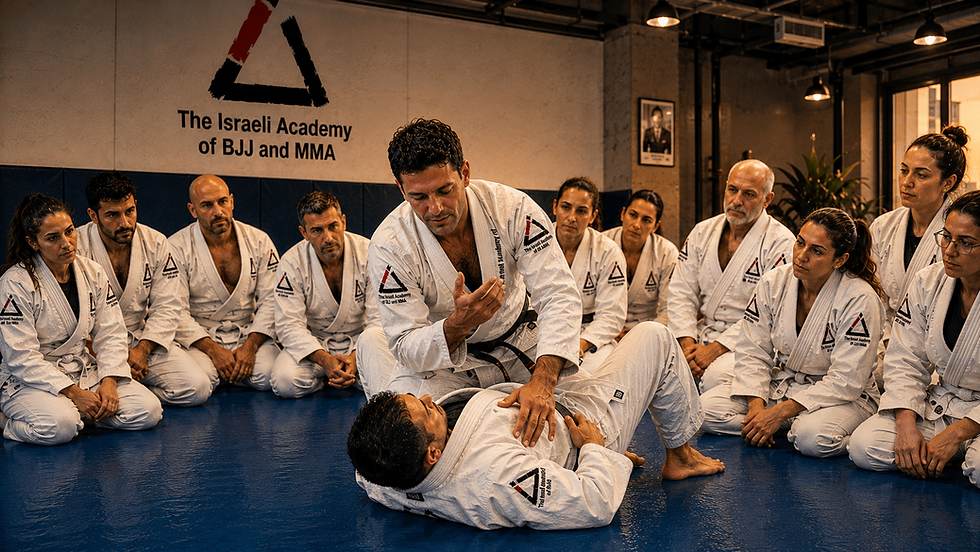
What Really Happens in a First Class at the Israeli Academy
Let me tell you what does not happen: you will not become a fighter in one day.
But here is what does happen:
Part 1: The warm-up (10-15 minutes)
No, it is not running laps around the mat. It is drills that mirror Jiu-Jitsu movements: rolls, shrimping, guard transitions.
Why? Because your body needs to learn to move in ways it is not used to.
Part 2: Technique and drilling (45 minutes)
The instructor shows one or two techniques. Not ten. Not five. One or two.
Why? Because Jiu-Jitsu is not memorising 100 moves. It is a deep understanding of 10-15 principles that you apply across hundreds of variations.
After the instructor explains and demonstrates, you drill it with a partner. Once, twice, a third time.
At first it feels like trying to dance with two left feet. After ten repetitions it starts to feel… possible. After a month it feels natural.
Part 3: Sparring and rolling (30 minutes)
This is the part everyone is afraid of, but honestly — it is the most important part.
Why? Because this is where you learn something no theory lesson can teach you:
what it feels like when someone is genuinely trying to control you, and you have to do something about it.
What No Instructor Tells You (But I Will)
Here is the honest truth:
In the first week you will walk out of training in Tel Aviv feeling like someone worked you over. Every muscle will ache. Including muscles you did not know you had.
In the second week you will start remembering some of the techniques. Not all of them — some.
In the first month you will start understanding why the techniques work, not just how.
And after three months? You will look at yourself in the mirror and realise something has changed.
No, you do not look like a UFC fighter (yet). But you feel different.
You walk down the street no less sure of yourself. You are not looking for trouble, but you are not afraid of it either.
Why Gracie Jiu Jitsu Is Different From Sport BJJ (And Why It Matters for Self-Defence)
Okay, this part is technical, but it is critical — especially if you are looking for Gracie Jiu Jitsu in Tel Aviv or simply trying to understand what it is.
There is an enormous difference between Sport BJJ (competitive Jiu-Jitsu) and Gracie Jiu Jitsu (self-defence).
Most academies in Israel teach Sport BJJ. Why? Because it looks impressive in competition. Because it is technical. Because it is a sport.
But Sport BJJ was not built for self-defence.
If you are looking for a realistic self-defence course — Gracie Jiu Jitsu is what you need.
The Differences Worth Knowing
Sport BJJ: - focuses on complex, technical submissions - built to win competitions (points, advantages) - works brilliantly against someone who knows Jiu-Jitsu - ignores strikes entirely (they are banned under competition rules)
Gracie Jiu Jitsu: - focuses on control and survival - built for real street situations - works brilliantly against someone who does not know Jiu-Jitsu - built around the assumption that strikes are coming
Which one is better?
It depends on your goal.
You want to compete? Sport BJJ. You want to defend yourself on the street? Gracie Jiu Jitsu.
The Principle That Saved My Life (And Might Save Yours)
Helio Gracie taught one simple principle:
“Position Before Submission” Control before the finish.
What does that mean?
It means: do not try to submit your opponent before you control him.
Why does that matter so much?
Because on the street, you do not want to submit anyone. You want to control him, and then leave — or hold him until help arrives.
If you jump for a submission without control, you are taking a risk. If you control first, you are safe.
That is the difference between a competitor and someone who can handle a street situation.
The Psychological Damage of an Assault (And How Jiu-Jitsu Prepares You for It)
Let us talk about something nobody likes to talk about:
Most people do not lose a physical confrontation because they are weak. They lose because they freeze.
It is called fight, flight, or freeze.
And in most cases? People freeze.
Why It Happens (And What Jiu-Jitsu Does About It)
Your brain sees danger. It does not know what to do. So it… does nothing.
That is not cowardice. It is simply biology.
But here is the remarkable part:
Jiu-Jitsu trains your brain not to freeze.
How?
In every session at the Israeli Academy you are placed in uncomfortable positions: - someone is sitting on you - someone is holding you down - someone is trying to choke you (safely, of course)
And instead of freezing, you learn what to do.
After hundreds of repetitions in those positions, your brain learns: “Okay, this is unpleasant. But I know what to do.”
And that changes everything.

Dana’s Story (And Why This Is About More Than Jiu-Jitsu)
Dana came to the academy in Tel Aviv three years ago. She told me:
“Itay, something happened to me. I do not want to go into details. But I want to feel that I can protect myself.”
She started training. At first, every time someone got close to her on the mat, she froze.
But slowly, with patience, with small steps forward, something shifted.
A year later she told me:
“Itay, I still have not forgotten what happened. But today, when someone enters my personal space, I do not freeze. I know I can do something.”
That is not magic. It is not therapy (though it can help).
It is simply training your mind and body to work together, even under pressure.
How to Get Started (And the Mistakes Worth Avoiding)
Okay, so you are convinced. You want to start.
Great.
But before you join the first academy you find on Google, there are a few things you must know.
Question 1: Does the academy teach Gracie Jiu Jitsu or Sport BJJ?
If your goal is self-defence, this is the most important question.
Ask the instructor: - “Do you start training from standing?” - “Do you teach defence against strikes?” - “Is there a real emphasis on self-defence here?”
If the answers are no, no and no — this is not the academy for you (at least not for self-defence).
At the Israeli Academy, across our eight branches in Tel Aviv, Netanya and beyond, we teach pure Gracie Jiu Jitsu — exactly the way Helio Gracie taught it.
Question 2: Is the atmosphere family-style or competitive?
Some academies build competitors. Some build confident people.
You need to decide which one you want.
If what you want is self-defence and confidence, look for an academy where: - people smile - there is a culture of helping each other - the instructors are patient with beginners - there is no ego flying around the room
At the Israeli Academy, that is how we do it.
Question 3: Are there dedicated classes for women?
If you are a woman in Tel Aviv looking for a women’s self-defence course, this is a critical question.
Why?
Because even though Jiu-Jitsu suits women, it is sometimes more comfortable to learn in a women-only environment — at least at the beginning.
Look for an academy that offers: - women-only groups (or at least dedicated times) - a focus on realistic self-defence - a supportive, respectful atmosphere
At the Israeli Academy we have the largest women’s group in Israel — more than 50 women training regularly, and around 30% of the academy is women.
The Biggest Mistake of All: Never Starting
I see it constantly.
People think: - “I need to get in shape before I start” - “I am not flexible enough” - “I am too old” - “I am not athletic”
Listen carefully:
None of those things matter.
I have seen people start from zero at 50 and earn a black belt at the Israeli Academy. I have seen women who could not do a single push-up become purple belts. I have seen people who thought they had no talent become instructors.
The only thing that decides is whether you start.

What Is the Next Step?
If you have read this far, you are probably serious about self-defence.
So here is what I recommend:
Step 1: Come to a trial class
Come to a trial class at the Israeli Academy. No commitment.
Why? Because we want you to feel the atmosphere and see whether it is for you. Classes are taught in Hebrew, but our instructors speak fluent English and a large part of our members are English speakers. On Saturday nights we run a class taught in English by Philip Paul.
You do not need any previous experience. You do not need to buy gear. Just come.
Step 2: Ask questions
Do not be shy.
Ask the instructor: - what kind of Jiu-Jitsu do you teach? - is there a real emphasis on self-defence? - what happens in the first class?
A good academy will be glad to answer. If it is not — that is a bad sign.
Step 3: Give it three months
Do not judge it after one class.
Jiu-Jitsu is a journey, not a sprint.
After three months at the Israeli Academy you will know whether it is for you. (Spoiler: it probably is.)
For more on self-defence training in Tel Aviv and Netanya, visit the academy’s self-defence page.
Frequently Asked Questions About Self-Defence in Jiu-Jitsu
How long does it take to learn to defend myself?
That is the question everyone asks. And the answer is: it depends.
After 3-6 months at the Israeli Academy you will know the fundamentals and be able to protect yourself in basic situations. After a year you will be able to handle most people on the street. After 3-5 years (blue to purple belt) you will be able to handle almost anyone.
But that is not the end. Jiu-Jitsu is a lifelong journey.
Do I need to be fit before I start?
No.
Jiu-Jitsu will get you fit. That is part of the process.
Most of my students at the Israeli Academy arrived with no fitness at all. After a month they already feel different. After three months they cannot believe it is the same body.
Is it suitable for women?
100%.
In fact, Jiu-Jitsu is the martial art best suited to women when it comes to self-defence.
Why? Because it does not rely on strength. It relies on technique, leverage and reaction time — exactly what a woman needs in a real situation.
At the Israeli Academy we have more than 50 women training regularly — the largest women’s group in Israel. Around 30% of our members are women.
Does Jiu-Jitsu hurt? What about injuries?
Let us be honest — yes, it will ache. Not because anyone is hitting you, but because you are using muscles you have never used before.
And like any contact sport, there is an injury risk.
At the Israeli Academy, with experienced instructors and the right atmosphere, that risk is very low.
Most Jiu-Jitsu injuries are minor: scrapes, bruises, a jammed finger. Serious injuries are rare — far rarer than in football or basketball.
How much does it cost? What does a self-defence course cost?
It varies between academies.
At the Israeli Academy, a monthly membership runs ₪300-600 (depending on the branch and how many sessions a week you train). There are also single-class and multi-class card options.
Worth remembering: you are not paying for a “course”. You are investing in an ability that stays with you for life.
What is the difference between Gracie Jiu Jitsu and regular BJJ?
Excellent question.
Gracie Jiu Jitsu focuses on realistic self-defence — street situations, defence against strikes, control and escape.
Sport BJJ focuses on competition — points, technical submissions, beating an opponent who also knows Jiu-Jitsu.
Both are excellent, but for different goals. If your goal is self-defence, Gracie Jiu Jitsu is what you need.
At the Israeli Academy we teach pure Gracie Jiu Jitsu — exactly as Helio Gracie developed it.
Is there a difference between Krav Maga and Jiu-Jitsu?
Yes, a significant one.
Krav Maga focuses on strikes, kicks and fast defensive responses. Excellent if you have distance.
Jiu-Jitsu focuses on what happens when there is no distance — grips, the ground, controlling an opponent who is trying to hurt you.
Both matter. But statistically? 90% of confrontations end up on the ground. And there, Jiu-Jitsu rules.
At the Israeli Academy we teach both BJJ and MMA (which combines striking and ground work).
Summary: Why Brazilian Jiu-Jitsu Is the Best Investment You Will Make in Yourself
After 36 years on the mats, I can tell you one thing with confidence:
Jiu-Jitsu changed my life.
Not because it made me a fighter. Not because it gave me muscles. Not because it made me “tough”.
But because it taught me something nothing else could:
How to stay calm when everything falls apart. How not to fear uncomfortable situations. How to be confident without being violent.
And that is not only about self-defence.
It is about how you handle life.
Because the same principles that work on the mat — control, patience, persistence — work off it too.
At work. In relationships. In whatever you are facing.
So if you are asking yourself “is this for me?” — the answer is probably yes.
If you are looking for a women’s self-defence course in Tel Aviv that actually works. If you want to learn Gracie Jiu Jitsu from scratch. If you want to feel safer on the street. If you want to be stronger — not just physically, but mentally.
Brazilian Jiu-Jitsu at the Israeli Academy is the place for you.
Ready to Start the Journey?
Come to a trial class at the Israeli Academy of Gracie Jiu Jitsu.
💬 WhatsApp: Click here
📞 Phone: 055-9212431 📧 Email: Info@bjj.org.il 📍 Tel Aviv: 29 Yitzhak Sadeh St. 📍 Netanya: 4 HaTzoran St.
Adult classes (men and women): morning and evening, Sunday to Friday
Women’s only group: Tuesday — the largest in Israel! MMA and striking classes: available for all levels
🌐 Academy website: www.bjj.org.il


Comments