
Why Don't I Feel Worthy of My Belt? The Dunning-Kruger Effect in BJJ

Updated: 6 days ago
By: Professor Itay Leibovich | Black Belt | Gracie Jiu Jitsu | June 2026 | ~15 min read

We were sitting on the bench after training. Just another everyday moment of a frustrated student cracking. Amit had been training with me for about a year and a half. White belt, comes three times a week, almost never misses a session, asks good questions, makes no noise, is not looking for applause. A good student. Not perfect, because there is no such thing. But good. Steady. Serious. The kind a coach watches from the side and thinks to himself: this one is going to stick around.
"I have no chance of getting a blue belt this year," he told me. "I still don't really know what I'm doing."
I asked him what it was that he did not know.
"Everything. Nothing. I don't understand guard. I don't understand when to get out. I don't know what to do when someone holds me in side control. I can't hold mount. I get confused between what we learned and what happens in sparring. The second there's resistance, all of it disappears."
I looked at him for a moment. This was the same Amit who, the week before, had held a new training partner nearly 20 kilos heavier than him in guard. Successfully. The same Amit who already knows how to put frames into side control, how to breathe under pressure, how to spot when an opponent puts a hand in the wrong place, and sometimes how to punish him for it. Gently. Relatively. This is still jiu-jitsu, not a macramé class.
He could not see it. All he saw was the gap. What was not working. What the blue belts do and he still cannot. The places where his body is half a second late. Half a second in jiu-jitsu is a long time. Long enough to find yourself with someone on top of you, strong, happy, and probably breathing into your ear.
I asked him: "Do you know the Dunning-Kruger effect?"
"A bit," he said. "That's the one where stupid people think they're smart?"
"Roughly," I said. "But that's the cartoon version. The real explanation is more interesting. And you are living in a different part of the effect."
He looked at me as if I had just added another problem to his list. That is fine. That is what coaches are for. Adding problems, and then calling it a process.
What the Dunning-Kruger effect actually is, in a nutshell
In 1999, two psychologists from Cornell University, David Dunning and Justin Kruger, published a study on the gap between people's actual ability and the way they assess that ability. They tested subjects in areas such as humour, grammar and logical reasoning, and found an interesting pattern: those who performed worst tended to rate themselves too highly. Those who performed better tended to be more accurate, and sometimes even to rate themselves too low.
The simple version is this: to know that you do not know, you have to know enough. That is the point. A person who lacks the tools to understand what a field demands cannot measure himself. He does not see the gaps, because seeing the gaps requires knowledge in the first place.
This does not mean people without knowledge are stupid. That is the lazy version of the idea. The Dunning-Kruger effect is not about IQ, and it does not split the world into the clever and the stupid. It is about metacognition, the ability to look at your own ability from the outside. In plainer words: knowing not only how to do something, but how well you actually do it. Think about bar-stool politics. Nobody around that table understands strategy. Nobody knows how legislation actually works, or what a parliamentary committee does. Nobody knows what was said behind closed doors in the foreign affairs committee. They probably could not tell you what is in any party's platform, what a point of order is, or the difference between capitalism and socialism, or between a liberal and a realist reading of international relations. And yet every sentence on a Friday afternoon ends with an exclamation mark, a hand on the table, and firm recommendations about what this or that politician ought to do and why we are in the mess we are in. Maximum effort, zero data. Exclamation marks pouring out of ignorance, absent knowledge and absent self-awareness.
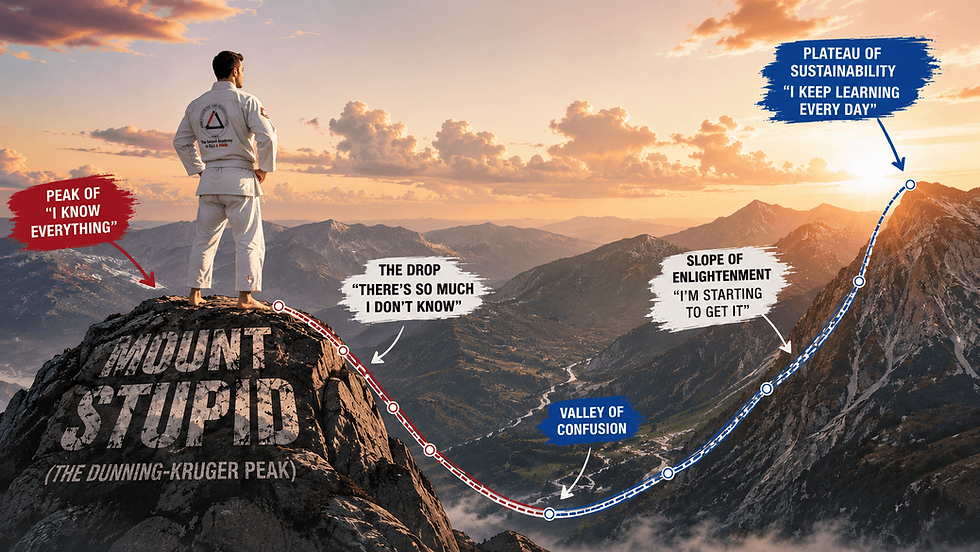
But what does the Dunning-Kruger effect look like in BJJ? In Brazilian Jiu-Jitsu it happens constantly. On day one you have no idea what you do not know, and you are certain you will take everyone apart because you did krav maga in the army, finished a course in a special unit, or fought your friends all through childhood and won. After two months you still do not know, but at least you are starting to notice that everyone is on top of you and smiling... and that is probably not a coincidence. After six months you start pulling things off on people newer than you and feel that maybe, finally, you have got it. After a year you train with someone good, and he dismantles your entire confidence in three minutes. Thanks for taking part in the experiment. Have some water.
There is also the popular version of the graph, with the 'peak of confidence', the 'valley of despair' and the 'slope of enlightenment'. To be honest about it: that graph is not a law of physics. It is an image. It simplifies a complicated process. Even the research itself has drawn debate and alternative explanations over the years, including arguments about regression to the mean and about people's general tendency to think they are above average. But as a teaching image, especially on the mat, it is close to perfect.
Why? Because it describes not only what you know, but what you feel you know. And in BJJ, the gap between what you know and what you feel is sometimes the whole story.

The beginner who does not know he is a beginner
I see it again and again. A new student walks into the academy in Tel Aviv or Netanya. In the first few weeks he is completely lost. He does not know where to put a hand, where to put a knee, what guard is, why everyone tells him not to push with a straight arm, and why every movement he makes puts him in bigger trouble. Which, incidentally, is not a bad description of life.
At this stage confidence is not high. It is low. And that is good. A beginner who understands he is a beginner is excellent raw material. He listens. He asks. He does not argue with physics. He does not try to invent a mount escape based on a video he watched at four in the morning. He accepts that he does not know.
And then something dangerous happens: he improves.
Suddenly he manages to hold a new guy in guard. Suddenly he escapes side control. Suddenly he gets to mount. Suddenly someone taps to him. For the first time. That moment is dangerous not because it is bad, but because it is sweet. The body says: I've got it. The head says: I am good at this. The ego says: let me talk to the new student, I'll explain it to him.
This is where the peak of confidence begins. Not always, not for everyone, but often enough that every experienced coach spots it from the edge of the mat. A white belt with six to eight months behind him, some successes, some muscle, some technique, and a great deal of opinion. He already knows how it 'should' be done. He does not yet know how much he does not know.
It is a natural stage. I am not angry at him for it. On the contrary, there is something healthy in it. You need a certain amount of confidence to keep going. Nobody stays in a martial art for years if he feels he is nothing but a failure. The problem starts when confidence grows faster than ability. And there BJJ does something beautiful. It corrects you. Not especially gently, but it corrects you.
The valley of despair arrives precisely when you are improving
After the peak of confidence comes the drop. Not a drop in ability. A drop in illusion. And that is the important difference.
At some point you start training with better people, more experienced, calmer. They do not have to be strong. Sometimes they even look tired. That is the most insulting kind. You work hard, you sweat, you try to pass, and there they are, as relaxed as a bank clerk on a short day. And then, with no visible effort, you are in side control again. In mount again. In a choke again. And tapping again.
That is where the sentence starts: 'I'm not improving'.
But it is not true. In most cases you are improving. You have simply started to see more. Six months ago you did not know there was a problem. Now you know. Six months ago you did not feel that your elbow was too far from your body. Now you feel it. Six months ago you did not understand why you lost the position. Now you know exactly: you opened a gap, you lost the angle, you leaned the wrong way, you breathed like a fish in a cracked aquarium.
That is not a regression. That is an increase in resolution.
When Amit tells me 'I don't know what I'm doing', I hear something else. I hear: 'I can already see enough to understand that there is depth here.' And that is a good sign. Unpleasant, but good. A large part of learning in Brazilian Jiu-Jitsu begins at the moment the internal feeling stops being positive. Sad but true. And entirely to be expected.
People want to feel that they are progressing. I understand that. The problem is that the feeling does not always arrive on time. Sometimes the body progresses before the confidence does. Sometimes confidence falls before ability rises. Sometimes the coach watches you improve for months while you remain convinced you are a national disaster with a belt on.
Why a belt feels like a test of character
A belt in jiu-jitsu is a strange thing. On one hand, it is only fabric. On the other, people behave as though it were a moral verdict. Especially on the road from white belt to blue belt.
At first it is comfortable being a white belt. Nobody expects you to know. You can make mistakes, ask, get confused, put your knee in the wrong place, and hear 'it's fine, you're new'. There is something liberating in that. Pleasant, even. Humility by force, which is the only kind of humility some of us are capable of.
But then new students arrive. Suddenly you are not entirely new. Suddenly a student showing up for his first class looks at you as if you know. And you, on the inside, still feel like the same person who tried a hip escape on day one and looked like a piece of furniture falling down the stairs.
This is where the fear is born: maybe the belt will tell a story about me I cannot live up to. Maybe if I get a blue belt, everyone will expect me to be good. Maybe if someone new submits me, it will prove I do not deserve the belt. Maybe the coach made a mistake. Maybe everyone will see.
I hear it all the time. 'I don't feel ready.' 'I don't want a belt out of pity, or just because I've been training three years.' 'I'm still not in control enough.' 'I'm afraid I'll get a blue belt and then every white belt will try to kill me.' That last one is partly true. They will try. It is tradition. Unwritten, but real.
But a belt is not given because you feel ready. A belt is given because the coach sees that you are in the right place for the next stage. That is not the same thing. You did not receive a belt and now have to grow into the level. You reached the level, and therefore received the belt.
A blue belt in BJJ does not mean you are an expert. It means you are no longer a beginner. You know the basic principles, you know how to survive, you know how to submit in certain situations, you know the difference between pressure that teaches and pressure that endangers, and you know enough to keep learning without someone holding your hand every second. That is a lot, and it is also only the beginning.
The students I trust most are very often the ones who receive a belt and quietly ask: 'Are you sure?'
Yes. Usually I am sure.

What the coach sees that the student does not
One of the reasons students cannot measure themselves is that they are measuring the wrong thing. They ask: how many people did I submit? How many times did I tap? Did I beat that guy? Did that guy beat me? It is a very human way to measure. And it is a bad one.
In jiu-jitsu, especially in the first years, real progress lives in far smaller details. A coach sees them. A student usually does not.
I see whether a student breathes better under side control. I see whether he has stopped pushing with a straight arm and inviting an armbar as though he had ordered pain on a delivery app. I see whether he knows to keep his elbows close. I see whether he brings a knee back in on time. I see whether he has stopped panicking when somebody takes mount. I see whether his questions have changed from 'what do I do here?' to 'why did I lose the angle?'
That is an enormous difference.
The student measures outcome. The coach measures process. The outcome can change according to your partner, your weight, your fatigue, a bad day, who slept and how much, who ate before training and who made dietary decisions we will not discuss here. The process is more stable. Process is the thing that tells you whether you are genuinely improving.
When I teach Gracie Jiu Jitsu, I am not only looking for submissions. I am looking for calm under pressure. I am looking at whether the student stays inside the problem instead of escaping it by force. I am looking at whether he understands principles like Position Before Submission. I am looking at whether he uses leverage and timing instead of strength. Because strength can hide a lack of knowledge. For a short while. Then someone stronger comes along, or someone far better, and the truth comes back. It always comes back. Sometimes with a knee on the belly.
That is also why structured learning matters. A student who does not know where he is on the map chases feelings. And feelings are a terrible navigation tool in jiu-jitsu. One day you feel like a world champion. The next you feel you do not deserve a white belt. On both days you are very probably wrong.
A big ego and a small ego are cousins
I wrote in another article about tapping in time and about the ego that refuses to tap. That is the classic ego of the mat: I'm not giving it to him. I'm not tapping to this. One more second and I'm out. One more second and my elbow will stop being an elbow and become a memory, but in principle I am still in the fight.
That ego is easy to spot. It is loud. It sweats. It argues with reality.
But there is another ego, a quieter one: the ego that says 'I'm not good enough'. It too is busy with itself. It is not arrogant, but it is still looking inward instead of at the learning. It asks "what does this say about me?" instead of asking what happened in the position. It is busy with image, not with information.
Pinned in side control? The unhelpful question is: what does this say about my level. The helpful question is: how did I lose the frame. Tapped to a choke? The unhelpful question is: maybe I'm not cut out for this. The helpful question is: at what moment did my opponent move from control to submission. Received a belt and did not feel worthy? The unhelpful question is: maybe everyone is wrong. The helpful question is: what is the next thing I need to improve.
Renzo Gracie said: 'My opponent is my teacher, my ego is my enemy.' I like that line because it does not let the ego wear a disguise. Not the 'I already know' ego, and not the 'I'm worth nothing' ego. Both of them stop you from seeing what is in front of you.
Your opponent shows you the truth. Your ego edits it. Sometimes it adds dramatic music. Sometimes subtitles. Sometimes it turns the whole thing into a Greek tragedy. In practice, you lost guard. It happens. Let us look at why.
The Hélio Gracie filter: do not believe your confidence, test it
Hélio Gracie said you should always assume your opponent will be bigger, stronger and faster than you, so that you learn to rely on technique, timing and leverage rather than brute strength. That line is with me in every session.
It matters enormously in the Dunning-Kruger context too. Because what it really says is: do not build your confidence on comfortable assumptions. Test it against real resistance. Against weight. Against pressure. Against someone who is not cooperating with you just because you are nice.
Gracie Jiu Jitsu was born out of that idea. Not looking good in a demonstration. Not collecting techniques that look pretty. Not beating someone smaller than you because you can. But building a system that works when you are at a disadvantage, when it is uncomfortable, when there is fear, when someone stronger than you is trying to control you.
In self-defence, that is the starting point. Not whether you look good performing a technique, but whether you can stay calm when someone bigger than you applies real pressure. Self-defence, or a civilian fighting situation rather than a military one, does not happen under laboratory conditions. It is messy, uncomfortable, and often starts from a bad position. That is why I keep coming back to leverage, positional control and real pressure testing. Without them, confidence is noise. With them, confidence starts to become knowledge.
That is why the mat is so straight and honest. It is not impressed by your story. It is not impressed that you were strong in the army, that you played basketball, that you manage a team at work, that you have a degree, or that you are certain you pick things up quickly. Jiu-jitsu does not argue. It returns a result.
On the other hand, the mat does not accept the opposite story either. It does not accept that you are 'not talented'. It does not accept that you are 'slow'. It does not accept that you are 'not suited to this'. If you show up, learn, drill, tap in time, ask questions and keep going, the body changes. The understanding changes. The ability changes.
Not immediately. Not at the pace you want. At the real pace. And that, unfortunately, is the only pace there is.
The four stages I see in almost everyone
After many years on the mat, at the Israeli Academy of Brazilian Jiu-Jitsu and MMA, in BJJ classes in Tel Aviv, in Netanya, at training camps and at competitions, I can describe the route without pretending it is exact for every person. Different people, different bodies, different backgrounds, different paces. But the pattern repeats often enough.
Stage one: the first months. You are lost. Everything is heavy, strange, too close. You do not know where to move, and when you do move, you are usually helping your opponent. It is a hard stage but a simple one: show up. Do not solve the whole system. Show up.
Stage two: things start working. You recognise positions. You escape here and there. You submit newer people. Confidence rises. Sometimes a little too much. This is the stage where students start giving advice to new people in the tone of a senior consultant. I let that happen, a little. A small dose of arrogance is cured very quickly by good sparring.
Stage three: the valley of despair. You have trained long enough to understand that there is depth. Suddenly everything you thought you knew falls apart against good people. You have not got worse. You have become more aware. This is a dangerous stage, because people quit here. Not because they are not progressing, but because they read the wrong feeling as the wrong sign.
Stage four: quiet work. You accept that the feeling never entirely goes away. Blue belts feel it too. So do purple belts. And brown. And black, just with less need to tell everybody. You learn to work inside the uncertainty. Sparring becomes a conversation. Mistakes become information. Confidence no longer spikes and crashes like a chip company's stock with every tweet. It becomes steadier. Less exciting. Far more effective.
In the fourth stage you start to understand something important: the goal is not to feel that you know. The goal is to know what to do even when you do not feel it.
How to train while you are inside the valley of despair
First of all, do not make retirement decisions on the back of a bad week. A bad week in BJJ is not data. It is weather. It passes.
I have seen students almost quit after a hard session, and then make an enormous jump a month later. The body processed something. The head settled. One technique connected to another. Suddenly what looked like a wall became a door. Not a particularly beautiful door, but a door.
Second, stop measuring yourself against the wrong people. If you are a white belt training against a good blue belt, you are supposed to feel a gap. If there is no gap, something is wrong. Either the blue belt is not good, or you are not really working against real resistance, or you are both doing theatre. And I do not teach theatre.
Third, narrow the goal. Do not go into sparring with the goal of 'being good'. That is not a goal. That is a wish. Go in with one task: keep your elbows close. Recover your knee. Do not give up mount. Breathe under side control. Escape once, correctly. Notice when your opponent breaks your posture. A small task creates large progress.
Fourth, ask good questions. Not 'why am I bad'. That is not a question. That is a mood with a question mark. Ask: at what moment did I lose control. What was the first grip I should have broken. Why did my knee stay outside. How should I have positioned my head. Those are questions a coach can answer. 'Why am I bad' can only be answered with coffee and patience, and even then it does not always help.
Fifth, keep showing up. Yes, it is the most boring advice there is. That is exactly why it works. Anyone promising you an elegant way around the frustration is selling something. In jiu-jitsu there is no way around. There is work.

How to know you are progressing even when you feel stuck
I give my students a simple list. Not a belt test, not an ego chart. A self-check.
Do you panic less under pressure? Not whether it feels pleasant. It is not supposed to feel pleasant. Whether you are less in a panic.
Do you recognise trouble earlier? You used to realise you were in a choke only when the room started to dim. Now you spot the first grip. That is progress.
Are you using less strength? Good students do not always do more. Often they do less, but at the right moment.
Have your questions improved? A good question is a sign of understanding. A new student asks 'what do I do'. A more advanced student asks 'what stopped that from working'. The difference is small in words and enormous in learning.
Can you explain one principle to a beginner without drowning him in twenty techniques? If so, something has settled. Not everyone who can perform can explain. But someone who starts explaining simply has probably understood something.
Do you tap in time, without drama? This may be the most important measure of all. Someone who taps in time understands that training is longer than one round. Someone who does not will learn it through physiotherapy. I prefer to teach it on the mat. Physiotherapists are good people, but they do not need our help paying the bills.
If you answered yes to three of these, you are progressing. Even if you do not feel it. Especially if you do not feel it.
And what about someone who just wants to start
There are people searching for BJJ for beginners in Tel Aviv, people who come to me after searching BJJ near me, jiu jitsu Tel Aviv, jujitsu in Netanya, or who simply asked a friend where to train. That is natural. We all start with the technical questions. Where is it, how many times a week, who is the coach, is there parking. Important questions. Parking in Tel Aviv is sometimes a character test in its own right. By the way, have you read my article on how to find the academy that is right for you?
But after a few months it turns out the real question is not only where to train. The question is who will explain to you what is happening when you feel you are not progressing. Who will spot whether you are on the peak of confidence or in the valley of despair. Who will stop you before your ego breaks your elbow. Who will tell you when you are genuinely ready to move up, even when you do not feel ready.
So choosing a BJJ academy is not only about picking somewhere close to home. I wrote about it at length in the guide on how to choose a BJJ academy. A good place is one with a system, a coach who is watching, a healthy training culture, and patience for the process. Not just a big mat and nice photos on Instagram.
Anyone starting jujitsu, jiu jitsu, ju jutsu or jujutsu, however they choose to spell it, needs to understand one thing early on: the feeling that you do not understand is not a bug, it is a feature. A good academy does not delete that feeling. It uses it. It turns it into a question. And then into a work plan.
Questions I hear all the time
Is it normal to feel unworthy of a belt?
Yes. Not only normal, common. Especially among serious students. People who do not care usually do not ask the question. Anyone who asks it is already showing the right attitude to the process.
Does the Dunning-Kruger effect mean I am actually better than I think?
Not necessarily. It means your feeling is not always a good measuring instrument. Sometimes you rate yourself too high, sometimes too low. That is why you need a coach, a syllabus, time, and sparring against real resistance.
Why do I feel like I am getting worse at jiu-jitsu?
You are almost certainly not getting worse. You have started to see more. Six months ago you did not know there was a problem. Now you notice the gap you opened, the angle you lost, the elbow that drifted away from your body. That is not a regression, it is an increase in resolution. The feeling gets worse precisely because the understanding got better.
What is the valley of despair in BJJ?
It is the stage that follows the initial peak of confidence, once you have trained long enough to understand how much depth there is. Ability keeps rising while the sense of competence drops, because the illusion falls away faster than the skill builds. It is the stage where most people quit, and quitting there is usually a misreading of a completely normal signal.
How long does it take to get out of the valley of despair?
There is no exact timeline. For some it is a few months, for others longer. It usually does not 'pass' like a cold. It changes. You learn to recognize the place and not to panic in it.
Should I quit BJJ if I feel stuck?
Do not make retirement decisions on the back of a bad week. A bad week in BJJ is not data, it is weather, and it passes. I have seen students almost quit after a hard session and then make an enormous jump a month later. Narrow your goal, stop measuring yourself against the wrong people, ask better questions, and keep showing up.
Should a blue belt feel ready?
Not entirely. A blue belt who feels too ready has probably not understood what is coming. A good blue belt arrives with a foundation, humility, the ability to keep learning, and an understanding that they are still at the start of the road.
Does everyone go through this?
Almost everyone. Anyone who trains long enough meets a moment where their self-image does not line up with reality. Sometimes reality lifts them. Sometimes it lowers them. In both cases it teaches.
How many times a week should I train to see progress?
For most adults, twice a week is a good pace for learning and progress. Three sessions a week already allows real change that you can genuinely feel. More than that? Possible, but it takes a body, time, sleep, and a family still willing to have you back.
The belt does not wait for you to feel ready
After the conversation with Amit he did not suddenly become a person full of confidence. Just as well. People who become full of confidence all at once usually need somebody to let a little air out. Gently, of course. With a knee on the belly.
What changed in him was smaller and more important: he stopped reading his lack of confidence as a sign that he was not progressing. He started to see it as a sign that he was already seeing more. Instead of saying 'I know nothing', he started asking 'what is the next thing I need to understand'. That is an enormous change.
Four months later he received his blue belt. Not because he felt ready, but because he was ready. Those are not always the same thing. If you have read this article carefully, they are almost never the same thing.
Brazilian Jiu-Jitsu does not build you through compliments. It builds you through repeated contact with the truth. Sometimes the truth is that you are worse than you thought. Sometimes it is that you are better than you allow yourself to believe. In both cases your job is the same: get to training, listen, work, tap in time, ask a good question, and come back again.
This is not a Hollywood story with peaks and valleys. It is a long, hard road. With more valleys than peaks.
If you are looking for a supportive framework to get through the 'valley of despair' in jiu-jitsu, at the Israeli Academy of Brazilian Jiu-Jitsu in Tel Aviv, and across our eight branches, we walk with students from white belt to black. You are welcome to message me on WhatsApp. We will try to work out what you are looking for, see whether it is a fit, and tell you the truth. No pressure. The pressure will come later, in the form of a 95 kg tech worker who has come to season his life with something interesting, and what will interest him is putting a knee on your belly. The Israeli Academy of Brazilian Jiu-Jitsu and MMA
Tel Aviv: Yitzhak Sadeh 29 | Netanya: HaTzoran 4
Professor Itay Leibovich | Gracie Jiu Jitsu Black Belt
Want to check where you are on the curve? All the details on BJJ training in Tel Aviv on the academy's training page. Classes are taught in Hebrew, but our instructors speak fluent English and a large part of our members are English speakers. On Saturday nights we run a class taught in English by Philip Paul.


Comments