
What Is Brazilian Jiu-Jitsu? A Black Belt's Complete Guide

Updated: Sep 5
Why a guy who had trained for six months and weighed thirty kilos less than me submitted me, and why that moment made me realise I had found something far bigger
By: Professor Itay Leibovich | Black Belt | Gracie Jiu Jitsu | May 2026 | ~17 min read
📌 The short version, because this one ran long (TL;DR)
Brazilian Jiu-Jitsu (BJJ) is a martial art and self-defence system that originated in Japan and was developed in Brazil by the Gracie family. It is built on leverage, timing and control, and it lets a smaller person overcome a bigger one through technique rather than strength. This article covers the history of BJJ, the difference between Gracie Jiu Jitsu and sport Brazilian Jiu-Jitsu, the principles behind the system, and who it suits.

Where it started (for me)
London, 2003. First-year student, 22 years old, a 1st dan black belt in Shai-Hun (a hybrid karate style developed in Israel in the 1960s) and three fresh years of army service behind me. I had heard about cage fights. I had heard about the UFC. I had seen fighters on television take boxers to the ground and do strange things to them. I understood there was something there I did not know, and that I needed to learn it. The problem was that I did not know exactly what to look for.
So I searched for "jiu jitsu". Spelled exactly like that, because that was what I remembered. I ended up at a Japanese ju jutsu club in the university gym, asked them whether they did ground fighting, and they said "of course, we are the London champions in ground fighting." Great, I said. I walked into the class, started learning, and stayed there for three years.
It was Japanese ju jutsu. An excellent martial art with centuries of history, beautiful throws and standing attacks. But it was not the thing I had seen on television. Not quite. It took me a few months to work out that there was something called Brazilian Jiu Jitsu, that it was at a completely different academy in London, and that getting there meant taking the tube to the other side of the city. By then I was deep in training, competing in national championships in England and picking up a few first places. I won the university MVP title and decided to stay.
In 2006 I came back to Israel. I had decided to compete in MMA, and I knew I needed the ground game. I walked into the first place I found that was closest to me, put on a white belt, and waited to see what would happen.
What happened was that a guy who had been training for six months, a white belt, thirty kilos lighter than me, submitted me. Not once. Twice. I had submitted him dozens of times, with an obvious physical advantage and years of technique on the mat. It was just the wrong technique, or the right one executed badly. He submitted me twice, and in exactly those moments it clicked. I had found a system that was not just another martial art. I had found something far bigger. A system in which an ordinary person, a small person, a person with no special physical gifts, can neutralise and beat someone who outmatches them on every measurable parameter. A system in which the head beats the body. A system people call, when they are not quite sure how to spell it, jujitsu, jiu jitsu, ju jutsu, jujutsu, or any of a dozen other spellings that all mean the same thing.
So what is Brazilian Jiu-Jitsu, really? What is this system, what is it not, where did it come from, what defines it, and how is it different from everything you thought you knew about martial arts? If you are thinking about starting to train in Tel Aviv, Netanya or anywhere else, in 2026 there is no shortage of places. If you already train but have no idea what to say when people ask about your "judo", or if you simply want to understand why all your friends will not stop talking about the new Gi they bought, this post is for you.
How do you spell it? A guide to getting Jiu-Jitsu right
Before we go on, we have to stop on one question that never goes away, and one I actually ask on the exam in the instructors' course at the Wingate Institute. How do you spell the name of this system? The short answer is that I have spelled it several ways myself over the years, and there is no single correct form.
But let us go back to the source. The original, historical, correct form is not "jiu jitsu". The name comes from Japanese, and the accurate spelling is jūjutsu. It means "the gentle art". Jū means soft, adaptable, yielding. Jutsu means art, technique. A soft, flexible fighting system that uses the opponent's own force against them and finds a way around resistance instead of meeting it head-on. That is the idea.
So how did we get from jūjutsu to "jiu jitsu"? Through Brazilian Portuguese. When the system reached Brazil in the 1910s, the Japanese who taught it pronounced it one way, the Brazilians heard it another, and when it went back out to the world through the Brazilians it came out as Jiu Jitsu, the incorrect-but-accepted Brazilian spelling of the Japanese word. That pronunciation took root so deeply that to this day we all say Jiu Jitsu. A historical mistake became the international standard.
And in English? The chaos is total there too. People write jiu jitsu, jiu-jitsu, jujitsu, jujutsu, ju jitsu, ju-jutsu, and occasionally, when they are trying to be precise, jūjutsu. Every one of them, if they mean the Brazilian art of ground fighting with joint locks and chokes, means the same thing.
I personally write Brazilian Jiu-Jitsu, because it is the closest to the Brazilian Portuguese. But if you send me a WhatsApp saying "I want to start jujitsu", I am not going to correct you. I will tell you when the next class is and which branch is closest to you.
💡 Golden tip: how to pronounce it properly
Writing it is one thing. Saying it out loud is something else entirely. Why? Because of the cluster of J, T and S sounds packed into one short word. It ties the tongue in knots, and people who read it straight off the page end up saying "gee-oo" instead of "jiu".
So here is a golden tip that will make you sound Brazilian and get it right every time. Zh. That is all. However you choose to spell it, pronounce it "zhoo-zhitsu". It rolls off the tongue. It sounds good, and it gives you a faint aroma of an açaí bowl on the beach in Copacabana. Try it and tell me how it went.
What does matter is that all of these forms refer, in 99% of cases in 2026, to the same Brazilian system. If you are searching for BJJ, if you are searching for jujitsu, if you are searching for jiu jitsu, you have arrived at the same place.
What is Brazilian Jiu-Jitsu? The definition and the essence
Brazilian Jiu-Jitsu is a martial art and self-defence system that specialises in ground fighting. It uses leverage, technique and timing to let a smaller person overcome a bigger one, through positional control and finishes with chokes or joint locks. Solutions that do not rely on physical advantages. That is the dry definition. But it misses the point.
Roger Gracie, a 10-time IBJJF world champion, two-time ADCC champion and one of the greatest competitors of all time, put it like this:
"People perceive fighting in different ways. One may see the primal nature of combat, another its artistic character. I see it as a pure art form, in which a true fighter can display his craft."
That is Brazilian Jiu-Jitsu. It is not aggression. It is not sport. It is not a technique or a drill. It is an art. Physical chess, as many people like to call it. Every movement is a move, every move opens two more, and you have to think several steps ahead to beat your opponent before he has thought of his. All of it rests on principles of weight distribution, angles and leverage, not strength. Someone who understands those principles can neutralise a person 30 or 40 kilos heavier, simply because his leverage is better. He understands something deeper than his opponent does, and that is the first lesson of Brazilian Jiu-Jitsu.

The history of Brazilian Jiu-Jitsu: from samurai to Brazil
The system began in the land of the rising sun. In the centuries before the modern era, Japanese samurai developed unarmed fighting methods as a backup for the moments they lost their sword or bow in battle. Those methods split into dozens of schools and hundreds of styles, some emphasising throws, some joint locks, some strikes. All of them fell under the broad umbrella of jūjutsu.
At the end of the 19th century and the start of the 20th, Japan modernised fast and the samurai disappeared. Japanese fighting systems lost their military context and became arts, sports and cultural traditions. I recommend The Last Samurai with Tom Cruise, which portrays the Meiji Restoration and the decline of the samurai class well. In that period a Japanese man named Jigoro Kano developed judo, a branch of jūjutsu with a modern emphasis on throws and organised ground fighting. Judo succeeded, spread around the world, and one of Kano's senior students, Mitsuyo Maeda, arrived in Brazil in 1914 as part of a missionary effort to spread jūjutsu and judo internationally.
Maeda taught the system to several Brazilian students. He taught the Gracie family, and that is the moment history changed. But it is worth remembering that Maeda did not only teach the Gracies. He also taught Luiz França, who taught Oswaldo Fadda and opened a completely parallel lineage of Brazilian Jiu-Jitsu that still exists today. The story is not only a Gracie story, but they are the ones who spread the system worldwide and did more than anyone else to bring jiu-jitsu to where it is now.
Gracie Jiu Jitsu: why one system has two names
In 1925, Carlos Gracie, Maeda's student, opened the first jiu-jitsu academy. Note that nobody called it "Brazilian" or "Gracie" yet. It was simply jiu-jitsu. The words "Brazilian" and "Gracie" came much later, with the breakthrough in the United States in the 1980s and 1990s. To distinguish their new system from the Japanese ju jutsu that already existed in the US, the Gracie family called it Gracie Jiu Jitsu, and everyone who was not a Gracie called it Brazilian Jiu-Jitsu. That is the story behind the two names.
Carlos's younger brother, Hélio Gracie, was a decent athlete in swimming and gymnastics, but he was not physical enough to pull off the techniques his brother taught him. The throws depended on strength, mass and explosive power, and the standing grips demanded a physicality Hélio simply did not have.
So Hélio did something radical. He took all the techniques and changed them. He adapted them to his own frame. He refined the leverage that was already there and added leverage where there was none. He found a way to apply joint locks and chokes from the ground with his back on the floor, where weight matters less and where smaller people find themselves most of the time against a superior opponent. He removed the reliance on physical power and replaced it with principles of angle, timing and position.
In effect, he took a Japanese fighting system and built something new out of it, a Brazilian system of jiu-jitsu designed for the ordinary person, not the athlete. Some will say he invented nothing and that all of it already existed in Kosen judo and in the original jūjutsu. They are not wrong, and he was the first to say so. He invented nothing.
But he did improve. He chose to focus on certain aspects of the system, and because he focused on them he improved them, until decades later they are de facto two entirely different systems. Rugby is not football. European basketball is not American basketball. Even when two disciplines share a starting point, it is perfectly possible for streams to develop down the road that look almost foreign to one another as the years pass.
That is the core of what we call Gracie Jiu Jitsu today. The system of Hélio and his descendants, which emphasises self-defence and the fact that any person, regardless of size or strength, can learn to protect themselves. A system that is strategic long before it is technical. Hélio himself said:
"Always assume that your opponent is going to be bigger, stronger and faster than you, so that you learn to rely on technique, timing and leverage rather than brute strength."
The Hélio Gracie filter: what I choose to teach
That is the DNA of the system. It is not just advice, it is the basic assumption underneath everything taught at the academy. Every technique I teach in Tel Aviv, in Netanya or anywhere else I go is built on the assumption that the person in front of you is physically more dangerous than you are. If you learn to handle the hard case, the easy case takes care of itself.
I never teach what I can do. I do not teach techniques that depend on my strength, my weight, my mass or my athleticism. I teach through the "Hélio Gracie" filter: can the smallest woman on the mat perform what I am teaching on the biggest man on the mat? If not, I do not teach it.
There are plenty of super-effective, genuinely excellent techniques that I choose not to teach because they do not pass that filter. That is my way, and there are others. When you coach competitors, or even ordinary people training in a sport-oriented style, there are many legitimate and effective techniques that do not pass the filter but have to be taught if you want the athlete to win. He is capable. He is athletic. He is fast. He is strong, and he can pull the technique off.
A 5 kg sledgehammer is a wonderful tool. But not everyone can swing it successfully. A surgeon's scalpel, on the other hand, anyone can hold. Are there jobs where a 5 kg sledgehammer beats a scalpel? Absolutely. But try telling that to Andy Dufresne 😊.
Sport versus self-defence: the point of contention
Over the years the sporting arm of BJJ developed as well. Competitions, championships, the IBJJF, the ADCC, hundreds of academies around the world specialising in the competitive track. Sport jiu-jitsu is beautiful to watch and technically deep, but at the end of the day it is a game with rules, restrictions, and a specific goal of scoring points inside a time limit.
Rickson Gracie, Hélio's son and one of the defining figures of modern jiu-jitsu, said something provocative that made waves at the time:
"If you don't know self-defence, you don't know jiu-jitsu."
This is a genuine point of contention in the Brazilian Jiu-Jitsu world. Some say sport jiu-jitsu is the pure continuation of the system and that self-defence is only a historical relic. Others say Gracie Jiu Jitsu is the real thing, and that what happens in competition is a game that lost touch with its roots. And there are coaches who will argue passionately that they are the ones doing the real thing, and that anyone doing it differently does not really understand what jiu-jitsu is.
My conclusion, after 36 years of training, 20 years of jiu-jitsu and 16 years as a jiu-jitsu coach, is simple. The system is complete. You should always do both. Self-defence without high-intensity sparring is theory. Sport without a self-defence context is a game. Combining the two is what produces a real martial artist. At the Israeli Academy in Tel Aviv we do Gracie Jiu Jitsu, which means the complete system. Self-defence, sparring, and competition for anyone who wants it. Each of these elements completes the others, and without them the system is not whole but narrow and partial.

💬 Want to check out the Israeli Academy of Brazilian Jiu-Jitsu in Tel Aviv or Netanya? To book a first trial class, message me on WhatsApp
What defines the system: the 9 principles of Brazilian Jiu-Jitsu
So let us get into the detail. What defines Brazilian Jiu-Jitsu? What does it actually look like on the mat?
1. Plenty of standing. The foundation always starts on the feet
This surprises most people who do not know the system, and it is the main criticism from people who have never trained. Everyone knows jiu-jitsu is ground fighting, right? (Count how many internet forum arguments have started with the claim that jiu-jitsu is useless on the street because "what are you going to do, pull guard?? hahahahahaha".)
And it is true, a large part of training happens on the ground. But the foundation starts standing. Always. How to take someone down, how not to go down, how to stay on your feet against someone trying to drag you down, how to take someone down without exposing yourself, how to move from the clinch (very close standing range) to a takedown to a controlling position. All of it has to start standing, because in the real world, in life, everything starts standing.
The reason is simple. If my solution to every problem is to go to the ground, then I am in trouble the moment I am standing in front of someone who does not want to go to the ground with me. And if I do not know how to fight standing at all, I will do dangerous things to get to the ground: jump on my opponent, throw myself down, fall backwards and put myself at risk. So the obvious answer is that standing is a discipline in its own right. Even if my goal is to get to the ground, I need to know how to get there safely, or how not to get there if I do not want to.
It is an important enough subject that I had something to say about it on a podcast I appeared on not long ago. They put it to me that there is a claim in BJJ that you have to be careful about "going to the ground" on the street, and I answered that this is the wrong framing. As I tell every one of my students: I do not go to the ground. I take you to the ground. That is an enormous difference. Someone who understands jiu-jitsu does not lie down on the ground as a strategy. He stays on his feet, neutralises the threat, and if he chooses to take his opponent down, he does it from a position of control. If he ends up on the ground by accident, he has the tools to get up quickly and safely. This is exactly where BJJ offers a strategic advantage that other systems do not have.
2. Position before submission
This may be the most important principle in the system. Instead of chasing the finish, you establish control. You neutralise your opponent. You get to a place where you have more options than he does, more weapons, more angles of attack. Only once you are in control do you move towards the finish. Most beginners do the opposite, chasing the choke or the lock before they are even in a position that allows it. The result is that the opponent escapes or launches an attack of his own. An experienced fighter does not go for the submission before he knows his opponent cannot get away.
There is a well-known mantra in BJJ: Position Before Submission. Every experienced coach will repeat it dozens of times.
3. Distance management
One of the things that is not obvious to an outside observer is that jiu-jitsu has several different ranges, and each range demands different tools. There is long standing range, close standing range (where most strikers, fighters who specialise in punching, prefer to stay), and there is the clinch, where the fight for the takedown begins. There is a half-and-half range, half standing and half on the ground. And there is full ground range, which splits into further sub-ranges. Range control means knowing when you want to be where, where you do not, and how to move between ranges safely and to your advantage.
4. Positional control
Once you are on the ground, there is a hierarchy of positions. Back (you are behind your opponent), mount (you are sitting on him), side control (you are lying across him at 90 degrees), and guard (you are on your back with your legs around him). Each position gives you different advantages and opens different finishing options. Each position also gives your opponent different escape options, if he knows what he is doing. Positional control means knowing which position you want, how to get there, and how to keep it while your opponent tries to escape.
5. Controlling your opponent
All the positions, all the ranges, all the techniques are ultimately means to one end: control. You want to reach a state where your opponent cannot move as he wants, cannot attack as he wants, cannot escape as he wants. Control is at the heart of everything we do.
On that podcast I said something every Brazilian Jiu-Jitsu coach would agree with: "Handcuff my ankles. What am I worth now?" Think about that for a second. Without his legs, an ordinary person becomes almost physically helpless. He cannot attack, he cannot escape, he cannot push, he cannot pull hard. Try throwing a stone a long way while standing, then try throwing that same stone the same distance while lying down. The difference is enormous. The human body draws most of its power from the legs and the base.
Now think about what it means that I can take away a person's legs, arms and ability to move using body control alone. Without grabbing his hands with mine, without striking, without strength. Just weight and correct position. Those are technique and strategy translated into power.
6. Leverage
Hélio could not perform his brother's techniques because he was not physical enough. His solution was to go deeper into leverage. Using the mechanics of the human body to generate force a person cannot produce with muscle alone. Leverage is the core of BJJ. Every technique is really a leverage solution to a specific problem. How can an 80 kg person control a 110 kg person? Through correct leverage. How can I choke someone who does not want to be choked? Through correct leverage. It is all leverage. And position.
7. Timing
Saulo Ribeiro, a six-time world champion and legendary coach, said something every beginner should remember: "If you think, you are late. If you are late, you use strength. If you use strength, you tire. If you tire, you die."
Timing can be the difference between a technique that works and one that does not. If you execute at the right moment, it will work even against someone far stronger than you. If you are a second late, it can fail even against a beginner. In BJJ we drill the same movements thousands of times precisely so that the timing becomes instinctive. Not something you think about, but something your body does automatically at the right moment.
When I say "timing", I do not mean speed. I do not mean beating your opponent to it. Timing in jiu-jitsu means doing the right thing at the right moment. Speed and quickness are beside the point here, because they run against the principles of jiu-jitsu. If I have no way to be faster, quicker or sharper than my opponent, either in absolute terms or relative to myself, then trying to out-race him is a road built for failure. I need to do the right thing at its right moment. I go for a kimura (a shoulder lock) from guard, and my opponent puts his weight on the arm so I cannot take it? That is the moment to wrap his neck for a guillotine (a front choke). He reacts by pulling back? That is the moment to sweep (reverse the position) or come back to the kimura. "Timing" is not acting faster. "Timing" is acting at the appropriate moment.
8. Base
The word "base" in BJJ means your physical stability in a position. Good base is the ability to stay in your position even when your opponent pushes, pulls and tries to knock you over. Weak base means you tip over every time somebody breathes on you. Strong base means you are like a tree with roots: your opponent can push you, but you do not move. Base is the foundation of every technique, and without it you cannot progress. Every student who walks into my academy in Tel Aviv learns base before they learn technique. Base starts standing and ends on the ground. I am always aiming to be in base.
9. Energy efficiency
The last principle, and perhaps the most important of all in the long run. Everything you do in BJJ should be energy efficient. If you use more energy than you need, you will tire before your opponent does, and then you will lose. Part of the difference between a blue, purple or brown belt and a black belt is exactly this efficiency. The black belt is not stronger than the white belt. He knows how to do the same thing on half the energy. That is why black belt sparring can look almost lazy, with barely any sweat and no wasted movement. Every movement is deliberate.
How jiu-jitsu has evolved in recent decades: from UFC 1 to today
How did BJJ get to where it is now, with hundreds of thousands of practitioners worldwide, academies in every major city, and an extraordinary boom here in Israel too?
1993, UFC 1 — the night that changed martial arts
Denver, Colorado. Royce Gracie, Hélio's son, thin and physically unimpressive, beats three fighters from different styles in a single night: a boxer, a shootfighter and a savate practitioner. All three had the advantage in size, weight, strength and athleticism. He does it by taking them down and choking them, without throwing a single strike. That night was the moment the world discovered that jiu-jitsu works, and that there was a problem with everything everyone thought they knew about martial arts. Royce proved Hélio's principle empirically: technique and leverage can overcome strength and size.
The 2000s — the competition explosion
BJJ became an organised sport with national and international competitions. New names emerged: Marcelo Garcia, Royler Gracie, Fabio Gurgel, Rodolfo Vieira, Terere, Roger Gracie and more. The sporting style developed with advanced guard games, new passing systems and counter-attacking from the bottom. That development also drew criticism from traditional Gracie Jiu Jitsu people, who argued that the sporting branch had lost touch with the source.
The ADCC, the world championship of no-gi grappling, became the most important competition in the jiu-jitsu world. Alongside it, a wave of leg locks developed. Fifteen years ago they were considered marginal techniques; today they sit at the centre of the competitive scene. Names like Gordon Ryan and Craig Jones changed the game completely.
Recent years — back to basics
Alongside the explosion of the competitive scene, there is a growing movement back to the classical principles of Gracie Jiu Jitsu. Academies around the world are returning to an emphasis on self-defence, on the fundamentals, on the complete system. In Israel, less so. At my academy in Tel Aviv we teach every layer, from the fundamentals through the sport to advanced self-defence. That is Gracie Jiu Jitsu, and that is Brazilian Jiu-Jitsu, and it is all the same thing, just with different emphases.

Who is Brazilian Jiu-Jitsu for?
The short answer is everyone. The long answer comes with a few caveats.
Brazilian Jiu-Jitsu is one of the most accessible martial arts there is. It does not demand exceptional fitness, exceptional flexibility or exceptional strength. The system does not favour a particular body type. It is built on principles that an ordinary person, regardless of size, age or fitness, can learn and apply. That is exactly how Hélio Gracie designed it. Over sixteen years of teaching I have worked with thousands of students, from six-year-olds to trainees over 70. The jiu-jitsu that is yours will be built around your abilities. Provided you choose the place that fits your needs.
Men
Men make up most of the BJJ population. The reasons vary: the need to know how to defend yourself, the desire to get past ego, the search for a physical and mental challenge, the sporting side. At my Israeli Academy in Tel Aviv most students are men between 25 and 50, but there are older ones and younger ones too.
Women
The growth of BJJ among women over the past decade has been enormous. Women discover that this system gives them a unique advantage in self-defence situations, particularly when they end up on the ground with their back on the floor. It also builds confidence, physical strength and a supportive community. If you are a woman interested in jiu-jitsu generally, or in self-defence specifically, I have a separate article explaining the five main reasons women choose BJJ. Read it here.
Children
Jiu-jitsu is one of the best tools there is against bullying at school. It gives a child confidence, it gives them techniques that work even against a bigger child, and above all it gives them peace of mind. A child who knows jiu-jitsu simply carries themselves differently from one who does not. Bullies feel it and look for a different target. If you have a child dealing with bullying, or you want to head it off before it starts, read my article on how jiu-jitsu helps children handle bullying here.
Older adults
One of the beautiful things about jiu-jitsu is that it suits every age. I have students who started at 50 and are still training at 65. I have one student well past 60 who has entered several competitions against opponents stronger and younger than him, by decades, and beaten them. Older adults who train sensibly, paying attention to their body and their pace, can keep going to a very advanced age. The system does not ask them to be as fit as a 25-year-old. It asks them to be smarter than the 25-year-olds on the mat with them.
Competitors at heart
For anyone who wants to compete, Brazilian Jiu-Jitsu has everything you need. Competitions at every level, from local to world championships. An international scene. It is all there. Just remember that sport is not the whole story, and even the best competitor needs a foundation in self-defence to truly understand the complete system. Even if he is a world-class expert in one niche inside it. Otherwise he is an expert in a niche, not in the system.
One more important point for anyone who is curious and thinking about starting. Choosing an academy is critical. Not every academy is right for every person, and the differences between academies can be enormous. If you are interested, go through my guide on how to choose a jiu-jitsu academy in Tel Aviv before you sign up anywhere.
Gi or No-Gi? Sport or self-defence? A common beginner's confusion
One of the biggest confusions for beginners is the question of the Gi. The Gi is the traditional training uniform used in some classes, and that is roughly all most people know about it. But what is the difference between training in the Gi and training without it (No-Gi), and does it matter? I wrote a detailed post explaining the differences, but here is the short version.
Training in the Gi, you use the uniform as part of the technique. You grip the collar, the sleeve, your opponent's belt. The uniform becomes a tool. Gi training is more technical, slower, and built on principles of gripping and sustained control.
Training No-Gi, there is nothing to grip. Just body against body. The training is faster, slipping beats gripping, and the emphasis is on body control and on principles of friction and pressure.
The good coaches say you should do both. The Gi teaches technique and principles, No-Gi teaches dynamics and speed. Combining them produces a complete fighter. At my academy in Tel Aviv we train both.
And then there is the sport versus self-defence question. I discussed it earlier, but let us restate the conclusion. Gracie Jiu Jitsu, the complete system, includes both. We spar competitively at the academy, we compete, we love the sporting side. But we also teach self-defence, defences against strikes, defences against weapons, dealing with real scenarios. These two sides complete each other, they do not compete with each other. Anyone who does only one of them is missing half the system.

How do you start training BJJ?
The first step is to show up to a class. Most academies offer a first trial class, and I recommend trying two or three academies before you decide where to sign up. Get a feel for the place, watch the coach, watch the students, and then decide. Nothing in jiu-jitsu matters more than where you train and who you train with.
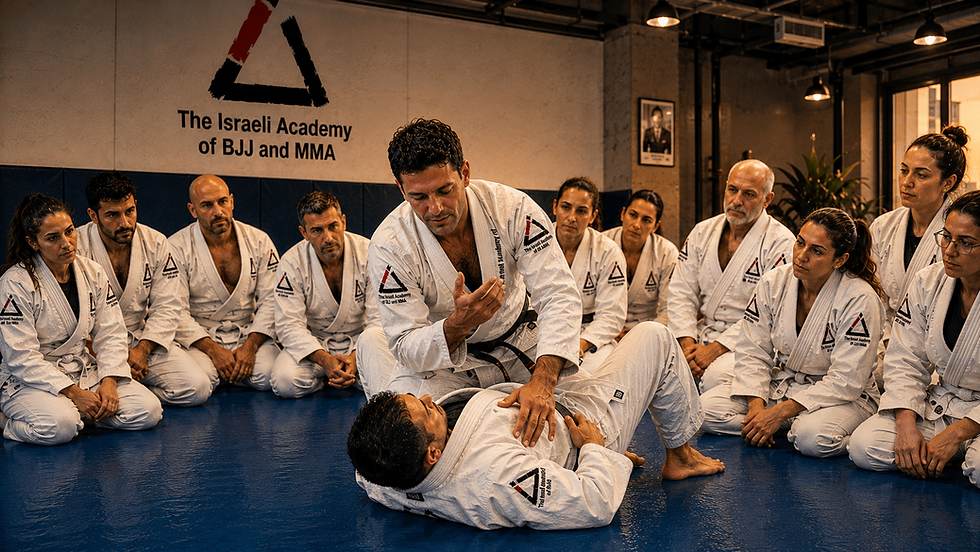
Across the branches of the Israeli Academy of Brazilian Jiu-Jitsu we teach the complete system, Gracie Jiu Jitsu in all its aspects. We teach beginners, women in a dedicated group, competitors, and people starting after 40. All of it.
For all the details on Brazilian Jiu-Jitsu training in Tel Aviv at the academy, including the timetable, the coaches and answers to common questions, head to the training page. Classes are taught in Hebrew, but our instructors speak fluent English and a large part of our members are English speakers. On Saturday nights we run a class taught in English by Philip Paul.
If you want to start, or just to ask questions, I am available on WhatsApp. Get in touch here and I will help you work out what suits you, which of our eight branches, which days, and I will try to answer any questions you have. There is no stupid question. I wrote a whole post about that.
In summary: what is Brazilian Jiu-Jitsu really?
Brazilian Jiu-Jitsu is a martial art and self-defence system that originated in Japan, was developed in Brazil by the Gracie family, and today includes an international sporting branch. The system is built on principles of control, leverage, timing, base and energy efficiency. It starts standing and moves to the ground, and it lets an ordinary person overcome a bigger one through technique rather than strength.
That is the dry explanation. But the essence runs deeper. Brazilian Jiu-Jitsu is chess with the body, an art that puts the head above the body. It is a system that becomes a way of life, teaching humility, persistence and acceptance of reality as it is. It is a community of people learning together and helping each other improve. It is genuinely a daily practice. Because when you are on the mat, facing a partner trying to submit you, you cannot lie. You cannot hide behind a mask. You are only you, and what you know.
And back to that guy who submitted me in 2006, six months on the mat and thirty kilos lighter than me. He was not stronger than me, he was better than me. He knew something deeper than I did. He understood the principles of the system, relative to a white belt, and I, with my black belt in karate and three years of Japanese ju jutsu, simply did not. That moment was the moment I understood I had found something far bigger.
Twenty years later, and I am still discovering something every day. That is Brazilian Jiu-Jitsu. That is jujitsu, jiu jitsu, ju jutsu, jujutsu. Call it whatever you like, just start training.
💬 Ready to start? Book a first trial class at the academy's branches in Tel Aviv and Netanya. message me on WhatsApp
Frequently asked questions about Brazilian Jiu-Jitsu
Is BJJ suitable for beginners?
Yes. Brazilian Jiu-Jitsu is considered one of the most beginner-friendly martial arts there is. You do not need a background, you do not need exceptional fitness, you do not need flexibility. It was in fact designed specifically for the ordinary, non-athletic person. Most of my students at the academy in Tel Aviv started with no martial arts background at all, and progress comes naturally with regular practice of two to three sessions a week. The system is also built so that a new person learns at their own pace, without pressure, and develops over time.
How long does it take to reach blue belt in BJJ?
On average between one and two years of regular training, two to three times a week. In BJJ, progression between belts is slower than in other martial arts, and that is no accident. The blue belt in jiu-jitsu, the second belt, is equivalent to a mid-level belt in most other styles in terms of the ability and knowledge required. The timeline depends on how often you train, how quickly you absorb technique, and the standard the academy demands for the belt. I wrote about that journey in detail in my article on going from white belt to blue belt.
Is BJJ dangerous?
BJJ is one of the safest martial arts to practise regularly. One reason is that we do not hit each other. Usually. The risk of brain trauma, so characteristic of boxing, MMA and kickboxing, simply does not exist here. The injuries that do happen are mostly overload on joints (shoulders, knees, elbows) and come mainly from beginners who do not know how, or do not want, to tap in time. With a good coach and responsible partners, BJJ is a discipline you can practise for decades without significant injury. I wrote about it in detail in my article on injury prevention.
Do you need to be fit to start BJJ?
No. One of the questions I dislike more than any other is "shouldn't I get in shape before I start?" My answer is always the same: the best way to get in shape is to start training. You do not need to arrive fit. Jiu-jitsu will build your fitness. I have seen people start their first class unable to do more than a minute and a half of sparring, and within six months they are rolling for six minutes without a problem. Fitness is a result of the training, not a prerequisite for it.
How do you spell Brazilian Jiu-Jitsu?
There is no single correct spelling. The original Japanese is jūjutsu, meaning 'the gentle art'. The form we all use, Jiu Jitsu, came through Brazilian Portuguese and became the international standard. Jujitsu, ju jutsu, jujutsu and jiu-jitsu all refer to the same Brazilian art of ground fighting with joint locks and chokes.
Who invented Brazilian Jiu-Jitsu?
It grew out of Japanese jūjutsu, brought to Brazil by Mitsuyo Maeda in 1914. Carlos Gracie opened the first academy in 1925, and his younger brother Hélio adapted the techniques for a smaller, weaker body, replacing reliance on strength with angle, timing and leverage. Maeda also taught Luiz França, who taught Oswaldo Fadda and opened a parallel lineage that still exists today.
What is the difference between Gracie Jiu Jitsu and Brazilian Jiu-Jitsu?
They are the same system with different emphases. When the family broke into the United States in the 1980s and 1990s, the Gracies called it Gracie Jiu Jitsu and everyone outside the family called it Brazilian Jiu-Jitsu. In practice Gracie Jiu Jitsu tends to emphasise the complete system including self-defence, while sport BJJ focuses on competition.
What is the difference between Gi and No-Gi BJJ?
In the Gi you use the uniform as part of the technique, gripping the collar, the sleeve and the belt. It is more technical and slower, built on gripping and sustained control. In No-Gi there is nothing to grip, so the pace is faster, slipping beats gripping, and the emphasis moves to body control, friction and pressure. Good coaches say you should train both.
Is Brazilian Jiu-Jitsu effective for self-defence?
Yes, and self-defence is where the system came from. It is built on the assumption that your opponent is bigger, stronger and faster than you. The foundation starts standing, and the aim is to control the situation rather than to go to the ground by choice. Self-defence without high-intensity sparring is theory, and sport without a self-defence context is a game. The complete system needs both.


Comments