
How to Choose a BJJ Academy: The Honest Guide (Yes, Even If You Do Not Pick Us)

Updated: Aug 23
By: Professor Itay Leibovich | Black Belt | Gracie Jiu Jitsu | May 2026 | ~12 min read
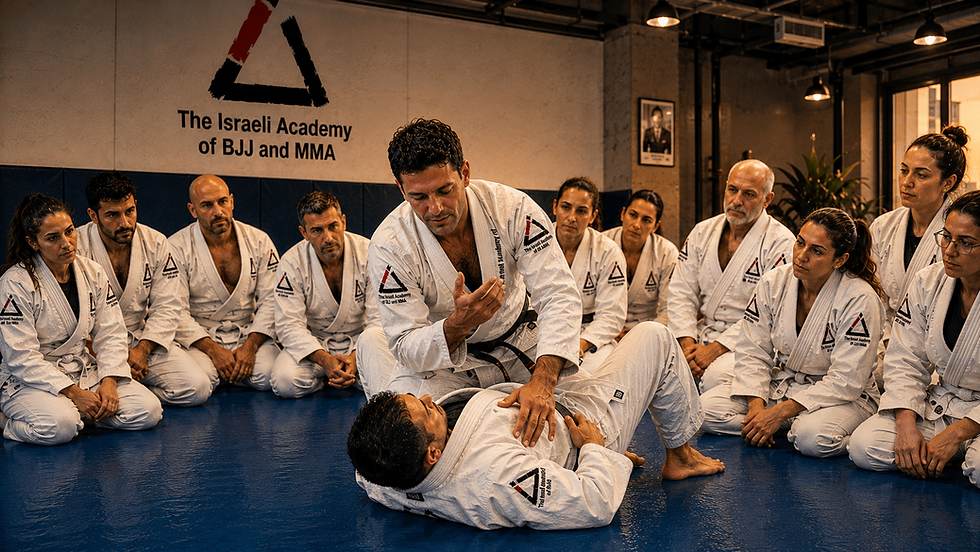
Monday evening, after class. A new guy, 32, well built, comes over to me at the end of sparring and asks if we can talk for a minute. He is wearing a brand new gi, a white belt with two stripes. I say sure, and we sit down on the mat by the wall.
"Itay," he says, "I have been training for two years."
I look at him. Two years. With stripes on a white belt. "Where?" I ask. He names another academy in Tel Aviv. It does not matter which one. He says he came to me because he had heard of me and wanted to see for himself. He does not understand how he has been training for two years and is still a white belt. And after watching him in two sparring rounds, I was wondering how, after two years, he did not know how to sit in guard.
That does not necessarily say anything about his instructor or his academy, but it does say that he may well have chosen the wrong place to train. Probably because nobody explained it to him, and probably because he had neither the knowledge nor the tools to judge whether he had chosen well. For everyone who has not started training yet, or who has started but feels that something is a little off, I wrote this article.
Choosing a Brazilian Jiu-Jitsu academy is the most important decision you will make in jiu-jitsu. Not the gi, not the first technique, not whether you compete. Choosing the academy comes before all of it. A bad academy will not just waste two years of your life, it will give you bad habits that take years to fix, if ever. It will make you quit without ever knowing that jiu-jitsu was not the problem. I have been coaching for more than 16 years. I have seen a lot of people come to me after years somewhere else, and I have learned that there are patterns. A good academy is not necessarily a big, popular or expensive one. And a bad academy is not necessarily a cheap or a new one. This article is the eight questions anyone looking for a Brazilian Jiu-Jitsu academy should ask themselves, in Tel Aviv or anywhere else. If you get good answers, you are in the right place. Even if that place is not us.
The first thing to check: who is the head instructor
The first thing you want to know is who the person standing in front of you actually is. Not just their name, their story. The head instructor at a jiu-jitsu academy should be a black belt. Full stop. That is not a title and it is not a certificate you print, it is at least 10 to 15 years on the mat with people teaching him. The more years he has behind the black belt, the better. Why does it matter? Because Brazilian Jiu-Jitsu is not a collection of techniques and it is not a syllabus. Brazilian Jiu-Jitsu is a system, an understanding, timing, feel, sensitivity, and you only get that combination from hours on the mat, and especially from hours spent teaching. There are no shortcuts, no online workshop and no YouTube video that replaces the fact that the person in front of you has put ten thousand hours on a real jiu-jitsu mat.
Do not let anyone confuse you with other titles. "Master", "certified instructor", "certified police instructor". All of that can be perfectly fine and legitimate, but it is not a BJJ black belt. Ask directly: how many years have you been training? When did you get your black belt? Who is your instructor? A lineage in martial arts does not make you good or bad, but it tells a story. It tells you whether this person comes from a serious Gracie Jiu-Jitsu tradition, or any other reputable club, whether he went through the process with people who went through it before him, or whether he taught himself and awarded himself his own ranks. Those are not the same thing. And this is not only about Gracie Jiu-Jitsu; it applies to Brazilian Jiu-Jitsu unaffiliated with the Gracie family, and to any other martial art.
Did the instructor learn from an instructor who learned from an instructor?
For how long?
At what intensity?
Who awarded him his belts?
Who qualified him to teach? In terms of real professional knowledge, not a formal certificate. Who mentored him as an instructor on the mat?
And most important of all: did he work under his own instructor, or did he train for two years and open his own place with no structured mentorship, oversight or professional supervision?
Anyone can teach a technique. Maybe with mistakes, maybe without. But teaching a system? Teaching a way? That takes a teacher who knows. Not just someone who trains a lot. Not someone who teaches you a technique because it happens to work for him. Someone who understood, and who has passed that understanding to other students over years. If the head instructor at an academy cannot show you 10 years as a black belt and name a clear instructor of his own, stop and think again. When the sport was in its infancy in Israel there were plenty of instructors who were not black belts. I was one of them. I started teaching as a purple belt. True, at that point I had been training martial arts for about 20 years, but in Brazilian Jiu-Jitsu I was relatively new. A purple belt can beat most people. But teach? Rather less. Today the sport is not in its infancy the way it was when I started training in 2006, or when I started coaching in 2010. Today it is developed and large enough that you do not have to compromise. In almost any city you will find black belts who can teach you. But wait, does every instructor have to be a black belt? No. A genuinely good instructor can also be a purple or brown belt, as long as they are supervised and mentored by a black belt. If you have found a large academy with a lot of classes and instructors, check who the head instructor is. Who is responsible for the professional content. Who sets the tone. In 2026 there is no reason for that not to be a black belt. Like a good bone broth, the longer it sits on the fire, the better.
The second thing: does each instructor genuinely specialise in their own slot
An academy can offer Brazilian Jiu-Jitsu, MMA, striking, women's self defense and more. That is fine. A wide offering is not the problem. The problem is when one instructor is shuffled between five slots because there is nobody else to teach them, and all five are run at the same level of mediocrity. There is a big difference between a jiu-jitsu academy that offers a lot and has a dedicated instructor for each discipline, and a sports centre that also does a bit of jiu-jitsu on the side. The first is a serious jiu-jitsu academy with add-ons alongside it. The second is a general fitness class doing everything mediocrely. It does not matter whether there is one group that does "everything" (it is very popular to call something MMA and say you basically do it all), or whether one person delivers every type of session. Unless he has genuinely trained and been qualified in everything he teaches.
What should you check? For every category that interests you, find out who specifically teaches it and what their background in that category is. Do they live and breathe that discipline, or is it something they deliver on the side? At the Israeli Academy of Brazilian Jiu-Jitsu in Tel Aviv we have jiu-jitsu, we have MMA, we have striking, and each one is headed by a dedicated instructor for whom that discipline is the core of what they do. Even though I have an extensive striking background, I choose not to teach that class. I believe whoever runs a striking session should be someone for whom that is their field and their passion. Not someone who grew up in jiu-jitsu and does it on the side. When I teach a jiu-jitsu class, I am doing something I have done for thousands of hours. I have heard every question. I have seen every mistake. I have taught every technique hundreds of times. It is automatic by now. I have my heuristics and the things I learned, forgot, forgot that I learned, and the things I forgot that I forgot. The same is true of a striking coach. Can I teach a jab? A cross? A low kick? Of course. Will I do it as well as someone who does it all the time, who has taught it for years? No. A good teacher is not measured by how he fights or who he can beat. A good teacher is measured by his ability to pass the knowledge on, and that has to be done by the person who passes on that specific knowledge all the time. It is a simple rule. Someone teaching you something he does on the side will teach you enough to think you are progressing. He will not teach you enough to understand.
The third thing: what are you actually looking for
This is the most important question on the list, and most people never ask it before they start looking for somewhere to train. There are three main reasons people come to jiu-jitsu. The first is self defense. You want to know that if something happens on the street you can protect yourself, your partner, your children. You want to walk down the street without being afraid. You want to feel that you own your own safety. You want realistic tools, not a sport. The second reason is enjoyment and lifestyle. You want to do something physical, challenging and clever. You want a community. You want to come to class two or three times a week after work and forget about the day. You are not planning to compete, and you do not need to be beaten up in order to feel you are "really" training. The third reason is competitive sport. You want to compete, you want medals, you want to reach championships in Israel and abroad, you want an academy that will build you as an athlete.
Each reason calls for a different academy. Some academies do two of them. But an academy claiming to do all three at once at the same level probably does none of them at a high level. A sport-competition BJJ academy will teach you techniques that work mainly in No-Gi, because that is the fashion of recent years, plus points, time, IBJJF rules, or whatever techniques are in fashion right now. Sometimes it is leg locks. Sometimes 50/50 guard. Sometimes berimbolo. All according to what is hot in the competition scene at that moment. There is no point learning how to escape a headlock, because a headlock is so inefficient and so easy to escape that no jiu-jitsu athlete would ever use one. And if nobody uses it, why learn to defend it? Someone who wants to be a competitive athlete needs to focus training on what is relevant to their sport. Defending against a punch? Does not happen in jiu-jitsu competition. Overcoming someone bigger and stronger than you? Competitions have weight divisions. Working fast, sharp and strong? That is great when you are young, fast, sharp and strong.
"Just as iron sharpens iron, so one scholar sharpens another." Rav Hama bar Hanina
If your goal is competition and progressing as a professional athlete, look for an academy that competes regularly and often. No matter how good the teacher is, how good he was as an athlete, or how much he wants to develop you, in order to improve you need people like you around you. You need an environment of people who want to compete, who push each other to the maximum and create a healthy competitive environment you can progress in. Check the academy's results in the competition scene. Check who you will be training with.
Jiu-jitsu as a sport is an incredible sport, to do and to watch. It is beautiful and complex, but it will not necessarily help you if somebody tries to grab you from behind in a car park or shoves you in a queue. An academy that does Gracie Jiu-Jitsu, like ours, will first teach you how to survive an uncomfortable position, how to get to a safe place, how to escape the grip of someone bigger, heavier and stronger than you. Headlocks? Rear bear hugs? A punch? Those are not situations in the sport of jiu-jitsu, but they are the situations of everyday violence. Classical Gracie Jiu-Jitsu, the founders' style of jiu-jitsu, is less "sexy" for competition spectators and more relevant to daily life. That is a viewpoint, not everyone will agree with it, but it is the viewpoint we are built on. If it is not what you are looking for, a competition academy will serve you far better.
There is another layer worth mentioning here. Many people are actually looking for self defense, and they turn to what they know, which in Israel is usually Krav Maga. That makes sense. But Krav Maga is a specific system, born as a military method for getting soldiers out of trouble fast within a short training window. Civilian self defense demands something else. A system that works when you are not in the shape of a 19-year-old soldier, when you are a woman of 1.60m, when you have ended up on the ground. Gracie Jiu-Jitsu was built for exactly that. That does not mean Krav Maga is not a good solution; it means that if the goal is self defense in everyday situations, there is a good chance Gracie Jiu-Jitsu is a more precise answer. (I wrote about this at length in the article on self defense for women, worth reading if that is your direction.)
Know what you are looking for. Then look for the academy that fits it. All three reasons are legitimate; there is no right or wrong. The only mistake is going to an academy that claims to give you all three and discovering a year later that you got none of them at a good level, or one that claims to do something it does not. If you search "BJJ near me" online without thinking about your goal first, there is a good chance you will choose by geographical proximity and discover six months later that the closest place does not fit what you wanted. Reverse the order. Goal first, location second. We will come back to that.
The fourth thing: what the group looks like
Go to the academy. Look around. Do not look at the equipment or the walls, look at the people. How many people are on the mat, how many of them look experienced, how many coloured belts do you see, blue, purple, brown, black, and how many white belts. A healthy academy is an academy with a pyramid. Lots of beginners, fewer blue belts, fewer purple, fewer brown, and a black belt instructor at the top. If it is a long-established academy, expect to see black belts besides the head instructor too. If you see an academy with only white belts, or a ratio suggesting that almost nobody has reached blue belt, there is a good chance people leave after a year and do not progress. That says something about the teaching or the atmosphere. Or both.
What is the average age? If you are 35 and walk into an academy where everyone is 22 and this is their sport, you will feel out of place, and after three sessions of being used as a crash pad you will quit. If you are 22 and everyone is 50, you will feel there is nobody to challenge you. In a good jiu-jitsu academy for adults you will see the whole age range of its audience. You will see men and women, every background, every weight, every fitness level. Ask yourself: do I see myself here? Not in a year. In six months. Do these people look like the people I want to do something with twice a week for the coming years? That is not a minor point, it is a fundamental one. In jiu-jitsu you will roll with them a lot, and very close. Sweating on them, letting them choke you and choking them back. These people become friends. Some of them close friends. Some of them a second family. If it matters to you, also check whether there is a separate women's group, because without one most women will face a male-dominated atmosphere that can be uncomfortable. Happily, the overwhelming majority of the women at the academy, and 30% of all students at my academy are women, started in the women's group, and once they felt comfortable they joined the mixed classes. That benefits everyone.

The fifth thing: how you are treated in your first class
Now spot the new person who has come to check the academy out, and watch how they are treated. A beginner's first class is the single most decisive moment in their relationship with the academy. Does the head instructor come over to say hello, shake their hand, ask whether they have any injuries, whether they have trained something similar before? Does one of the academy's seniors receive them, explain the rules, the safety, where the bathrooms are? Or, and this is the red flag, do they stick them on the mat with someone, say "roll with him", and see what happens? Mentorship is the difference between a good academy and a bad one. Not mentorship in the sense of children, mentorship in the sense of a teacher-student relationship. An instructor who knows what you need to learn, at what pace, what to correct, when to push and when to let you breathe.
In a genuinely good jiu-jitsu academy you will feel that you are seen as a person, not as another body on the mat. Not as a customer. That someone is responsible for your progress. That if you miss a week, somebody will ask if everything is alright. This is not a romantic idea from an eighties movie, it is the pedagogical basis that makes real learning possible. You cannot teach someone you do not know. Test it. If you turned up at an academy and nobody spoke to you by the end of class, if they glanced at you sideways and asked whether you would be back, if the head instructor did not know you were there, forgive me, but they will not mentor you in the second class either, or the third, or the fifth. People do not change overnight. An academy does not change its organisational culture week to week. What you see is what you get.
The sixth thing: who teaches the beginners
This is a question almost nobody thinks to ask, and it has enormous consequences. At many academies the black belt teaches the advanced classes. The beginner classes are delivered by one of his students, a purple belt, sometimes even a long-standing blue belt, filling a slot. That person may have been training four or five years himself, but he is not an instructor, he is a student. Perhaps he teaches without any training in how to teach. Perhaps with training, but certainly without experience. What happens is that you, a fresh white belt starting the journey, get your single most critical instruction from a person who has not yet reached the level where you could say he understands the depth of what he is teaching you.
Carlos Gracie Jr., founder of the IBJJF and son of Carlos Gracie, said:
"I have always been a fan of the basics. After you have a good, strong foundation in jiu-jitsu, the rest comes by instinct. You create, you invent. The rest is easy. The hard part is the beginning."
The hard part is the beginning. Exactly. And you want the person delivering your beginning to be the most experienced one, not the most available one. In a good jiu-jitsu academy the beginner classes are delivered by a senior, experienced coaching team all working from one guiding approach. Different instructors at the academy may teach a technique slightly differently from one another, because each one absorbs information differently and passes it on differently, but they will not teach you contradictory things. There will be no fundamental clash in the principles each one teaches. There is no chance you turn up to a class and get instruction that contradicts what you learned yesterday. That is not only a question of teaching quality, it is a question of consistency. Without consistency you cannot progress. A detailed article on the 5 most common beginner mistakes in BJJ will teach you what to look for in yourself in the first months, and it is a good tool for measuring whether the team at the academy you are checking really knows how to teach the basics properly.
Ask the academy directly: who teaches the beginner classes? What belt are they? How many years have they been teaching? If the answer is "a long-time student" or "someone who knows the material well", that is not a satisfactory answer. A BJJ academy in Tel Aviv should be a place where beginners, the people at the most fragile point of what might become their jiu-jitsu career, are taught by the best, not by substitute teachers.

The seventh thing: what people on the mat say
Google reviews are mostly written by satisfied people who still train there. They will not give you the full picture. Someone who already left because they were unhappy will not bother going back to write a bad review. They simply left. So how do you get the truth? You go to the academy and ask people on the mat. Come to a trial class. After the class, before you leave, say hello to someone who looks like they have been training a while, a blue belt at least. Ask them: how long have you been training here? Why did you pick this place in particular? What is the best thing about the academy? What is the most annoying?
The people on the mat will tell you the truth. If the place is good you will hear it in the energy with which they tell you. If the place has problems you will see it in their hesitation, in the way they choose words, in what they do not say. Ask friends who train, ask people who have switched academies. That is how you get the truth. Online reviews are marketing. Conversations with people are far more accurate.
The eighth thing, the least romantic: will you actually stick with it?
The final reason, and the least romantic on the list: location.
Not lineage. Not a black belt. Not a syllabus. Location.
Even the best and most suitable academy will not help you if you cannot get there at least twice a week. If I want to be a champion and the academy is in Haifa but I am in Beer Sheva, it will not work. I had a student who came every morning by train from Nahariya to Tel Aviv. He trained and even competed and won, but he could not keep it up. If I want a Gracie Jiu-Jitsu academy because self defense matters to me, but the nearest one is 100 km away, or the classes run during my working hours, it will not work. So what can you do? Look at what exists around you. Go to a trial class at each of the relevant academies. Once you have chosen, talk to the instructor. Tell him what your goal is and ask what to do if that goal does not match the character of the classes. You will be surprised how many solutions he can offer you.
Three red flags you will not find on other lists
There are things academies will not tell you on a tour, and you need to be able to spot them.
The first is called Smash Culture. Some academies like to test new white belts by pairing them with the toughest fighter in the room. The idea is to see whether the beginner is "strong enough" to stay. That idea is not just stupid, it is destructive. A beginner who gets smashed in his first class will not come back. A beginner who comes back and gets smashed for a month develops injuries, fear and an extremely defensive posture. He is not learning, he is surviving. A good jiu-jitsu academy will wrap the beginner up. The seniors will roll with him at his pace, teach him, show him things. They are not proving to themselves how tough they are; they know they are tough, they do not need to test it on a white belt. That is how a serious jiu-jitsu academy works.
The second flag is the absence of any questions before your first class. If you arrived at a BJJ academy and nobody asked you a single question about yourself before throwing you on the mat, that is a bad sign. Basic questions a good instructor will ask you: do you have any injuries? Have you trained a martial art before? What is your goal, why are you here? Do you have any concerns or fears? An academy that does not ask those questions is not interested in you as a person. It is interested in you as another paying membership. That pattern will continue afterwards, and you will be a nameless person in a group of 30. An article I wrote on injury prevention in jiu-jitsu explains why knowing about previous injuries is not a luxury, it is a basic safety requirement.
The third flag is a group that never changes. Come back to the academy after three months and see the same faces. Come back after six months, the same faces. Come back after a year, the same faces. It sounds stable, but it may say exactly the opposite. It may say that new people arrive and do not stay. And it says that the ones who stay are not progressing through the belts. A healthy academy is dynamic. People receive new belts. White belts become blue, blue become purple. If you do not see that movement, there is a systemic problem there. (In the article on the journey from white belt to blue belt I explained what real progress looks like, if you want to know the standard.)
How to do a trial class properly
Now that you know what to look for, do the trial class properly. Call ahead, send a WhatsApp. Do not simply turn up. Notice how you are treated. Poor customer service on the phone may be a bad sign for what comes later. Arrive 15 minutes early and see what the academy looks like before class starts, who arrives, how they treat each other. Look at the people you are going to train with. Look at the white belts who have been there three or four months. They are your standard in three or four months. Do you want to look and think like them?
Train. Do not feel you need to "show" anything. You did not come to prove anything. You came to check whether the place suits you. Stop after class, do not run straight home. Talk to someone. Ask the questions I listed. Look at who the instructor is and whether he comes to talk to you. Do a trial class at at least two academies. That is the smartest thing you can do. When you hold the two academies side by side in your head, the difference will be obvious. Without comparison or reference points, everything looks the same.
Jean Jacques Machado, a 9th degree black belt and one of the greatest teachers in the world, said a line I like to repeat:
"If you ask me what my rank is today, I will tell you I am a white belt that never gave up."
You should be training with people who hold that attitude. People who understand that they are always students. If you spot that attitude at the academy you are visiting, you are in a good place.
Final checklist: 8 signs of a good BJJ academy + 3 red flags
And now, because after all that talking I need a tidy list too, here is what to take with you to a trial class before you join any jiu-jitsu academy. If you got a satisfying answer to most of these questions and you see no red flags, you have found a home.
8 signs of a good BJJ academy:
1. The head instructor is a black belt with 10+ years on the mat and a clear instructor of his own. He can tell you who taught him, and the explanation sounds structured rather than improvised.
2. Every discipline at the academy has a dedicated instructor for whom it is the core. If there is MMA, there is an MMA coach. Not one person filling five slots.
3. The academy has a clear identity. It can tell you what it is, self defense, competitive sport or lifestyle, and it does not try to be everything to everyone.
4. The group is a healthy pyramid. Plenty of white belts, fewer blue, fewer purple, a few brown, a black belt at the top. Mixed ages, women too, a family atmosphere.
5. In your first class you are received as a person. They ask about injuries and goals, explain the rules and the safety, introduce you to people. They do not throw you on the mat to see whether you survive.
6. Beginner classes are delivered by senior staff. Brown or black belts, not an advanced student filling a slot.
7. People on the mat speak well of the place without being asked. You ask them simple questions after class and they answer without hesitating and without holding back.
8. It is easy to get to in terms of distance and location, and it fits your schedule. Every obstacle between you and training is an accelerator toward quitting early. And remember, a black belt is a white belt who did not quit.
3 red flags. If you see them, keep walking:
1. Smash Culture. Advanced students smash beginners as a "test" or to prove toughness.
2. Not a single personal question before your first class. Nothing about injuries, nothing about background, nothing about goals. You are just another body walking onto the mat.
3. The group never changes. The same faces year after year, with no movement through the belts. New people do not stay, and the ones who stay do not progress.
If you managed to identify 6 to 8 good signs and saw no red flags, you have found a good BJJ academy. Even if it is not ours 😊

If you are weighing up where to start training in Tel Aviv, Netanya or anywhere else in Israel, or you are not sure whether BJJ, Gracie Jiu-Jitsu, MMA or self defense is even your direction, talk to me. Classes are taught in Hebrew, but our instructors speak fluent English and a large part of our members are English speakers, so if you have recently moved to Israel you will not be the only one on the mat.
For questions, advice, details and to book a trial class at the Israeli Academy of Brazilian Jiu-Jitsu and MMA
Get in touch on WhatsApp
Further reading: Self defense in Brazilian Jiu-Jitsu: the complete guide for women | Gi vs No-Gi: the difference and what suits you | From white belt to blue belt: the journey in BJJ | Injury prevention in jiu-jitsu | Fighting fire with water: BJJ against bullying | 5 common beginner mistakes in BJJ
See for yourself: the academy's Brazilian Jiu-Jitsu in Tel Aviv page has all the information about the classes.
Frequently asked questions about choosing a BJJ academy
What is the most important thing to check when choosing a BJJ academy?
The most important thing is the head instructor. Check their background, whether they compete themselves, and whether they have teaching experience. A good instructor changes your entire experience on the mat.
How long should you try a BJJ academy before deciding?
One trial class is enough to get a feel for the atmosphere, but it is best to try at least two different academies before deciding. Pay attention to how you are treated, who the instructor is and what the coaching team looks like.
Is there a difference between BJJ academies and Gracie Jiu-Jitsu academies?
Both teach Brazilian Jiu-Jitsu, but Gracie Jiu-Jitsu places more emphasis on self defense and the traditional side of the art, while BJJ sometimes focuses more on sport and competition.
Are the classes taught in English?
Mostly not, and I would rather tell you straight than have you find out on the mat. Regular classes are taught in Hebrew. What makes this work for English speakers is everything around that: the instructors speak fluent English, a large part of our members are English speakers, and on Saturday nights we run a class taught in English by Philip Paul. In practice jiu-jitsu is learned far more by watching and feeling than by listening, and no English speaker has ever been left behind on our mat. If Hebrew genuinely worries you, come to the Saturday night class first.


Comments