
Your First Brazilian Jiu-Jitsu Class in Tel Aviv: What Really Happens (And How to Get Through It)

Updated: Jul 30
A minute-by-minute guide to your first class: what to wear, what happens on the mat, why nobody is going to break you, and why the tap is the most important tool you will learn on day one.
By: Professor Itay Leibovich | 3rd Degree Black Belt | Gracie Jiu Jitsu | July 2026 | ~13 min read

You have been standing outside the academy in Tel Aviv for seven minutes now.
You are not going in. You check your phone. You look at your watch. You check your phone again (no new messages, you know that, you checked a minute ago). You have a bag with clothes, you have water, you have everything you need except one small thing: the nerve to open the door and walk into your first class.
I know those seven minutes. Every single person wearing a black belt today once stood outside that door. I stood there. My coaches stood there. Even Helio Gracie himself started out as a frail kid sitting on the sidelines watching his brother Carlos teach, before he ever touched a mat. Everyone starts in exactly the same place: outside, stomach in knots, convinced that everyone inside is going to look at them and think "what is he doing here".
So let us make a deal. I am going to tell you exactly what is going to happen in your first Brazilian Jiu-Jitsu class, minute by minute, without sugar-coating it and without scaring you. By the time you finish reading this, those seven minutes outside the door will turn into seven seconds. That is all I want.
First things first: your fear makes sense, but most of what it is telling you is wrong
Let us start with the truth. Being nervous about your first class is not a sign that you are weak or that this is not for you. It is a sign that you are a normal human being about to do something completely new in front of people you do not know. It is the same fear you get before a job interview, before a first date, before you stand up to speak in front of a room.
Your head is telling you three things, and all three are wrong:
Your head says: "everyone there is an expert and I will be the worst one". The truth? In every Brazilian Jiu-Jitsu class in Tel Aviv, and everywhere else, there are white belts who walked in a week before you. The art runs on a constant stream of beginners, people who had never touched jiu-jitsu until a month ago. You will not be "the worst", you will be "the new one", and that is a role everyone has played and everyone remembers fondly.
Your head says: "I am not fit enough for this". Completely backwards. You do not come to jiu-jitsu because you are fit. You get fit because you come to jiu-jitsu. Nobody is waiting for you to be ready. You become ready along the way.
Your head says: "someone will injure me, or I will injure someone". That is the most legitimate of the three, which is why I have given it a whole section further down. We will get there. Hang on tight (but not too tight, it is your first class).
There is one line I like to give anyone standing in the doorway. Carlos Gracie Jr., the man who founded the IBJJF (the sport's international federation) and the son of one of the founders of the art, said it best: "I have always been a fan of the basics. After you have a good, strong foundation in jiu-jitsu, the rest comes by instinct. You create, you invent. The rest is easy. The hard part is the beginning." Notice what he is saying. Not "the hard part is the black belt". Not "the hard part is competition". The hard part is the beginning. You are standing right now in the single hardest part of the entire journey. Which means that from the moment you walk in, everything gets easier.
What to wear and what to bring, so one less thing is on your mind
A big part of first-day stress is purely logistical: "what do I even wear". Let us take that off the table right now, because it is the easiest part to solve.
For a first trial class you do not need to buy any special gear. Come in comfortable athletic clothes: a shirt that fits close to the body (not too loose, it will get grabbed and pulled), and long trousers, or shorts with spats underneath, with no zippers and no zippered pockets (a zipper is the enemy, it catches fingers and scratches). If you have a rashguard, a tight-fitting shirt like surfers wear, perfect. If not, a plain long t-shirt will do the job.
Classical Brazilian Jiu-Jitsu is trained in a Gi, the traditional uniform (some people call it a kimono, but we say gi). You do not need one on day one. When you decide you are staying, we will talk about it. In the meantime, at the academy in Tel Aviv and Netanya we also train No-Gi, without the uniform, so you will feel at home either way. Not sure what the difference is? Read about the difference between Gi and No-Gi.
What to bring: a large bottle of water (you will sweat, even in your first class, even if you are convinced you will not). A small towel. And flip-flops or shoes that are easy to slip off, because on the mat you are always barefoot, and off the mat you are never barefoot. That is an iron-clad hygiene rule, and we will get to it.
What not to bring: watch, rings, earrings, necklace. Anything that sticks out from your body is something that can get caught or cause an injury. Take it all off before you step onto the mat. Nails, hands and feet, short and trimmed. That is the single most important thing for hygiene and safety at the same time. A scratch from a long nail is the most common and most avoidable injury in every jiu-jitsu academy in the world.
That is it. Logistics done. You are dressed, hydrated and jewellery-free. Let us go in.
The first hour, minute by minute
You are in. Now what.
A typical class runs about an hour to an hour and a half. It breaks down into roughly four parts.
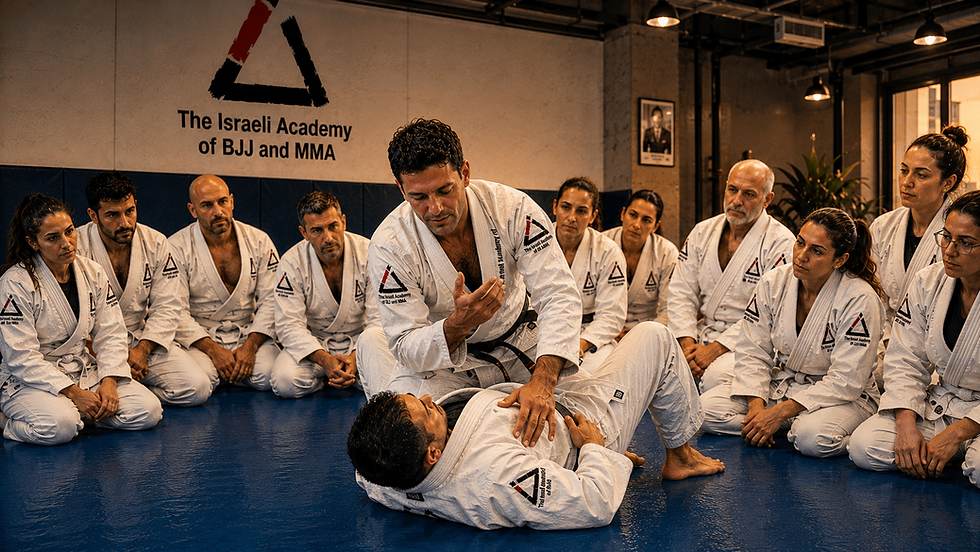
Minutes 0 to 5, arriving: you take your shoes off and introduce yourself. Shoes come off at the edge of the mat. Someone, usually the instructor or a senior training partner, will come over to say hello and ask if this is your first class. Say yes. The moment you say "yes, it is my first", something good happens: everyone who hears it automatically switches into "I look after the new person" mode. Nobody teaches that, it is simply the DNA of a healthy training room. At the Israeli Academy of Brazilian Jiu-Jitsu, the new person is not prey. The new person is a training partner and a future friend.
Minutes 5 to 20, the warm-up: ten to fifteen minutes that will take your breath, and your soul, away. And that is fine. Most classes open with a warm-up. Light running around the mat, ground-based movement drills such as forward and backward rolls, shrimping and hip bridges. It will look strange on day one, as if everyone knows a secret dance nobody taught you. They do not know anything you will not know in two weeks. Do your best, and do not be embarrassed to stop and breathe. Nobody is counting how many rolls you did. We count that you showed up.
Minutes 20 to 45 or so, technique: the instructor demonstrates and you drill it slowly. After the warm-up the instructor gathers everyone and shows one or two techniques. Say, how to get out from underneath someone lying on top of you, which we call a mount escape. He will show the movement slowly, break it into steps, then have you pair up. Now you drill the movement on a partner who lies still and cooperates. No resistance, no fight. It is like learning to drive in an empty car park before you go out on the road. You will do the movement wrong the first time. And the second. On the third, something will start to click. That is exactly the process. That is how jiu-jitsu is learned. Repetition after repetition after repetition.
Minutes 45 to the end in a one-hour class, rolling: the part everyone is afraid of, and the part most people do in their very first session. At the end of class comes "rolling", or sparring. This is where two people genuinely try, with resistance, to apply what they have learned. Here I want to stop and be very clear: in a first class, with a responsible instructor, you do not have to roll at all. Beginners sometimes just sit on the side and watch the sparring happen in front of them. That is completely legitimate. That said, my recommendation is to do at least one round in your first class, if not all of them. If you want a taste, because you cannot get full reading the menu, you will be paired with a higher belt whose job is to look after you. They will not try to "beat" you. They will let you work, correct you, and stop before anything dangerous. You set the pace, not them.

Why nobody is going to break you on day one
Let me speak directly to the biggest fear, because it deserves a straight answer. I have been teaching Brazilian Jiu-Jitsu for years, I have seen thousands of first classes, and I can tell you exactly how this works.
Brazilian Jiu-Jitsu is a contact sport. Like any contact sport there is a risk of injury, and I am not going to lie to you and say there is not. What I can tell you is that in a controlled environment, with responsible partners and one simple rule I am about to explain, that risk drops dramatically. It does not disappear. It drops dramatically. That is the difference between someone promising you "zero injuries", who is lying, and someone telling you the truth.
The reason nobody will break you on day one is not politeness, although that is part of it. It is the nature of the art itself. Brazilian Jiu-Jitsu is built so that you can train at full intensity without striking and without getting hurt, because every dangerous technique, every choke and every joint lock, comes with a built-in stop mechanism: the tap. The moment something hurts or feels wrong, you tap, and everything stops immediately. In most martial arts you have to take a hit in order to learn. In jiu-jitsu you learn without taking any. That is the beauty of the art, and it is exactly why people in their fifties start it without hesitation.
There is a line from Royce Gracie, Helio's son and the man who won the first UFC in 1993 and proved to the world that the art works, that sums up the whole idea: "Jiu-jitsu is not the art of hitting, it is the art of not getting hit." Think about that for a second. You are learning an art whose entire purpose is that you do not get hurt. That is the exact opposite of what your head is afraid of at the door.
The tap: the most important tool you will learn on day one, and it is not a technique
If you take one thing from this article, make it this:
The tap is how you say "enough". You tap two or three times, clearly and firmly, on your partner. Not on the mat. Your partner cannot feel you tapping the mat. The instant you tap, your partner must release immediately. It is not a request, it is sacred law. Anyone who does not release on a tap is removed from the mat. Full stop.
What matters most on day one is entirely practical: tap early and tap often. The moment something feels uncomfortable, tap, even if you are not sure it is "serious enough". Better to tap one unnecessary time than to miss the time that mattered. Being shy about tapping is the number one cause of pointless beginner injuries, and it is also the easiest thing in the world to avoid. It is also one of the classic beginner mistakes I wrote about in the most common beginner mistakes. You do not need to prove anything on day one. You only need to learn, and come back to the next class.
If you want to know exactly when to tap, why it is not losing, and how it changes between training and competition, I wrote a separate article on it: when and why we tap in jiu-jitsu. On day one it is enough to remember: if it hurts or feels wrong, you tap.
There is a principle everyone who trains long enough comes to understand: in the end, time on the mat beats talent and natural ability. On your first day you will not beat anybody, and you are not supposed to. But every minute you spend on the mat is a deposit that pays out later. You will learn more in one hour of training than in a year of watching videos on YouTube.

Why it feels hard, and why that is actually a good sign
A lot of people walk out of their first class with two feelings at once: "wow, that was amazing" and "wow, I am terrible at this". I want you to know in advance that this is the correct feeling. If you walked out of your first class feeling like you understood everything, you probably were not in a jiu-jitsu class.
There is a structural reason for it. In your first class you are not trying to learn one technique, you are trying to learn an entirely new language. Your body has never been in these positions. You are asking it to move in directions it does not know, while somebody else is attached to it. That is an enormous load on the system, and it is exactly the load that builds this thing called jiu-jitsu. Nobody is born knowing jiu-jitsu, and that includes every black belt you see on the mat. If you want to understand in depth why "the gentle art" feels so hard at the start, I wrote about it here: why the gentle art feels hard at the beginning.
Jean Jacques Machado, a cousin of the Gracie family who was born without fingers on his left hand and became one of the greatest teachers and competitors in the world, was once asked what his rank was. His answer is, to me, the most important sentence a beginner can hear: "I am a white belt that never gave up." Take in how deep that is. A man who is an 8th degree black belt, one of the greatest of all time, defines himself as a white belt. The difference between him and you on day one is not talent and it is not genetics. The difference is that he did not quit. That is the whole secret. That is the entire secret.
What happens when the class ends
The class ends. Usually with handshakes and a short, warm hug with everyone you trained with. Every academy has its own custom; ours is simple and friendly. You are sweaty, tired, and probably smiling without noticing.
Now one of two things will happen. Either you will feel satisfied and accomplished, "I finally did it", and know immediately that you are coming back. Or you will feel overwhelmed and unsure, "I do not know if this is for me". Both are completely legitimate. All I ask of you is one thing: do not judge Brazilian Jiu-Jitsu on a single class. Nobody rides a bike on their first attempt. Give it three or four classes. By then the movements will start to feel less foreign, you will know a few faces, and you will begin to understand why people get hooked on this thing.
And here I want to touch on something broader. A lot of people come to the academy in Tel Aviv and Netanya not because they want to be fighters. They come because they were looking for self defense, or fitness, or a way to burn off the pressure after a day at work. Some of them never thought of themselves as "martial artists" until the week before they walked through the door. And that is completely fine. Gracie Jiu-Jitsu, the version developed by the Gracie family with the emphasis on self defense, is one of the most effective self defense tools in the world, in Tel Aviv and anywhere else, especially for anyone smaller or weaker than their attacker, because the entire art is built on leverage and technique instead of strength (if you want to understand in depth what Brazilian Jiu-Jitsu actually is and where it came from, I wrote about that too (what Brazilian Jiu-Jitsu actually is). But what keeps people on the mat for years is not the self defense. It is the community, the progress, and the feeling that every week you are a little less the person who once stood terrified outside the door.

Hygiene and safety: the unwritten rules worth knowing in advance
So that you feel at home from the first moment, here are the rules nobody always remembers to explain to a beginner:
On the mat you are always barefoot; off the mat you are never barefoot, and flip-flops in the bathroom, always. That is not cosmetic, it prevents fungal and skin problems. Come to training clean, in clean clothes. You are going to be pressed up against people, and they against you, so it is basic mutual respect. Nails trimmed. We said it already, but it is twice as important, so I said it twice. If you are sick, a cold and especially anything on the skin, stay home. One week at home beats infecting half the academy. And if something genuinely hurts, not effort but pain, tell the instructor. We do not read minds, and we would much rather know.
It sounds like a lot, but it sinks in within a class or two and becomes second nature. Like putting on a seatbelt in the car.
A few practical things before you book
Age and fitness: there is no "right" age to start. On the mat in Tel Aviv we have people in their twenties and people in their fifties and sixties. Brazilian Jiu-Jitsu is one of the few sports you can genuinely start later in life and actually progress in, because it does not depend on explosive power or youthful energy but on technique and biomechanical principles.
Men and women train together in the regular classes, and it works very well and with mutual respect. Alongside that, the academy runs a women's-only group in Tel Aviv, for anyone who prefers to start in that environment. Both doors are open. You choose.
How often to come: at the start, two or three times a week is excellent. Enough for your body to remember from class to class, not so much that you burn out. But once a week beats zero. Start wherever you can.
Where this happens: the Israeli Academy of Brazilian Jiu-Jitsu and MMA runs classes in Tel Aviv (Yitzhak Sadeh 29) and Netanya (HaTzoran 4), plus additional branches across Israel. We teach the classical version of Gracie Jiu-Jitsu, the same jiu-jitsu developed with an emphasis on self defense. Classes are taught in Hebrew, but the instructors speak fluent English and a large part of our members are English speakers, so English speakers settle in fast. If you are looking for BJJ for beginners in Tel Aviv, or for where to start Brazilian Jiu-Jitsu in Tel Aviv or Netanya, this is the address.
Frequently asked questions before your first class
I am completely out of shape. Will I make it through a whole class?
Yes, because nobody expects you to keep an advanced student's pace. Do your best, stop to breathe when you need to, and drink water. The fitness comes on its own within a few weeks. You do not need to be fit to start, you need to start in order to get fit. Most people who start jiu-jitsu find they are in better shape within a month without even noticing.
Does it hurt? Will I leave with bruises?
It is a contact sport, so you will feel effort and some mild pressure. Real pain, hopefully not, as long as you tap on time and train with responsible partners. A small bruise here and there will happen, as in any physical activity. Scratches from long nails are the common one, which is exactly why we trim nails. A first class with a responsible instructor is one of the safest sessions you will ever do.
Do I need to buy a Gi before my first class?
No. Come in comfortable, close-fitting athletic clothes. You buy a Gi only when you decide to continue, and even then we will guide you on what to get. We also run No-Gi classes, without the uniform.
Am I too old to start Brazilian Jiu-Jitsu?
No. If you are healthy enough to start physical activity, you are "young" enough for jiu-jitsu. Technique beats age, and that is exactly what makes Brazilian Jiu-Jitsu so well suited to older beginners. Tell the instructor if you have any physical limitation and we will adapt.
What if I am embarrassed that everyone will see me being bad at it?
Everyone was the new person once, and everyone remembers their first day. Nobody judges a beginner, because everything a beginner does reminds the veterans where they came from. You will not be the centre of attention. You will be the guest everyone is glad showed up. That is true in any healthy BJJ club, and especially in ours.
What is the difference between Brazilian Jiu-Jitsu and Krav Maga or other martial arts?
Krav Maga is a standing system focused on rapid neutralisation. Brazilian Jiu-Jitsu specialises in what happens when a confrontation reaches the clinch or the ground, a situation that occurs in a great many real confrontations, and it lets a smaller, weaker person control a bigger one without trading strikes. Two different approaches, and in BJJ the emphasis is on control rather than damage. A lot of people who start jiu-jitsu discover it is exactly what they were looking for without knowing it.

Are the classes taught in English?
Mostly not, and I would rather tell you straight than have you find out on the mat. Regular classes are taught in Hebrew. What makes this work for English speakers is everything around that: the instructors speak fluent English, a large part of our members are English speakers, and on Saturday nights we run a class taught in English by Philip Paul. In practice jiu-jitsu is learned far more by watching and feeling than by listening, and no English speaker has ever been left behind on our mat. If Hebrew genuinely worries you, come to the Saturday night class first.
Let us close this out
Back to the door.
Now you know what to wear, what to bring, what happens minute by minute, why nobody is going to break you, and why the tap is a friend and not an enemy. The fear will not disappear entirely, and I do not want it to. A few butterflies are a sign you are doing something that matters to you. But now the butterflies know the way.
See you on the mat.
If you want to start Brazilian Jiu-Jitsu in Tel Aviv or Netanya, or simply understand what a first class looks like without committing to anything, message me on WhatsApp. We will work out what you are looking for, make sure it is a fit, and book you a trial class. And if it is not with us, I will help you find a place that is close to you and right for you.
Tel Aviv: Yitzhak Sadeh 29 | Netanya: HaTzoran 4
You can see the class schedule here.
Professor Itay Leibovich | 3rd Degree Black Belt, Gracie Jiu Jitsu | The Israeli Academy of Brazilian Jiu-Jitsu and MMA


Comments