
Why Do They Call It the Gentle Art When It Feels So Hard?

Updated: Jul 30
By: Professor Itay Leibovich | Black Belt | Gracie Jiu Jitsu | June 2026 | ~14 min read
Yuval finished his first class flat on his back, staring at the ceiling, trying to remember how this whole breathing thing works. Big guy, strong, comes from CrossFit, lifts weights I prefer to admire from a distance. Three training partners, none of them bigger than him, moved him from position to position for five minutes like he was a sack of potatoes. An unusually polite sack. But a sack.
"Hold on," he said, still on his back. "Didn't you tell me this was the gentle art?"
I told him I did. I did.
"So why do I feel like I got run over by a tractor? Where is the gentle part?"
I smiled. It is a smile I smile a few times a week. Because Yuval's question is the best question a beginner can ask in his first class, and it is also almost always built on one small misunderstanding that drags all the frustration along behind it. And it is not just Yuval. The exact same question comes from the slim woman who has never played a sport in her life, from the 45-year-old tech worker who sits in front of a screen all day, and from the ex-athlete who is certain this will be easy for him. Let us fix that misunderstanding right now, and everything that happened to Yuval on the mat will start to make sense.

Gentle according to whom?
Brazilian Jiu-Jitsu picked up the nickname "the gentle art" a long time ago. In Portuguese it is a arte suave, and it is a beautiful name that has convinced countless beginners they are walking into a yoga class wearing a heavy pyjama. They are wrong, but not completely. They are simply reading the word "gentle" in the wrong context.
"Gentle" does not describe what you feel. It describes how the system works. In a physical confrontation, strength, size and athleticism give you an advantage, and that is true in almost every martial art. Brazilian Jiu-Jitsu teaches you how to shrink that advantage. You are not trying to be stronger than your opponent. You take his force and redirect it against him. Not in the Hollywood sense, in the biomechanical one. Leverage instead of muscle. Angle instead of collision. Timing instead of speed. That is the "gentle", and it lives in the system, not in the experience of the person learning it for the first time.
Helio Gracie, one of the central figures in the development of Gracie Jiu Jitsu, was thin, short and not especially strong. His brother Carlos Gracie studied Japanese jiu jitsu, and the family went on to adapt and develop it. Helio could not lean on a system built around strength, because he simply did not have any, so he was among those who reshaped it around leverage, timing and positioning instead of raw power. A system in which a small person can control someone bigger and stronger, not despite the opponent's size but by using it. That approach is exactly why jiu jitsu is called the gentle art. And it is also why it feels so hard at the start, because the first thing you have to give up is precisely what has worked for you your whole life. Strength. If you had any.
That line, from Helio to me, is not a slogan. I received my black belt in a direct lineage: Helio Gracie taught Royler Gracie, Royler taught Moshe, and Moshe taught me. When I explain to a beginner in Tel Aviv or Netanya why he does not need strength, I am not inventing a theory. I am passing on exactly what Helio built for people who do not have strength. Now that we have cleared that up, let us talk about why the first few months feel like a punishment. There are five reasons I see in almost every beginner, and every one of them makes complete sense.
Soft versus hard: two families of martial arts
The word "gentle" is worth pausing on, because it is not a marketing invention. The martial arts world splits, roughly, into two families: "hard" systems and "soft" systems. The difference between them is not how much it hurts, it is how each one deals with force.
Hard systems answer force with force. They block, they check, they return a strike with a strike, and they rely on speed, power and the timing of an impact. Boxing is the clearest example. So are Muay Thai, karate, taekwondo and kickboxing. The logic is simple: produce an effect fast, before your opponent produces one on you. For that to work, it usually helps to be big, strong and fast.
Soft systems work the other way around. Instead of colliding with force, they yield to it and send it somewhere else. The idea is ancient, and it comes from the Japanese word "ju" (柔), meaning flexible, yielding, giving way. From that exact root we got judo and jiu jitsu. Aikido and tai chi belong to the same family. The classic image is bamboo in the wind: it does not break because it bends. Instead of stopping your opponent's force, you ride it.
Brazilian Jiu-Jitsu is unmistakably a child of the soft family, but with a development of its own. It took the principle of yielding and leverage and brought it down to the ground, to the place where size and strength lose much of their advantage. There, on the mat, a small practitioner who knows what he is doing can control someone far bigger without exchanging a single strike. That is the difference between answering force with force and turning your opponent's force into his own problem.
In practice the split is never perfectly clean. Judo, soft in principle, has some extremely decisive throws. A good boxer uses timing and angle exactly the way a "soft system" does. And an MMA fighter mixes everything as needed. But as a system, Brazilian Jiu-Jitsu sits deep on the soft side of the map, and that is also where its power comes from.
So when I say "gentle", I do not mean "easy". I mean a system that wins without insisting on being the strongest thing in the room. And that, somewhat comically, is exactly what makes it so hard to learn at the beginning. Because in order to learn to be soft, you first have to stop being hard.
Reason one: you are learning a new language and a new body at the same time
Imagine somebody asks you to learn Chinese. Now imagine that while you are learning it, somebody else is trying to knock you off your chair. That is roughly what happens in your first jiu jitsu class.
There is an entire language you do not know. Guard (lying on your back and controlling your opponent with your legs), mount (sitting on your opponent's chest), side control, sweep, frame, base. Every one of those words is not just a name, it is a movement, a position, a problem with a solution or a solution to a problem. And while you are trying to remember what guard means, your body is being asked to do things it has never done. Move from the hips. Push at an angle. Stay calm while somebody is lying on top of you. Your brain is overloaded, your body is confused, and all of it is happening in real time against a person who is not cooperating.
That is not a weakness in you. It is simply overload. You are trying to build two things at once, and more than two, a new vocabulary and new motor control, and that takes time. A lot of time. And it is completely fine. Everybody training jiu jitsu today, in Tel Aviv or anywhere else in the world, went through exactly that overload at the start.

Reason two: your ego walks onto the mat before you do
This is probably the hardest reason, because it is not technical. It is emotional.
The big strong guy who shows up for his first class arrives with a quiet assumption: I am strong, I am fit, I will manage. And then a thin training partner 25 kilos lighter takes his back, sinks a choke, and waits patiently for him to work out that he needs to tap. Something happens in that moment. Not to the body. To the ego. Well, to the body too. But mostly to the ego.
There is something beautiful in that, actually. Brazilian Jiu-Jitsu is one of the only systems I know that dismantles ego gently but without mercy. You cannot pretend on the mat. If you do not know, you tap, and that is that. And that is exactly the difference between a beginner who progresses and a beginner who stays stuck. Whoever can leave the ego at the door and walk in as a genuine beginner progresses fast. Whoever fights in order not to lose stays stuck. Jiu jitsu does not forgive pride, but it is extremely generous with humility. And that, by the way, is one of the reasons a lot of women progress quickly early on: less ego to leave at the door.
Reason three: your body is running late behind your head
There will come a point, maybe as early as your second week, when you understand exactly what needs to happen. You will see your opponent's movement, spot his mistake, know which technique fits. And then your body will simply... not respond in time.
This is one of the great frustrations for beginners, and one of the best signs of progress there is. When your head understands but your body is still behind, it means you are right in the middle of building. The knowledge is already there. The muscles have not absorbed it yet. The only way to close that gap is repetitions, more repetitions, and then a few thousand more repetitions. There is no shortcut, and I know that is not what you wanted to hear. That is how it works in jiu jitsu, and that is how it works with every other real skill you have ever learned.
Reason four: in jiu jitsu the resistance is real
A lot of martial arts train with choreographed drilling. One person attacks according to a script, the other responds according to a script, and everybody knows in advance what is going to happen. It looks good. It also falls apart the moment somebody refuses to play along.
In Brazilian Jiu-Jitsu the resistance is alive. In sparring, your partner is genuinely trying to control you, genuinely trying to submit you, genuinely does not want you to succeed. There is no script. That is why it feels hard. And that is exactly why it works. When it comes to self defense, the difference between what you drilled in the air and what you did against real resistance is the difference between knowing about something and knowing how to do it.
This is a point worth being honest about, because a lot of people considering Krav Maga in Tel Aviv as their self defense solution are coming from exactly the same need. Krav Maga is a system in its own right with its own history, and I am not here to say a bad word about it. But anyone asking what happens when a fight reaches the ground, and a great many confrontations end up in the clinch or on the ground at some stage, will find that Brazilian Jiu-Jitsu is built entirely around that moment. It is not a replacement for anything. It is simply the tool that specialises in exactly the place where most people are most vulnerable. For that same reason, live resistance is not a bug in the system. It is the heart of it.
Reason five: there are no shortcuts, and there is good news in that
Let us start with the part that is unpleasant to hear. You cannot cheat on the mat. There is no YouTube video, no trick, no magic week at the end of which you suddenly know jiu jitsu. Every black belt you have ever met went through exactly the period you are going through now, on the same mat, with the same frustration, with the same feeling of "maybe this just is not for me".
And now the other side, which is genuinely freeing. Because there are no shortcuts, talent alone will not overtake you either. In certain sports genetics decide things from the start. Height in basketball. Speed in sprinting. Explosive power in athletics. In jiu jitsu, the person who turns up consistently will almost always end up passing the person who was gifted but did not show up. In the end, time on the mat is worth more than talent. That is possibly the fairest gift the gentle art gives you, and it also means that all of it is in your hands. There is no closed club of the naturally gifted here. There is a mat, and there are the people who keep coming back to it.
And then the strange thing happens: it becomes gentle
After a few months, if you keep showing up, you will notice something funny. You start working less hard and achieving more. Instead of fighting with strength, you start moving correctly. Instead of resisting, you start flowing. Suddenly you can hold guard against somebody bigger without sweating the way you did at the start, because you are no longer trying to hold him with muscle. You are holding him with structure.
Roger Gracie, grandson of Carlos Gracie and one of the most decorated competitors in the history of the sport with ten IBJJF world titles, said one sentence that beginners hate and advanced students understand:
"Jiu Jitsu is simple, you just gotta do it right."
Simple. Not easy. Those are two very different words.
He is not making fun of you. He is describing the moment when the gentle art finally becomes gentle for you too. The difficulty at the start is not a bug. It is part of the process that leads to exactly that moment, and most people who train jiu jitsu consistently get there in time.

Thinking about starting? What actually happens in your first class
Let us assume everything you have read so far did not scare you off but actually made you curious. Good. Let me tell you what is really waiting for you in a first class, so you arrive without strange expectations.
We do not throw beginners into sparring on day one. It happens gradually. You will learn to fall without getting hurt, you will meet a few basic positions, you will do slow repetitions with a patient partner. You set the pace, you tap whenever you want, and nobody is there to break you, they are there to teach you. You will be confused, and that is part of it. You will be tired in a way you did not expect, because Brazilian Jiu-Jitsu uses muscles you did not know you had. I have been in martial arts for 36 years and I have taught this first class to countless beginners, and I can tell you what happens at the end of it for most of them. One of two very clear thoughts: either "what on earth just happened to me" or "give me more of this".
This is the moment to say something about the beginning itself. Carlos Gracie Jr., founder of the IBJJF, the International Brazilian Jiu-Jitsu Federation, put it in a way I repeat to beginners constantly:
"I've always been a fan of the basics. After you have a good solid foundation, the rest comes by instinct. The difficult part is the beginning."
Read that last sentence again. It is the one that matters.
The beginning is the hard part. Not because you are not suited to this. Because that is how it is built. Whoever understands that in advance stays. Whoever assumes something is wrong with them leaves right before it starts being fun.
This guide was written for BJJ beginners and for anyone still hesitating about starting BJJ. At the Israeli Academy of Brazilian Jiu-Jitsu and MMA I coach beginners from zero, and I built the academy so that precisely the people who have never touched a martial art can walk in without being afraid. Some of them arrive after twenty years without sport, some are convinced they are too old or not fit enough, and most of them are wrong about themselves. The simplest way to find out whether this is for you is to come to a trial class and see how it feels in your own body rather than in theory. One practical note for English speakers: our regular classes are taught in Hebrew, but the instructors speak fluent English, a large part of our members are English speakers, and on Saturday nights we run a class taught in English by Philip Paul.
What nobody bothers to tell you about the first month
There are a few things beginners discover on their own, the hard way, and I would rather say them up front. First, you will remember everything wrong. You will leave a class certain you understood a movement, and at the next session your body will do something else entirely. That is normal. Muscle memory is built through repetition, not through understanding, which is why progress feels jerky before it feels smooth.
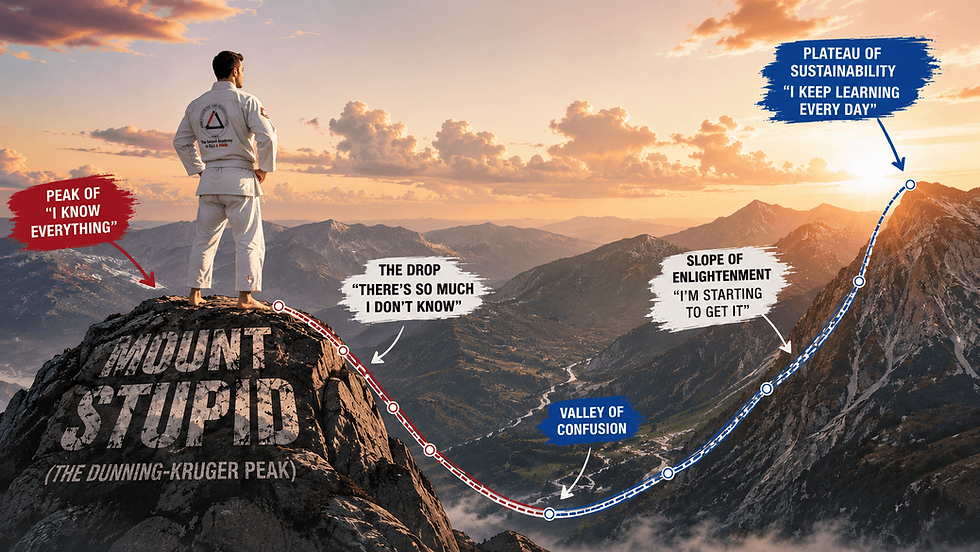
Second, there will be days when you feel you have gone backwards. Last week you held guard beautifully, this week a complete beginner passed you as if you had learned nothing. That is also normal, and it says nothing about your rate of progress. Progress in Brazilian Jiu-Jitsu is not a straight line upward, it is more like a stock market chart. Plenty of zigzags, but the trend rises if you keep showing up.
And third, the most important one: most people who quit, quit at exactly the point where they were about to start enjoying it. The first month is not a representative sample. It is the steepest stretch of the whole journey, and it is also the shortest. In my experience, anyone who gets through the first six weeks significantly increases their chances of staying.

Questions I hear all the time
Am I too old to start Brazilian Jiu-Jitsu?
Almost always the answer is no. I have students who started after 40, after 50, and even in their 60s. Jiu jitsu is built exactly for this, using technique instead of strength, and that makes it one of the most age-friendly martial arts there is. The same principle that let a thin man control a bigger one also helps older students train alongside younger ones, with the pace and the load adjusted. Age alone disqualifies nobody, but it is not a guarantee either, so you start from where you are now, not from where you were at 20.
I am out of shape. Is that a problem?
No. Fitness comes from the training, not before it. You do not need to be in shape to start jiu jitsu, you start jiu jitsu in order to get into shape. In the first few weeks you will get tired quickly, and that is completely normal. The body adapts faster than you think.
Will I get injured?
As in any contact sport, Brazilian Jiu-Jitsu carries a risk of injury. But there are no strikes other than by agreement and everything is controlled, so with responsible partners, graded training and tapping in time, that risk can be reduced substantially. The single most important safety tool is tapping in time, and I wrote about that separately in the guide To Tap or Not to Tap.
How long until it stops being so hard?
It varies from person to person, but for most people something starts to connect after three to six months of regular training. It does not become easy all at once, but it stops feeling like a wall. If you want to understand why you feel like you know less at exactly that stage, read about the Dunning-Kruger effect in BJJ.
Gi or No-Gi to start with?
Both are excellent, and there is no single right answer. If you are genuinely unsure what the difference even is, start from the basics and read the differences between the styles. In practice, most beginners train in both formats and it only helps.
How many times a week should I train for this to start working?
Twice a week is a good starting point, and three times a week already moves you along nicely. But the number matters less than the consistency. It is better to come once a week reliably for a year than five times a week for two weeks and then disappear. The body rewards consistency, not bursts of enthusiasm.
I am not in shape. Is that a problem?
No. Fitness comes from the training, not before it. You do not need to be in shape to start jiu jitsu, you start jiu jitsu in order to get into shape. In the first few weeks you will get tired quickly, and that is completely normal. The body adapts faster than you think.
So yes, the gentle art is hard. And that is precisely the point
The difficulty at the beginning is not a sign that something is wrong. It is a sign that you are learning something real, something that cannot be faked, something that starts hard precisely so that it can later become soft. Everyone training comfortably today started exactly where you are now: on their back, confused, asking where the gentle part is.
Yuval, by the way, stayed. He comes three times a week. He still gets annoyed sometimes, but he stopped asking why it is hard a long time ago. Now he asks different questions, the questions of somebody who is starting to understand. And that is the whole difference.
We coach Brazilian Jiu-Jitsu and MMA in Tel Aviv and Netanya, including a separate women's class. If you want to start Brazilian Jiu-Jitsu in Tel Aviv or Netanya and you are not sure you are "built for it", message me on WhatsApp. We will talk, see whether it fits, and book a trial class. No pressure. The pressure will be waiting for you on the mat, and you will be surprised how quickly you start to enjoy it. And if you live around Tivon, Haifa, Hadera, Tirat Carmel or Modiin, we have branches there too. Get in touch and I will point you to the right one.
Tel Aviv: Yitzhak Sadeh 29 | Netanya: HaTzoran 4
Professor Itay Leibovich, Black Belt, Gracie Jiu Jitsu, the Israeli Academy of Brazilian Jiu-Jitsu and MMA, Tel Aviv and Netanya.

Want to start? Full details on Brazilian Jiu-Jitsu classes in Tel Aviv are on the academy's training page.


Comments