
BJJ Near Me: How to Actually Find a Jiu-Jitsu Academy (And Why Closest Isn't Always Right)

By Professor Itay Leibovich | 3rd Degree Black Belt, Gracie Jiu Jitsu | September 2026 | ~11 min read
11:47 pm. Someone is sitting on the couch, finishing one more UFC choke video, picking up the phone and typing into Google: "BJJ near me".
I know it happens, because the next morning I get the WhatsApp messages. "Hi, I saw you on Google. Do you have anything in my area?" Google understands every spelling of jiu jitsu people throw at it. The question is not how you spell it. The question is what you do with the ten results that pop up.
So let's talk about it seriously. I have been teaching Brazilian Jiu-Jitsu in Tel Aviv for more than 16 years, and I am going to tell you a few things coaches usually prefer not to say out loud. Including the truth about distance, which is a little less flattering than you might expect.
The Moment Everyone Types "Near Me"
Let's admit it: nobody searches for "the best jiu-jitsu academy in Israel". People search for "Jiu Jitsu near me", "martial arts Tel Aviv", "BJJ classes for beginners", "self defence Tel Aviv". The search starts from the most human place there is: I want something, and I want it to be convenient.
And that is completely fine. Really.
Because here is the training world's little secret: the most expensive membership is the one you don't use. Gyms know this better than anyone (their business model is built on it, but that's another blog). A martial arts academy is the exact opposite: it lives on you actually showing up. No attendance, no progress. No progress, no belt. And without the journey, there is nothing.
So when someone asks me "how far is it worth travelling for good training?", I answer with a question: how many times a week will you actually make that trip? Not in week one, when motivation is at its peak. In month four, in winter, after an annoying day at work.
The Uncomfortable Admission: Distance Beats Motivation
Here is something it took me years to say out loud: I have watched talented people leave excellent academies, and not because of the coach, not because of the price, and not because of an injury. Because of the traffic at the entrance to the city.
Motivation is a perishable resource. It is wonderful at the start, and it runs out exactly when the rain begins. What remains after motivation is gone is habit, and habits are built on low friction. A class that is 12 minutes from home or on your way back from work is a class that happens. A class that requires a logistics operation is a class postponed to "next week", and next week, as we all know, is where dreams go to die.
I run a thought experiment with everyone who is torn: imagine two friends starting on the same day. One signs up at the best academy in the region, a 40-minute drive. The other signs up at a good, not perfect, place 10 minutes from home. Fast-forward one year. Which of them is still training? You know the answer, and I know the answer, because I have seen this movie dozens of times. And in jiu-jitsu, whoever is still training after a year has already overtaken everyone.
So when you filter results for brazilian jiu jitsu classes near me, don't feel shallow. You are doing exactly the right calculation. Consistency is the single most important parameter in jiu-jitsu, more than talent, more than fitness, more than age. I wrote about this at length in my guide to Brazilian Jiu-Jitsu after 35, and I will repeat the key line: those who show up, progress. Those who don't, don't.
That was the part where I justify your search. Now comes the but.
But Close Isn't Everything: The Quality Floor
Distance decides whether you get to training. It does not decide what happens to you there.
And some of the things that can happen there are worse than not training at all. An academy without a culture of safety is a place where your body pays the price. A coach without a clear lineage and real knowledge is someone who will teach you technique wrong, and later someone like me will have to spend a year dismantling your habits (it is possible, but it is like renovating an apartment with the tenants still inside). And a group where every sparring round is a world war is a recipe for injury, not for a belt.
So my formula is simple: distance is a filtering criterion, not a selection criterion. First, mark on the map what is genuinely workable for your life, say up to 20-25 minutes door to door. Then, inside that circle, choose on quality alone. If there is only one place inside the circle and it does not clear the bar, widen the circle. A mediocre academy five minutes away is not "a reasonable compromise". It is a waste of the only years in which your body learns fastest.
What is the quality bar? I wrote a whole, very undiplomatic guide about it, How to Choose a BJJ Academy: The Honest Guide, including eight good signs and three red flags. The bottom line: a clear lineage, safety as a supreme value, beginners who get real attention, and an atmosphere you can picture yourself inside two or three times a week for years.

Six Steps: From the Google Search to the Decision
So how do you do it in practice, without wasting two years in the wrong place? Here is the process I would run today, step by step, if I were starting from zero.
Step 1: Search the map properly, not just Google. Open Google Maps and type "Jiu Jitsu" or "BJJ" around your home and around your work. Two circles, not one. Plenty of people miss their best option because it is next to the office rather than next to home. Training on the way home is sometimes the most stable habit there is.
Step 2: Read reviews like a detective, not like a tourist. Don't count stars, look for patterns. If five different reviews mention personal attention for beginners, it is probably real. If someone writes about injuries or an ego-heavy atmosphere, don't dismiss it just because someone else left five stars. And notice who replies to reviews and how. A coach who answers a negative review with respect is telling you something about how he runs the mat.
Step 3: Check who the coach is and what his lineage is. Brazilian Jiu-Jitsu has a thing called lineage. Who gave your coach his black belt, and who gave it to him. A serious academy displays it proudly on its website, because it has nothing to hide. Ours, for example, runs through Royler Gracie directly to Helio Gracie, one of the central figures in the development of the art. If you cannot find anywhere who certified the coach, it is not necessarily fraud, but it is the first question I would ask on the phone. And if the answer starts with a stammer, keep moving. (If you want to understand why this lineage matters, I wrote about what Gracie Jiu-Jitsu is and why one family name changed an entire world.)
Step 4: Check the timetable against your life. Not against the life you wish you had. If you can only train at 7 pm and the academy runs its beginners class in the morning, it is not a match, even if the coach is a world champion. Look for a place with enough suitable classes per week that missing one doesn't wreck the whole week.
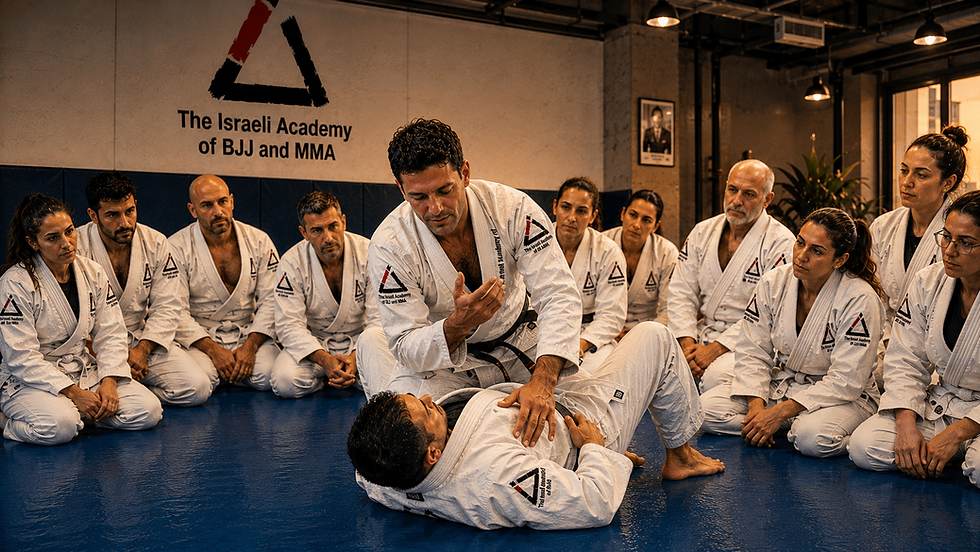
Step 5: Make sure there is a real path for beginners. Your first jiu-jitsu class ever should not look like competition prep. A good academy can tell you exactly what awaits a beginner: what the class looks like, what to wear, what happens in sparring and when sparring even starts. If there is no organised answer to "I'm completely new, what do you do with me?", that is a sign. By the way, I wrote a minute-by-minute guide to your first Brazilian Jiu-Jitsu class, worth reading before you walk into any academy, not just ours.
Step 6: A trial class. Always. Everywhere. Don't buy a membership over the phone, don't buy one from the website, and don't buy one because of a pretty Instagram feed. One hour on the mat is worth more than all the internet research you have done. Which brings us to the part that really matters.
And What Doesn't Matter (Even Though It Looks Like It Does)
Now that we have covered what to check, let's clear a few things off the table that look critical during the search and in practice predict nothing.
The fancy facility. A new gym with flagship-store lighting and a coffee machine is nice. Truly. But jiu-jitsu happens on the mat, between two people, and I have seen luxurious academies with mediocre teaching and modest halls that produce world-class black belts. Watch what happens on the mat, not what happens in the lobby.
The coach's competition titles. A great champion is not necessarily a great teacher, and vice versa. They are two completely different skills. The right question is not "how many medals does he have" but "how many students has he built from zero, and what do they look like today". A teacher is measured by his students, not by his trophy cabinet.
Group size. A huge class looks impressive on Instagram, but for a beginner what matters is how much time and attention you actually receive. Better a class of fifteen with a coach who sees you than a class of fifty where you are still a selfie in the background.
And price, the way most of us think about it. People compare price per month. That is a calculation error. Compare price per class you will actually attend. A cheap membership at a place you visit once a fortnight is the most expensive one in town, and a full membership at a place that pulls you in three times a week is the deal of your life. We keep coming back to the same point: consistency is the real currency, everything else is fees.
The Trial Class: One Hour That Reveals Everything
Carlson Gracie, one of the greatest teachers in the history of the art and the man who built a whole generation of champions in Brazil, said a sentence I quote to every new student: "Always enter like a kitten and leave like a lion. But never enter like a lion and leave like a kitten. Always be humble."
Walk into your trial class exactly like that, like a kitten. Nothing to prove, no comparing yourself to anyone. You came to test the place, not yourself. And here is what to check while you are there:
Watch the beginners, not the advanced students. It is easy to be impressed by a purple belt flying across the mat. But you are not going to be that purple belt this year. Watch how they treat whoever is in their first month. Does he have a drilling partner? Is anyone correcting him? Does he look lost in the corner? That is your future, right there on the mat.
Listen to the sound of the sparring. Jiu-jitsu mats tell a story without words. Healthy sparring sounds like work: breathing, fabric friction, the occasional laugh. Unhealthy sparring sounds like a car crash in slow motion. And if you see experienced students rolling with beginners gently and with control, you have found gold.
Check the ego in the room. Renzo Gracie, one of the most loved and best known members of the family, put it best: "My opponent is my teacher, my ego is my enemy." In a good academy that sentence hangs in the air even if nobody says it. People thank whoever submitted them. They ask questions. They make mistakes out loud. In a lesser academy, every tap is an insult and every class is the world championship final. Run away from there.
And ask yourself one question on the way home: do I want to go back there tomorrow? Not "it was professional", not "the facility is impressive". Do you want to go back tomorrow, yes or no. Your gut already knows the answer.
One more small thing that is actually enormous: notice whether anyone bothered to learn your name. You came once, you are not a customer yet, you are a guest. A place where the coach or the students remember your name after one hour is a place that treats people as people. It sounds simple, but you would be surprised how rare it is, and how well it predicts the treatment you will get in your third year there.
So What Does "Near Me" Actually Mean?
In a busy city, "near me" that actually survives real life is up to about 20 minutes door to door in the evening, parking included (yes, parking counts; whoever circles the block for 25 minutes will not make a 60-minute class).
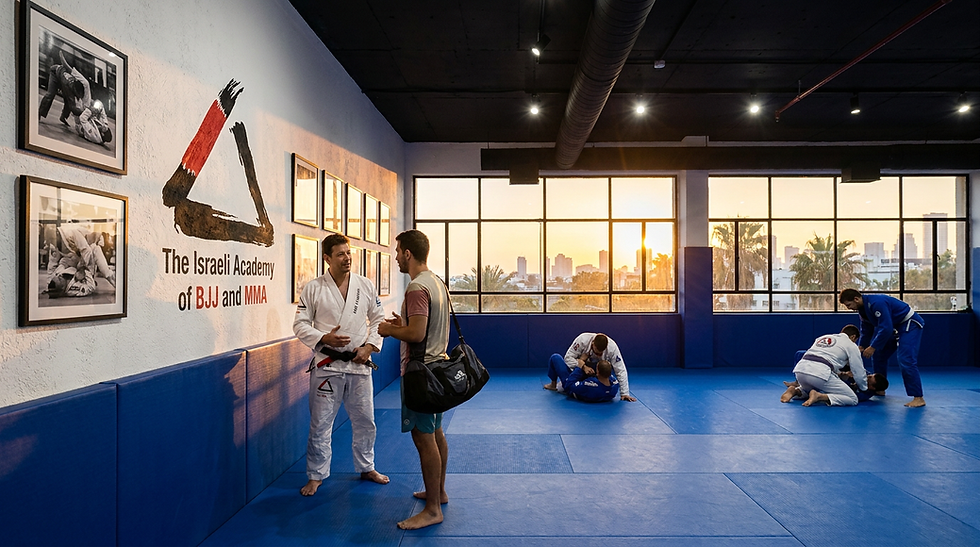
The Israeli Academy of Brazilian Jiu-Jitsu and MMA sits at 29 Yitzhak Sadeh Street in Tel Aviv, a few minutes' walk from the Azrieli complex, on the route half the city already takes on its way home. Search BJJ Tel Aviv or Jiu Jitsu Tel Aviv and you will find us there: adult BJJ classes at every level, a dedicated women's group, MMA training, and kids and teens classes, all under one roof. Alongside Tel Aviv we also have branches in Tivon, Haifa, Hadera, Tirat Carmel, Modi'in and Shoham, so even if you type "BJJ near me" outside the centre, we may be closer than you think.
One more field tip: don't lock onto "near home". Check near work too. If you work in central Tel Aviv and live in the suburbs, an evening class on the way home often beats the traffic, skips the whole "leaving the house again" dilemma, and builds the most stable routine there is. The car is parked anyway, let it be parked next to a mat.
For Her, Not Only for Him
A large share of the searches that reach us come from women, and that is no accident. Self-defence is one of the main reasons women come to jiu-jitsu, alongside fitness, community and confidence. If you are looking for a short self-defence course, it is worth knowing the longer, more systematic path as well. I wrote a full guide: women's self-defence in Tel Aviv, including what students who walked this road themselves told me.
In short: when you are checking out an academy, every rule above applies, plus one more: check whether there is a women's group, and what the atmosphere looks like in the mixed classes. We have both, and you are welcome to come and see for yourself.

Questions I Get on WhatsApp Every Week
How far is it reasonable to travel for jiu-jitsu training?
My rule: up to 20-25 minutes door to door is a distance that holds for years. Beyond that, only if the academy is truly worth it and only if you can be honest with yourself about the month of December. A good place 20 minutes away beats an excellent place 50 minutes away.
Which is better: a nearby academy or a great coach?
Both, and it does not have to be a trade-off. First filter by workable distance, then choose on quality within what remains. If there is no quality inside the circle, widen the circle. On what quality means, there is a whole guide.
How do I know an academy is serious before I even visit?
Three five-minute checks: who the coach is and what his lineage is (it should be written on the website), what Google reviews say about how beginners are treated, and whether there is a clear answer to what awaits a beginner in the first class. A place that passes all three deserves a trial class.
Do I need previous experience or fitness for a trial class?
No and no. Come with sports clothes, water and the humility of a kitten. Everything else is built on the mat, at your pace. Most of the people training with me today arrived with zero background, and some were sure they were "not fit enough to start". I covered that mistake and others in the five mistakes every beginner makes.
I'm 40 / 45. Is this still relevant for me?
Relevant, and sometimes more so. In adult BJJ classes the emphasis is on technique, control and wisdom, not athleticism. I have students who started Brazilian Jiu-Jitsu after 40 and they are among the most consistent people on the mat. The full guide: Brazilian Jiu-Jitsu after 35.
How much does training cost?
It depends on the track and how often you train, and I am not going to throw out numbers that will be outdated in six months. Message us on WhatsApp and you will get a direct answer, including booking a trial class.
I found two academies at the same distance. How do I decide?
A trial class at both, in the same week if possible. After two sessions the comparison will be clearer than words can make it: where you got more attention, where the sparring looked healthier, and where you feel like returning tomorrow. If it is still hard to decide after both, that is a sign both are good, and then any choice is genuinely right.
Can I just come and watch a class first?
You can, but I will tell you the truth: watching gives you maybe ten per cent of the picture. Jiu-jitsu is a sport of feel, not of spectating, and from the side everything looks either too scary or too boring. Come to a trial class, do the warm-up, feel the mat. Your body will tell you within an hour what your eyes would not tell you in a month.
What is the difference between jiu-jitsu and MMA? And where can I train both?
MMA is a combined sport that includes striking, takedowns and ground work; jiu-jitsu is the art of the ground and of control. At our academy in Tel Aviv you can train both under one roof, and many students combine them. If you are torn about which suits you, the best way to decide is to try both on the mat.
Bottom Line: Start Close, Stay for the Level
The "BJJ near me" search is an excellent starting point, because it measures the thing that actually determines whether you will stick with it. But it is only a filter. The decision itself is made on the mat, at a trial class, with your eyes and your gut.
And if your circle on the map happens to include 29 Yitzhak Sadeh Street in Tel Aviv, I invite you to come and test us with exactly the healthy suspicion I described here. Watch our beginners, listen to the sound of the mat, ask me about the lineage (I will be delighted, it is my favourite subject after Position Before Submission).
Message us on WhatsApp to book a trial class, and come find out how close you really are to a road that lasts for years.
See you on the mat,
Professor Itay Leibovich, The Israeli Academy of Brazilian Jiu-Jitsu and MMA, 29 Yitzhak Sadeh St., Tel Aviv


Comments