
Brazilian Jiu-Jitsu After 35: A Guide for Anyone Convinced They've Missed the Train

Your body creaks a little in the morning, your calendar is packed, and the mirror gently reminds you it's been a few years since the army. And yet, it turns out, right now is a great age to step onto the mats for the first time. Let's break down why.
By: Professor Itay Leibovich | 3rd Degree Black Belt | Gracie Jiu Jitsu | August 2026 | ~12 min read

"Be honest with me. I'm 43, a father of three, and the last time I trained seriously was in the army. Is there any point in me starting, or am I about to make a fool of myself in front of twenty-year-old kids?"
I got that message on WhatsApp about a year ago, from a man we'll call Guy. I remember it word for word because it's phrased especially well, but there's nothing special about its content: I get some version of it every single week. The age changes, the number of kids changes, the excuse changes. The question stays the same, and behind it always hides the same quiet assumption: that martial arts is a young man's game, and whoever didn't start on time has missed the train.
So here's the answer I gave Guy, the same answer I give every day and will give you now, after years on the mats and thousands of students who've passed through these choking hands of mine: the train hasn't left. In Brazilian Jiu-Jitsu, the train hasn't even reached your station yet.
And so you don't think this is a sales pitch from a coach who wants another membership, I'm going to dedicate the rest of this blog to proof. We'll go through the myth and where it came from, what actually happens to your body after 35, the surprising advantages you have over the twenty-year-old on the mat, and what smart training looks like at this age. At the end you can decide for yourself whether the story you've been telling yourself still holds water.
Oh, and Guy? He still trains with us today. Not the most flexible in the group, not the fastest. Probably the most consistent. In a minute you'll understand why that's worth more.
Where the "Too Old" Myth Comes From
Let's be honest: the picture in your head when you think about martial arts is not you. It's a 22-year-old with a six-pack doing backflips on Instagram, or an MMA fighter in peak condition walking into the cage. Our culture sells fighting as a product of youth, and that makes marketing sense: young people look better in slow motion.
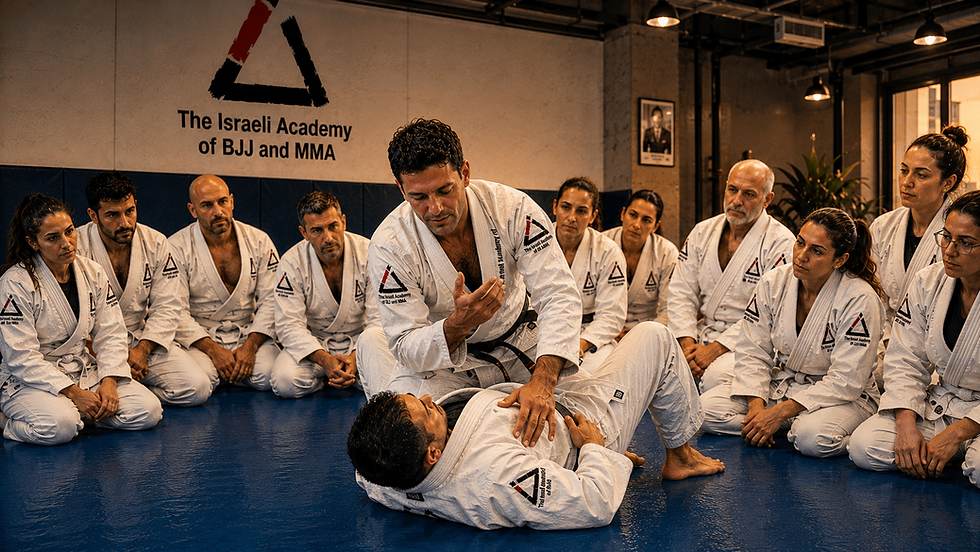
But let's run a simple experiment. Walk into an average evening class at our academy in Tel Aviv and look at who's actually on the mats. You'll find a 38-year-old lawyer rolling with a 24-year-old student. A 45-year-old dad who started because his son fell in love with jiu-jitsu in the kids' group, and after two months of watching from the bench said "actually, why not me". A 36-year-old product manager. A 52-year-old doctor. That cross-section is not an anomaly of our academy; it looks like that in every serious BJJ academy in the world. The backbone of the training community is exactly the people who were sure, each in their turn, that they had "come too late".
And there's a structural reason for it, one worth understanding. A sport like gymnastics or competitive swimming really does close its doors at a young age, because it's built on attributes that peak early: explosive speed, extreme flexibility, reaction time. But Brazilian Jiu-Jitsu was built from the ground up on the opposite principle. The system was developed by the Gracie family in Brazil around one idea: leverage, timing and position beat raw strength. Helio Gracie, one of the central figures in the development of Gracie Jiu Jitsu, was exactly the man the "athletic" systems rejected: skinny, physically weak, no natural gifts. He didn't beat that problem with strength. He went around it with technique, and that is precisely the inheritance he left to everyone who starts without the attributes of an Olympic athlete. He himself, by the way, kept putting on a Gi and stepping onto the mats well into the tenth decade of his life. Do with that fact what you will, the next time you tell yourself that 40 is the end of the road.
His famous line sums up this philosophy better than anything I could write:
"Always assume that your opponent is going to be bigger, stronger and faster than you; so that you learn to rely on technique, timing and leverage rather than brute strength."
Now read that sentence again, slowly. A system whose entire foundation is "assume you're at a physical disadvantage and win anyway" is not a system that closes the door on someone who's lost a bit of speed. It's a system that was built for him.
Straight Talk: What Actually Happens to Your Body After 35
I'm not going to sell you fairy tales, because this whole blog is built on honesty, and also because you'll discover the truth yourself after three sessions. So here it is upfront.
Yes, recovery is slower. What disappeared after one night's sleep at 25 stays with you until Wednesday at 45. Yes, flexibility has dropped, especially if you and your office chair have spent the last decade and a half together. And yes, a contact sport is a contact sport: like in any such discipline there is injury risk, and anyone promising you zero injuries is simply lying to your face. Controlled training, responsible partners and tapping on time reduce the risk dramatically, but they don't erase it. I wrote about this at length in the blog on injury prevention, and it's required reading for every beginner, at any age.
Those are the facts. Now let's look at what they actually mean for your start, because this is where most people get the math wrong.
The mistake is comparing yourself to who you were at 20. That comparison is meaningless, because that person isn't standing across from you on the mat. Who will be standing across from you is people your age and in your condition, in a system built so that technique beats physical attributes. The only relevant question is not "am I as fast as I used to be", but "can this body, as it is today, learn a new skill, get stronger and improve". And the boring scientific answer is yes, unequivocally. The body adapts to load at any age. More slowly? Yes. But it adapts, and a 45-year-old after a year of jiu-jitsu is in a completely different place, physically and mentally, from where he started.
And there's another point almost nobody says out loud: in jiu-jitsu, unlike striking sports, the training itself is not built on absorbing blows to the head or body. Most of the training happens on the ground, under control, with a built-in stopping mechanism: the tap. You feel caught, you tap your partner, you're released, you keep training. That mechanism is exactly what allows people with a job in the morning and a nine o'clock meeting to train against real resistance, several times a week, year after year. Compare that to any discipline where "really training" means taking shots to the head, and you'll understand why the adult groups in BJJ just keep growing.
In the biggest competitions in the world, by the way, there are separate masters divisions by age, starting at 30 and climbing past 60. Thousands of practitioners compete in them every year. The jiu-jitsu world didn't build those divisions out of politeness. It built them because there are people to fill them.

Your Unfair Advantages Over the Twenty-Year-Old
So far I've been defending. Now let's attack, because you have several advantages on the mat that twenty-year-olds simply don't have, and I watch them in action every week.
The first advantage is the ego, or more precisely what's left of it. A 22-year-old walks into his first sparring round with something to prove, and from day one tries to beat everyone in front of him with strength. The result: he gets exhausted, gets injured, and learns slowly, because you can't learn when every roll is a fight for survival. A 45-year-old has already eaten enough slices of humble pie in life: in his career, in parenting, in all the places where life teaches us we're not the center of the universe. He can listen, tap on time, ask questions. And because of that, and this is the part that surprises everyone, he often progresses faster than the athletic youngster who refuses to learn.
The second advantage is that this game is first and foremost a thinking game. Jiu-jitsu gets called "human chess" often enough for it to sound like a cliché, but the cliché happens to be true: every position is a state with constraints, every movement opens some options and closes others, and whoever thinks two moves ahead beats whoever is merely stronger. People who've managed projects, raised children and solved complex problems for twenty years arrive with thinking muscles developed exactly where this game is decided. Your strength isn't in a leg that kicks high. It's in a head that already knows how to learn complex systems.
And the third advantage, the most important one: consistency. The 22-year-old has infinite time and motivation that comes in waves - a peak month, then two months of vanishing. You have two hours a week carved in stone, between work and family, and precisely because they're precious, you show up. Two years of twice a week, consistently, beat almost any burst of youthful enthusiasm. Ask Guy from the opening: he never beat anyone with his athleticism. He simply never stopped showing up, and that, it turns out, is the real secret technique of the higher belts.
If you need inspiration from the wider world: Anthony Bourdain, the late chef and television host, started training jiu-jitsu at 58, after a lifetime of kitchens, cigarettes and flights. About two years later he received his blue belt, and he trained in every city he traveled to for filming. If a 58-year-old with the busiest shooting schedule on television found his way to the mats, the assumption that you're "too old" at 38 starts to sound a little less like a fact and a little more like an excuse.
What Smart Training at 40 Looks Like (Hint: Not Like at 20)
This is the practical part, so pay attention, because here lies the difference between someone who lasts years and someone who breaks after two months.
Rule one: you're running long distance. Your goal is not to win today's training session, but to still be on the mats five years from now. In practice that means tapping early and easily (the tap is a learning tool, not an admission of failure), skipping the crazy rolls when your body says enough, and understanding that one session you missed because you were wiped out is a mature decision, not weakness.
Rule two: choose your partners wisely. A good academy has a culture of controlled rolling, and the veterans know how to match their intensity to their partner. Part of my job, and my coaching team's job, in Tel Aviv and in Netanya, is exactly to make sure the 45-year-old beginner doesn't find himself in his first sparring round facing a 19-year-old energy bomb who hasn't yet learned to control herself. That, by the way, is one of the things worth checking when you choose where to train, and I wrote a complete guide to choosing an academy about it.
Rule three: warm-up and preparation are not a recommendation. At 25 you can jump onto a cold mat and survive. At 45, the ten minutes of warm-up are the difference between a full season of training and a month at the physiotherapist. Same goes for sleep and basic strength work on the side. None of this requires becoming a professional athlete. It requires treating your body like a car you intend to keep for another twenty years.
And rule four, which is really the only rule: leave the comparisons at home. There's a 24-year-old in the group progressing faster than you? Good for him. Your path is your own. In jiu-jitsu there's a saying that repeats in every academy in the world: the black belt is a white belt who never gave up. Nowhere does it say how long it took, and by the time you reach the age where most of your friends are wheezing up a flight of stairs, nobody will care what age you started. And statistically, the young guy quit long ago. If he ever makes a comeback one day, odds are good you'll beat him twice over.

What It Gives You Off the Mats (The Real Reason People Stay)
Now let's talk about what actually happens after a few months, because nobody stays for years because of a sophisticated choke technique.
Ask any adult student of ours what changed in his life, and you'll get different versions of the same answer: the hour and a half on the mats is the only hour and a half in the day when the phone is in the bag, the head is quiet, and nobody wants anything from you except to try to take your arm. There's something almost meditative about an activity that demands such total concentration: you cannot think about the email from your boss while someone is trying to pass your guard. The worries simply don't come onto the mat, because there's no room for them.
Beyond the peace of mind there's what may be the biggest gain of all at this age: the quiet confidence of someone who knows how to handle discomfort. Ryron Gracie, Helio's grandson and one of the senior teachers of Gracie Jiu Jitsu in the world, put it like this:
"Once you learn to remain calm under the stressful circumstances of a fight, you will have no trouble remaining calm under the stressful circumstances of life."
It sounds nice on paper. In practice it feels like this: after half a year of learning to breathe while someone heavier than you sits on you, suddenly the stressful quarterly meeting is not such a big deal. The traffic jam at the entrance to Tel Aviv is not such a big deal. A crisis at home gets its proper proportions. Not because you've become indifferent, but because your body has learned, at the most basic physical level, that discomfort is a state you can function inside. No management course and no mindfulness workshop teaches it like that.
And there's the simple matter of self-defense. Not because you'll be attacked on the street tomorrow - odds are you won't, and I wrote a whole blog about what actually works in a real confrontation. But because of the quiet that comes from knowing that if something does happen, your body knows what to do. For a dad or mom walking down the street with their kids, that knowledge is worth more than any six-pack.
And the community. I know it sounds like a line from a community-center brochure, but give me a second: at 40 it's hard to make new friends. Genuinely hard. The army friendships have scattered, work friendships are always a bit political, and at the kids' preschool the conversation is mostly about preschools. Then you find yourself grinding it out two or three times a week with the same people on the same mat, and something happens that's hard to explain to anyone who hasn't lived it: people who struggle together become friends at an accelerated pace. Some of the best friendships formed at our academy started with two awkward adults trying to learn together how to escape from mount.
How to Actually Start, Step by Step
You've got five minutes of reading left, so let's make this practical.
Step one: stop waiting to get in shape. "I'll start after I lose a bit of weight / get back to running / build some strength at the gym" is the sentence I've heard most often in my career, and it's a trap: the fitness for jiu-jitsu is built from the training itself. Nobody arrives ready, and everybody gasps through the first month, including athletes from other sports. The training will do the work, at your pace.
Step two: come see with your own eyes. One trial class is worth a thousand blogs (yes, including this one). Come, look at the group, check who the people are, feel the atmosphere. I wrote a detailed guide on exactly what happens in your first class, including what to wear and what not to do, so you arrive relaxed.
Step three: commit to two months, not to one session. The first class confuses everyone, at any age: new terms, movements your body doesn't know, and a feeling that everyone understands something you don't. That is completely normal, and it passes. Judging jiu-jitsu by one session is like judging a foreign language by one lesson. Give it eight weeks of twice a week, then decide. I've yet to meet anyone who lasted two months and didn't continue to a third.
And what about us? At the Israeli Academy for Brazilian Jiu-Jitsu and MMA, in Tel Aviv and in Netanya, people of all ages train with us, and the adult groups are part of the heart of the academy. Classes are built so that everyone works at the intensity that suits them, the coaching team personally accompanies every beginner, and for women who prefer to start in a separate environment we run a women's group in Tel Aviv. We're not the only academy in Israel, but if you're looking for a place that treats a 45-year-old student as a long-term student and not as another membership, you should get to know us.

FAQ: Starting Brazilian Jiu-Jitsu After 35
I'm 45 and I've never trained in martial arts. Is BJJ really for me?
Yes, and you're far from being an exception: people who start in their late thirties and forties are a large part of every serious BJJ academy, here and worldwide. The system is built on technique and leverage rather than athleticism, the training is gradual, and nobody expects you to know anything on day one. The only thing genuinely required is patience and persistence, and in that, as I wrote above, adults actually have the advantage.
Do I need to be in shape before I start Brazilian Jiu-Jitsu?
No, and that's the most common trap. The fitness for rolling is built from rolling itself, and there's no way to "prepare" for it at the gym. Everybody gasps through the first month; that's part of the deal. Start where you are, and your body will do its adapting at its own pace. After six months you'll look back and won't believe where you were.
I have a sensitive back and knees. Is BJJ dangerous for me?
That's a question for a coach face to face, and sometimes for a doctor too, and I take it seriously every time it comes up. In general: jiu-jitsu is a contact sport and carries injury risk like any contact sport, but the training is exceptionally adaptable. Students with back, knee and shoulder limitations have trained with us for years, with adjustments: exercise selection, graduated intensity, and responsible partners. Tell the coach about your limitation on day one, and he'll know how to build your path.
How many BJJ sessions a week make sense after 35?
Twice a week is the golden number for an adult beginner: enough to make noticeable progress, moderate enough for the body to recover between sessions. Some move up to three after half a year, some stay at twice a week for years, and both keep progressing. Consistency beats volume, always. Twice a week for a year is better than five times a week for a month and a half.
Will I be training against 20-year-olds? Won't they tear me apart?
In an academy with the right culture, no. Rolls are consensual and intensity-matched, the coach pairs partners, and the veterans, even the young ones, know how to roll with an older beginner in a way that teaches him instead of crushing him. The surprising truth is that after a few months you'll find you actually enjoy rolling with the young ones: they bring pace, you bring a head, and both sides learn. And if you've seen an academy somewhere where beginners get crushed with no supervision, that's a red flag about the academy, not about your age.
What about women starting BJJ after 35?
Everything in this blog applies to women exactly as it does to men, and sometimes even more: this system was built from the ground up for the person who is smaller and weaker than the opponent, and that is exactly where women gain the most from it, both as self-defense and as day-to-day confidence. At our Tel Aviv academy we run a dedicated women's group where women of all ages train, alongside the option of training in the mixed groups. The door is open on both tracks.

Let's Wrap This Up
Back to Guy's message from the opening: "Is there any point in me starting, or am I about to make a fool of myself?"
Here's what I've learned after years on the mats: nobody makes a fool of himself when he starts something hard at an age when most people have already stopped starting things. The exact opposite. In the jiu-jitsu community there is enormous respect precisely for those who arrive late, because everyone on the mat knows exactly how much courage it takes to stand at the side of the room on day one, at 43, and say "I know nothing, teach me".
The train hasn't left. It stops at your station every day there's a class, and that happens with us almost every day, in Tel Aviv and in Netanya. The best age to start training is five. The second-best age to start is the age you are today.
So if this blog moved something in you, don't let it cool down. Message me on WhatsApp, tell me how old you are and what worries you, and we'll set you up with a trial class. No commitment, no drama. The worst that can happen: you'll discover it's not for you, and go home with a story. The best that can happen: in ten years you'll tell everyone that the best thing you did in your fifth decade started with one WhatsApp message.
Tel Aviv: Yitzhak Sadeh 29 | Netanya: HaZoran 4
You can see the full training schedule here.
Professor Itay Leibovich | 3rd degree Black Belt, Gracie Jiu Jitsu | The Israeli Academy for Brazilian Jiu-Jitsu and MMA


Comments