
Kids Martial Arts Classes: Jiu Jitsu, MMA or Self Defense? A Parents' Guide

By: Prof. Itay Leibovich | 3rd Degree Black Belt, Gracie Jiu Jitsu | November 2026 | ~14 min read
"So what does he need, karate, MMA or jiu jitsu?"
A father asked me this on the phone, in the voice of someone who had already asked the same question in three parent WhatsApp groups and received seven answers. (He is a composite character, for illustration. But every coach who teaches kids knows this conversation by heart.) His son is eight, they live in the Krayot north of Haifa, and he asked me for one thing only: to tell him what is best.
I told him what I will tell you: there is no "best". There is "best suited". And unfortunately, the difference between the two is exactly what nobody explains to parents before they pay for a full year up front.
This guide is for parents facing that decision right now: which kids martial arts class to choose, how jiu jitsu for kids, MMA for kids and self defense for kids differ, what age to start, and what to check at a trial class so you do not get it wrong. At the end you will find the practical details: where kids and teens train with us in Haifa, Tirat Carmel and Hadera. (And throughout this post, "kid" means boys and girls alike.)
Three Questions Every Parent Asks, and One They Forget

When parents call, they almost always ask three questions, in this order:
Is it safe?
Will it help my child defend themselves?
How much does it cost, and when are classes?
These are all good questions. But the most important one almost never gets asked: will this child want to come back next week?
Here is the truth nobody likes to hear: the best method in the world is worth nothing if the kid quits after a month. A "less perfect" method that the kid falls in love with and sticks to for three years will give more confidence, more fitness and more tools than any shiny class they abandoned.
I have seen this again and again and again in 36 years on the mat. The difference between a kid who changes and a kid who does not is not talent. It is time on the mat. So everything here points to one question: how do you choose a martial arts class your specific child will stick with?
Jiu Jitsu, MMA, Self Defense: What Is the Difference for a Child?
To parents, these three names sound like the same thing in different wrapping. They are not. The main difference is not the uniform. It is what happens to your child's body during class.
Jiu Jitsu for Kids: Wrestling Without Strikes

Brazilian Jiu Jitsu (BJJ) is a martial art of ground work and control. There are no punches and no kicks. Kids learn to take someone down without hurting them, to control someone without causing pain, to escape from underneath, and to end a conflict without anyone getting hit in the face.
To me, this is the greatest advantage of jiu jitsu for kids: a child can train at full intensity, against another child who is truly resisting, in almost every class, without anyone hitting them in the head. That is how you really learn. Not against air, not against a pad, but against a person who will not cooperate.
With younger kids, most of the class looks like play. Control games, "catch the back" games, balance games. Parents see kids rolling around and laughing. What they do not see is that each of those games is a drill in fundamentals, timing and self-control.
MMA for Kids: This Is Where You Ask Questions
MMA (mixed martial arts) combines wrestling, jiu jitsu, punches and kicks. For adults it is a fascinating sport, and I love it (I wrote about the difference between MMA and jiu jitsu in a separate post). For kids, the question is not "MMA, yes or no". The question is how the class is built.
And here I am not the authority. In 2016, the American Academy of Pediatrics (AAP) published a clinical report on children and teens in martial arts (Pediatrics, 2016). The report says martial arts can give kids intense physical activity that improves overall fitness. It also separates technical practice without contact, where the risk is relatively low, from full-contact sparring and competition, where the risk is higher. And it explicitly lists blows to the head, as well as choking and submission moves, among the riskier activities.
In other words, pediatricians are not saying "do not send your kids to martial arts". They are saying: check exactly what happens in the class. And for a child, blows to the head are the first thing to ask about.
So if your child wants MMA (and for some kids, that world simply calls to them), the questions for the coach are: Are there blows to the head in class? From what age is there contact sparring? How is the move from hitting pads to contact with another kid graded? A good coach will answer without getting defensive. A coach who gets annoyed by the question has answered a different question for you.
What About the Chokes in Jiu Jitsu?
A fair question, since the same report also mentions choking and submission moves. My answer: in jiu jitsu for kids the emphasis is on position and control, not submissions. Our principle is position before submission even with adults, all the more so with kids. The bodies that run kids' jiu jitsu competitions ban, at younger ages, a list of techniques allowed for adults.
And when a child does learn a submission, the first thing they learn is to tap in time and to let go at once when a partner taps. I wrote about this in to tap or not to tap: tapping is not humiliation. It is the tool that lets you train hard without getting hurt. A child who learned that at eight has learned something many adults have not learned at forty.
Self Defense Classes for Kids: What You Actually Get
"Self defense for kids" is not a method. It is a goal. Behind that name could be a jiu jitsu class, a Krav Maga class, a three-session workshop, or someone who decided to open a course last week.
The way to check is to ask: what will my child do in class? If the answer is mostly practicing scenarios against air, without ever facing someone who truly resists, your child will learn moves, but will not necessarily learn to use them when someone bigger really grabs them.
With us, self defense for kids runs through Gracie Jiu Jitsu. The logic is simple: most conflicts between kids at school are not a tidy fistfight. They are a grab, a shove, a headlock, a fall to the floor. And that is exactly where jiu jitsu works. I wrote about this at length, including the research, in my post on Gracie Jiu Jitsu for kids and bullying.
The Gracie family itself built a whole program around this. Rener Gracie, grandson of Helio Gracie and one of the most influential teachers in the jiu jitsu world, developed Gracie Bullyproof with his brother Ryron, a program that teaches kids verbal and physical tools for dealing with bullying, through games. And there is a line attributed to Rener that I love quoting to parents:
"Learn Jiu Jitsu so that when a giant walks by, you don't think to yourself oh no, you think to yourself how interesting!" (Attributed to Rener Gracie)
That is the heart of self defense for kids. Not that your child will beat everyone. That your child will stop being afraid of everyone.
What Age to Start, and What Suits Each Age
Every club sets its own ages, and at each branch the groups are built a little differently. So here is the general direction, and in the end you always ask the coach at the branch.
Ages 4-6: Play, Movement, Boundaries
At this age a child does not learn "techniques". They learn to listen, to wait their turn, to fall without panicking, and to roll without crying. And that is a lot. A good class for this age looks like a playground with rules, and a good coach for this age is first of all a kindergarten teacher with a belt.
Ages 7-10: The Jiu Jitsu Age

To me, this is the best age to start Brazilian Jiu Jitsu. Kids already understand instructions, can hold a drill for a few minutes, and enjoy competing. On the other hand, they are not yet embarrassed to roll on the floor with another kid. This is where the base, the escapes from underneath, and the confidence are built.
Ages 11-14: Confidence, Friends, and Sometimes Hormones
At this age motivation changes. Kids come because a friend brought them, because someone was bothering them, or because they want to be strong. It is also the age when some kids start getting interested in MMA and striking. If that is the case, this is the time for the questions above about contact and blows to the head.
Teens: From Here It Is Almost Adults
A teen of 15-17 can train at an intensity close to adults, with supervision. Many of them arrive with no background at all, and that is perfectly fine. It is never too late to start, and never too early either, as long as the class fits the age.
By Personality: Not Every Kid Needs the Same Class
Age is half the picture. The other half is who the child is.
The shy kid. Parents usually worry that he is "not built for this". Sometimes he is the one who gains the most. In jiu jitsu there is no need to shout, hit or show aggression. You need to think, hold your position and persist. Quiet kids often discover they are very good at it, and from there the confidence starts to leak into the classroom.
The energetic kid. He needs an outlet. Jiu jitsu gives him a legitimate one, with clear limits. A kid allowed to wrestle with all his strength against another kid, with rules and a coach, has less need to test the limits at recess.
The kid who has already hit someone. Parents worry that a martial art "will teach him to hit better". In practice, a good martial art teaches the opposite. A child who knows he can control someone without hurting them stops feeling the need to prove it.
Helio Gracie, one of the central figures in the development of Gracie Jiu Jitsu, said it better than I can:
"You should never have a power, in any area, with the purpose of harming someone." (Attributed to Helio Gracie)
That is the test for any kids martial arts class: does it teach power, or does it teach what to do with power?
Girls: Self Defense for Teen Girls, and What Happens When They Discover They Can
Girls train jiu jitsu from a young age, sometimes in the same group as the boys and sometimes in a separate one. In jiu jitsu, technique, leverage and timing matter more than strength, so a ten-year-old girl who has trained for a year can control a bigger boy who has not. The moment she discovers this for the first time changes something. I have seen it for years in our women's group in Tel Aviv. With teen girls, that moment simply comes earlier.
Eran Oknin runs a dedicated teen girls group in Tirat Carmel. For parents of a girl who is hesitating, this is often the easiest way to start: training with girls her own age, at their own pace.

The Trial Class: What to Check From the Bench
You make the real decision at the trial class. Not on the website, not on the phone, and not in the parent WhatsApp group. Here is what I would watch if I were sitting on the bench beside the mat:
Does the coach know the kids' names? Not all of them in the first class, but most. A coach who knows each child by name sees each child.
How many kids are there per adult? When a coach is alone with too big a group, he supervises and does not teach.
What happens when a kid cries? It will happen. The question is whether the coach stops, calms and returns the kid, or carries on as if nothing happened.
Are there blows to the head? In jiu jitsu there should not be. In a class that includes striking, ask from what age and with how much contact.
How are kids matched up? By age, height, weight and experience. Sometimes a six-year-old will face a ten-year-old. What matters is that the coach knows who to match with whom (for example, a responsible ten-year-old or a gifted six-year-old).
Are the kids laughing? If nobody is laughing in a kids class, something is wrong.
Are the rules clear? When to start, when to stop, how to let go when someone taps. Kids like rules more than they admit.
What does your child say in the car? This is the most important check of all. If the question is "when is the next class?", you have found it.
One more thing: do not be shy about asking the coach about their experience with kids. Coaching adults and coaching kids are two different professions. A black belt does not automatically make someone a good teacher for six-year-olds. And if you want a wider view on choosing a club, I wrote about how to choose a jiu jitsu academy.
Safety: What Is Reasonable to Expect, and What Is Not
I will not tell you jiu jitsu is a sport without injuries. Like any contact sport, it carries risk. What reduces that risk significantly is controlled training, suitable partners, a supervising coach, and kids who learn to tap in time and let go at once. This does not eliminate the risk, but it is the difference between a class that manages it and a class that hopes for the best.
A few things parents can do themselves: make sure your child arrives fed and hydrated, tell the coach about any medical limitation, and pay attention if your child complains of pain that keeps coming back. There is much more on this in my post on preventing jiu jitsu injuries, written for adults but mostly true for kids too.

How Many Times a Week, and How Long Until You See a Change
Once a week is a good start for a young child, and lets you check whether they enjoy it without overloading the family schedule. Twice a week is the pace at which most kids really start to progress, because they remember what they learned last time. Beyond that, it is a matter of love, not of a program.
And the change? Fitness shows up relatively fast. Coordination, falling correctly and body control show up after a few months. Confidence is the last thing to arrive, and the first thing parents notice. It does not come in a day. It comes on the day a child discovers, in the middle of sparring, that they do not panic when someone bigger is on top of them. Because they have already been there twenty times, and got out.
And there is one more thing parents keep telling our coaches, which nobody promised them: a child who trains Brazilian Jiu Jitsu learns to lose. They tap ten times in a class, get up, shake hands and start again. A child who learned to lose without breaking the world will also learn to succeed without breaking it. That lesson is hard to teach in a classroom and very easy to learn on a mat.
Where Kids and Teens Train: Haifa, Tirat Carmel, Hadera
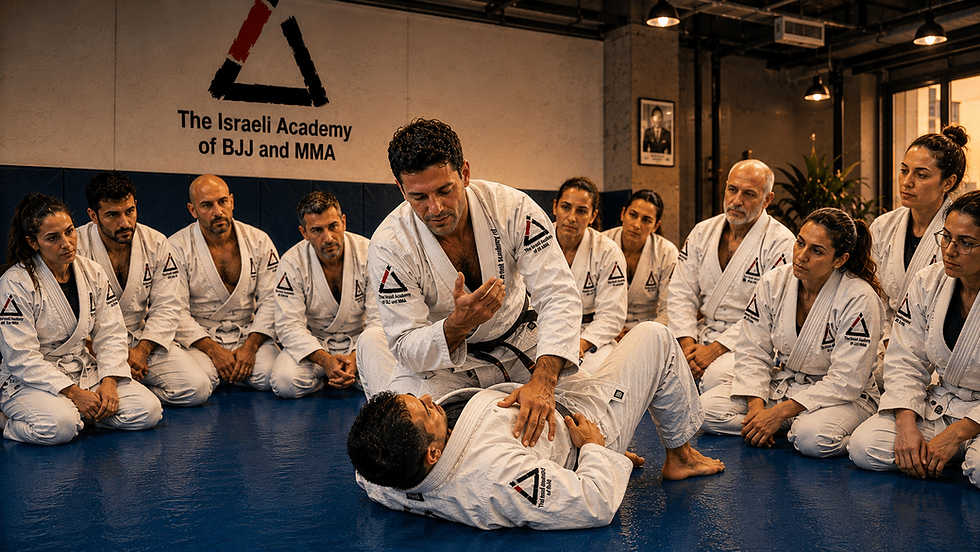
The Israeli Academy of Brazilian Jiu Jitsu and MMA is a network of coaches who grew up and trained together. Our kids and teen groups in the north are led by three coaches, each at his own branch:
Jiu Jitsu for Kids in Haifa: Timor Ozlner
Timor is one of the first Brazilian Jiu Jitsu practitioners in Israel, training since 2002, a black belt since 2013, and coaching in Haifa since 2014. The Haifa branch, at Oren 25, teaches jiu jitsu only, to kids and adults. If you are looking for martial arts in Haifa for a child who likes to wrestle rather than hit, this is a natural address.
Tirat Carmel: Eran Oknin, Kids, Teens and Teen Girls
Eran holds a bachelor's degree in physical education and sport from the Wingate Institute, has coached since 2014, and has rich experience training kids and teens. The Tirat Carmel branch, at Etzel 38, is about ten minutes from Haifa and has kids and teen groups and a teen girls group.
Hadera: Rami Abuhav
Rami holds a bachelor's degree in physical education, is a black belt in several martial arts, and has wide experience in boxing and wrestling. The Hadera branch, at Herbert Samuel corner of HaGiborim, has kids and adult groups, along with MMA and striking. For residents of Hadera, Pardes Hanna and the area, this is the nearest branch.
Rami also coaches in Kiryat Tivon (HaShkedim 1). There are no kids groups there, and teens train together with adults.
The simplest way to get the exact schedule and ages at each branch is by message. Send us a WhatsApp with your child's age and your city, and we will connect you with the right coach. All branches are also listed on our branches page.
FAQ: Martial Arts Classes for Kids
What is the difference between jiu jitsu for kids and MMA for kids?
Jiu jitsu for kids is wrestling and control on the ground, without punches or kicks. MMA combines wrestling with punches and kicks. For kids, the key question in MMA is whether there are blows to the head and from what age there is contact sparring. The American Academy of Pediatrics lists blows to the head among the riskier activities for children.
What age can a child start jiu jitsu?
Some clubs accept kids from age 4, but ages vary from branch to branch. At ages 4-6 the class is mostly play and movement. In my view, ages 7-10 are an excellent time to start Brazilian Jiu Jitsu. It is best to check the exact ages at each branch with the coach.
Will jiu jitsu make my child more violent?
Usually the opposite. Jiu jitsu teaches kids to control someone without hurting them, with clear rules and a supervising coach. A child who knows they are capable has less need to prove it. Still, if you have a specific concern, tell the coach in advance.
Do self defense classes for kids help against bullying?
A good class gives a child two things: confidence that makes them look less like a target, and tools for when someone grabs them or takes them down. Programs like Gracie Bullyproof also include verbal tools for setting boundaries. It does not replace the school's handling of the problem, but it gives a child something nobody can take away.
Can girls train jiu jitsu?
Absolutely. In jiu jitsu, technique and leverage matter more than strength, and girls progress very well. Tirat Carmel has a dedicated teen girls group, led by Eran Oknin.
Where can kids train jiu jitsu in northern Israel?
The academy has kids groups in Haifa (Timor Ozlner, Oren 25), Tirat Carmel (Eran Oknin, Etzel 38, including teens and teen girls) and Hadera (Rami Abuhav, Herbert Samuel corner of HaGiborim). Kiryat Tivon has no kids groups, and teens train together with adults.
What should I check at a kids trial class?
That the coach knows the kids by name, that there are enough adults per child, that kids are matched by age and size, that there are clear rules for stopping and tapping, and, if there is striking, from what age and with how much contact. Most important of all: what your child says in the car on the way home.
Bottom Line: The Right Class Is the One Your Child Comes Back To
So what did I tell the father from the Krayot?
That his son does not need karate, MMA or jiu jitsu. He needs a coach who sees him, a group where he has fun, and a class where nobody hits him in the head at eight years old. And that for me, the best way to get all of this is jiu jitsu. But the real decision will be made in the car, after the trial class.
Jiu jitsu, BJJ, Brazilian Jiu Jitsu, call it what you like. What matters is what happens on the mat: a child who walks in worried and walks out a little taller.
Want to come to a trial class with your son or daughter? Send us a WhatsApp message with their age and your city, and we will connect you with a coach in Haifa, Tirat Carmel or Hadera.
See you on the mat,
Itay
Prof. Itay Leibovich | 3rd Degree Black Belt, Gracie Jiu Jitsu
The Israeli Academy of Brazilian Jiu Jitsu and MMA


Comments