
MMA vs BJJ: What's the Difference, and Which One Is Actually Right for You?

Updated: Sep 5
Written by: Professor Itay Leibovich | 3rd degree black belt | Gracie Jiu Jitsu | July 2026 | ~15 minutes reading
"So which is better, MMA or Jiu Jitsu?"

I get this question about once a week. On WhatsApp, over the phone, at the front desk after training. It usually comes with an explanation attached: "Because I watched the UFC and it looks insane, but my friend said I should start with Jiu Jitsu, but his brother did MMA and swears it's the most effective thing out there, but..."
But. But. But.
I understand the confusion, and I'm also in a slightly odd position to answer it. Here at the Israeli Academy of Brazilian Jiu Jitsu and MMA, we teach both Jiu Jitsu and MMA, in Tel Aviv and in Netanya. I have no interest in selling you one at the expense of the other (well, I do.. but we'll get to that). I have exactly one interest: getting you into the right training for you, because people who find the right class stay for years, and people who land in the wrong one disappear after a month.
So let's clear things up. No slogans, no "my style beats your style," and with a bit of history that most of the people shouting about this online have never heard.
What Is MMA, Exactly?
Let's start with the basics, because it turns out they're not obvious. MMA stands for Mixed Martial Arts. It's a distinct competitive sport where almost everything is allowed: strikes on the feet, takedowns, grappling on the ground, submissions. Its most famous stage is the UFC, but there are dozens of organizations worldwide, with referees, rules and weight classes.
And here's the point I want to sharpen, because it's the foundation of this whole comparison: MMA is not a single fighting style. It's a sport that combines different systems. An MMA fighter builds their game from several worlds: boxing and Muay Thai for the striking, wrestling for takedowns and takedown defense, and Brazilian Jiu Jitsu for the ground and the submissions. There is no "MMA technique" floating in mid-air without roots. There are parent disciplines, and MMA is the way to stitch them together under one set of rules.
That's exactly why at our academy, someone training MMA isn't training "punches in the air." They build a standing game, they build a ground game, and they learn to sew the two together. And what about someone walking in with zero background? We'll get to that. There's a myth in there that needs gentle demolishing.
The Story Most People Don't Know: MMA Was Born From Brazilian Jiu Jitsu
Now for the part that makes the whole "MMA vs BJJ" argument a little funny.
November 1993, Denver, Colorado. A new event called UFC 1 goes on air, and the idea is simple and brutal: fighters from different styles, almost no rules, no weight classes, and let's see what actually works. A boxer, a kickboxer, a wrestler, a karate man. And across from them, a skinny Brazilian named Royce Gracie, barely 80 kilos, wearing a white Gi.
Royce wasn't there by accident. The Gracie family, who developed Gracie Jiu Jitsu in Brazil over the course of the twentieth century, initiated the entire event. The goal was to show the world something the family had been claiming for decades: that technique, leverage and ground control beat raw power. That night, Royce went through three opponents bigger than him, one after another, and submitted them all. He went on to win UFC 2 and UFC 4 as well.
The world lost its mind. Suddenly every fighter understood that without a ground game he was exposed, and every martial arts club on the planet started looking for someone to teach them jiu jitsu. Out of that revolution, modern MMA was born: a sport where every fighter has to know every range, because Royce proved that whoever knows only one dimension loses the moment the fight moves to another.
Royce himself put it in the way I like best: "Jiu jitsu is not the art of hitting, it's the art of not getting hit." That's the whole story of UFC 1 in one sentence. He didn't win because he hit harder. He won because nobody could touch him.
So when someone asks me "which is better, MMA or BJJ," I smile a little (and despair a little at the question that never stops coming back). It's like asking which is better, English or the alphabet. One is built from the other.

What Is Brazilian Jiu Jitsu, and Why It's More Than a Sport
If MMA is a sport that connects several systems, then Brazilian Jiu Jitsu is first of all a martial art. And that difference matters to me, because it's the difference between "what you do when there are rules and a referee" and "what you do when there aren't."
The core of the system, as the Gracie family built it, is self-defense: staying on your feet when you need to, surviving a fall to the ground when you have no choice, neutralizing someone bigger and stronger than you using leverage, timing and positional control, and ending the confrontation without falling apart and without taking anyone apart. Many real confrontations end up in the clinch or on the ground, and that is exactly jiu jitsu's home turf. There's a sporting side too, competitions, points, medals, and I love that side. But it's the branch, not the root.
Rickson Gracie, Helio's son and perhaps the most mythical fighter the family ever produced, said it in a way that leaves no room for interpretation: "If you don't know self defence, you don't know Jiu Jitsu." And Rickson knew what he was talking about. He fought in Brazil and Japan in Vale Tudo matches (the nearly rule-free Brazilian format that predated MMA) and in MMA fights, and never lost.
It's worth remembering where all of this came from. In the early twentieth century, a Japanese fighter named Mitsuyo Maeda arrived in Brazil and taught Carlos Gracie the Japanese fighting art he knew. Carlos opened the family's first academy, and together with his brothers, above all Helio Gracie, one of the central figures in the system's development, they reshaped it around a single idea: it had to work for a smaller, thinner, weaker person. Leverage instead of strength, timing instead of speed, position before submission. That's how Gracie Jiu Jitsu was born, and that's exactly the DNA Royce carried into Denver seventy years later.
That's why I insist that with us, in our Brazilian Jiu Jitsu classes in Tel Aviv and in Netanya alike, the foundation is Gracie Jiu Jitsu with an emphasis on self-defense, position before submission, and technique before strength. If you want to go deeper, I wrote a whole post about it: What is Brazilian Jiu Jitsu.
OK, So What Does Training Actually Look Like?
Theoretical comparison is nice, but at the end of the day you're going to walk into a gym, put something on, and sweat. So here's the difference as it looks from the mat, not from YouTube.

A Typical BJJ Class
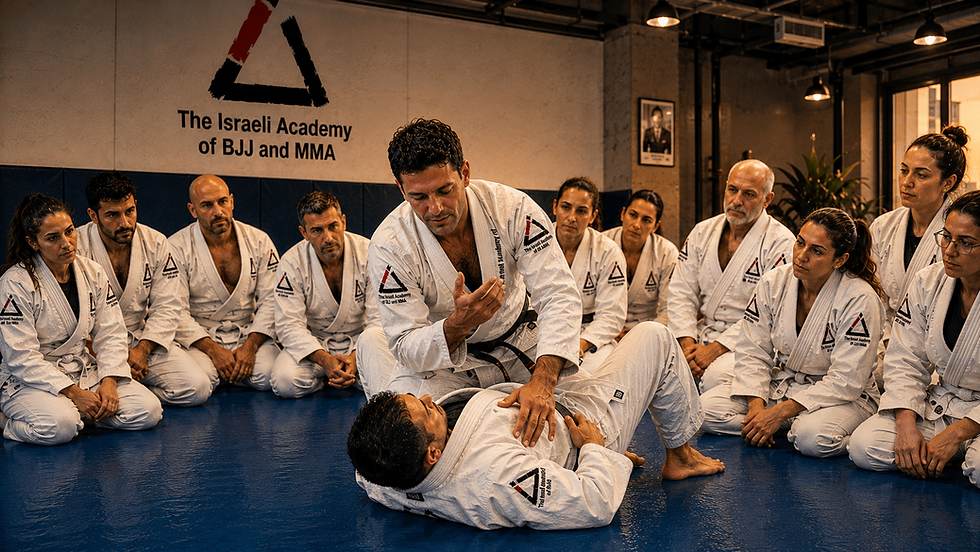
Warm-up, technique, drilling, sparring. That's the skeleton of almost every class. After the warm-up I teach a technique or two, then you drill them again and again and again with a partner, against gradually increasing resistance. And at the end of class comes the part everyone falls in love with: rolling. Full sparring, at real intensity, against a partner who is genuinely trying. Beginners and advanced students share the same mat, each matched against someone at their level.
The gear is simple: a Gi or No-Gi clothing, depending on the class (I wrote about the difference in my post on Gi vs No-Gi). No headgear, no gloves. And most importantly, there's an exit button: the tap. The moment something hurts or clamps down, you tap your partner or the mat and everything stops that same second. That's what makes it possible to train at high intensity, night after night, even at 45.
A Typical MMA Class
An MMA class is built differently, because it has to cover more worlds. Some sessions are devoted to striking: punches, kicks, movement, combinations on pads and gloves. Some are devoted to the connections: how to get from standing to a takedown, how to move from the takedown to control on the ground, how to stand back up correctly when someone is trying to keep you down. The sparring is far more graduated and controlled, because you can't take full-power shots to the head every week and stay in one piece. You work with protective gear, MMA gloves, shin guards, a mouthguard.
It's a superb, demanding, varied workout. But notice the structural difference: in jiu jitsu you can "play the full game" every single night. In MMA, the full game is saved for small, measured doses. Each approach has its price and its advantage, and that's exactly what you need to know when choosing.

And What About Your Head? The Side Nobody Talks About
One more difference that hardly anyone mentions, and it sometimes matters more than all the technical ones. A jiu jitsu session is a kind of chess in motion. Your mind works the entire time: position, pressure, solution, mistake, correction. People who come to me after an insane day in high-tech tell me it's the only ninety minutes of their day when they think about nothing else. There's no smartphone on the mat. There's only the problem in front of you, and it weighs 85 kilos and is sitting on your chest.
MMA training gives you something else: release. There is something purifying about hitting pads until you can't lift your arms, and if you need that, you need that. Both kinds of training build confidence, fitness and mental toughness. They just do it in different ways, and it's worth asking yourself which way will make you come back for the next session. Because in the end, the best martial arts training is the one you actually show up for.
Five Myths It's Time to Break
Now for my favorite part. Here are the myths I hear again and again and again, from the MMA side and from the BJJ side.
Myth 1: "MMA is violence for thugs in a cage. Baboons. Neanderthals"
In 2013 I was in the US on my honeymoon. I sat down to dinner in Los Angeles with some "local" Israelis, and somehow the conversation rolled around to MMA. One of the guests, a chef in his forties, dropped this pearl of wisdom: "Every MMA fighter comes from a rough childhood, something to prove, mental issues and built-in Neanderthal genes.. modern barbarian gladiators." So I introduced myself and my background (a kid from Afula, not that rough a childhood), holder of two degrees, a man who loves reading and cooking, with no desire to hurt anyone, and whose only known mental issue is excessive restraint around people who insult him. And an MMA fighter. The chef went quiet. Statements like his were never limited to laymen, by the way. Over the years, martial artists from various disciplines, including veteran instructors with decades of training, plenty of students and "status," have called us baboons and Neanderthals in endless Facebook and forum debates.
So no. MMA is a sport in every sense, with rules, refereeing, weight classes and medical oversight. A good MMA class has an orderly warm-up, technical work, bag and pad work, sparring controlled by level. The people who come to our MMA classes are high-tech workers, students, fathers. Regular people who want real fighting fitness instead of another boring aerobics class. The aggression in a professional cage is the tip of the pyramid, not the daily life of the person training.
Myth 2: "You can learn MMA from scratch, twice a week"
Here's the uncomfortable truth: MMA is a combination of disciplines, and to combine something, there has to be something to combine. A professional MMA fighter trains hours every day, and almost always arrived with a background in at least one parent discipline: wrestling, boxing, judo, jiu jitsu. Someone starting from absolute zero on a twice-a-week schedule who expects to "learn MMA" is effectively trying to study four professions in parallel, part-time. That's not realistic, and I think it's important to say so honestly to anyone considering it.
What is realistic? Starting from one strong base and building from there. For most people, Brazilian Jiu Jitsu is the logical starting point: you can train it at full intensity without taking shots to the head, the learning curve is measurable, and progress is felt within the first few months. From there, whoever catches fire for the striking and the blend moves into MMA classes with a real base under their feet. That's how it works between our groups in Tel Aviv and Netanya, and it's the path I recommend to almost every beginner.
Myth 3: "BJJ is just a points sport, it doesn't really work"
This myth is usually spread by people who watched a sport jiu jitsu competition on YouTube and decided they understood the system. So yes, there is a competitive sport branch, and it includes things I would never do where there's no referee. But the root of the system, Gracie Jiu Jitsu, was built precisely for the situation where there are no points and no timer. The historical proof was told above: Royce didn't score points at UFC 1. He submitted people. If you want the full version of this argument, it's in my post on self-defense with Brazilian Jiu Jitsu.
Myth 4: "There's no striking in BJJ, so it doesn't prepare you for reality"
The opposite claim, the same shallowness. First, serious jiu jitsu training includes understanding a fight with strikes: how to close distance without getting hit, how to use the clinch, how to control someone who is trying to punch. That's the difference between learning the system as a sport only and learning it as a martial art. And second, let's be honest about the other side: most people who train "striking" have never taken or thrown a real full-power punch, because you can't do that kind of sparring every week and stay healthy. In jiu jitsu you actually can train at close to one hundred percent intensity, night after night, and that is an enormous training advantage almost no other system has.
Myth 5: "You need to get in shape first, and after 35 it's too late"
This myth is shared by both worlds, and it kills more training careers than any injury. So no: you don't get in shape in order to train, you train in order to get in shape. Nobody expects you to survive your first class with dignity, least of all me. And on the age question, jiu jitsu was built from the ground up for the person who is not the youngest, biggest or strongest in the room. Helio Gracie, one of the central figures in developing the system, was himself a thin, physically unimposing man, and much of what he and his brothers developed was born from his need to deal with bigger, stronger opponents. On our mats you'll find 50-year-old lawyers next to discharged soldiers, and everyone survives. Some of them even smile.
So Which One Is Right for You? The Short Guide for the Undecided
Now that the myths are out of the way, we can finally answer the original question. And notice that it has changed: it's no longer "which is better," but "which is better for you, right now, given your goals." Here's the most honest answer I can give, by what you're coming to achieve.
If your goal is self-defense: start with Brazilian Jiu Jitsu. It's the only way I know to train real confrontation scenarios, at real intensity, without paying for it with your health. Whether you're looking for Krav Maga, a self-defense course in Tel Aviv or any other solution, you're really looking for the same thing: real ability against a real attacker, and Gracie Jiu Jitsu delivers that in the most systematic and safest way I know. That goes double for women, who also have a dedicated women's BJJ group at our Tel Aviv academy.
If your goal is fighting fitness and adrenaline: our MMA classes in Tel Aviv and Netanya will give you that mix of cardio, strength and technical work standing and on the ground. It's a demanding, sweaty, head-clearing workout on a level that's hard to explain to anyone who hasn't tried it.
If you dream of competing, on the mats or in the cage: you'll eventually need both, but the order matters. A strong ground base first, striking and blending later. Ask almost any successful Israeli MMA fighter where they started. Most of them grew out of the BJJ community in Israel, and that's no coincidence.
If you're 35, 40 or 50-plus and wondering whether this is even relevant: yes, emphatically. Jiu jitsu was built from the ground up so that a smaller, older person can handle someone bigger and stronger. In our jiu jitsu classes in Tel Aviv and Netanya you'll find people training in their fifties and sixties, and they are not there for the photos. If your first question is "how do I survive a first class," I wrote exactly about that: Your first BJJ class, what to expect.
And if you're still undecided: come watch a class of each. Five minutes in front of the mat are worth more than fifty YouTube videos..

How It Works at Our Academy
At the Israeli Academy of Brazilian Jiu Jitsu and MMA we teach both worlds under one roof, and that's not an accident, it's a philosophy. BJJ classes at our Tel Aviv location (Yitzhak Sadeh 29) and our Netanya location (HaTzoran 4), MMA classes in Tel Aviv and Netanya, and striking in Tel Aviv. The schedule is built so you can combine: start from the ground, add the standing game, and build a complete fighter. You can see the full timetable on our class schedule page, and all our locations on the locations page.
And why should you listen to me of all people? My name is Itai Leibovich. I've been training in martial arts for 36 years, teaching Brazilian Jiu Jitsu and MMA continuously for 16, and my jiu jitsu lineage runs from my own teacher through Royler Gracie directly to Helio Gracie. I've also fought on the other side of this comparison: I had my first MMA fight in 2008. In other words, I'm not recommending either world from theory. I've lived both. So when I say I have no side in this argument, believe me: I have only one question, what will get you onto the mat and keep you there. Anyone searching for martial arts in Tel Aviv or Netanya will find a home for both paths with us.
Frequently Asked Questions
What's the difference between MMA and BJJ in one line?
BJJ is a martial art specializing in grappling, control and submissions, mostly on the ground. MMA is a competitive sport that combines several systems, striking, takedowns and ground work, and BJJ is one of its cornerstones.
What does MMA stand for?
Mixed Martial Arts. The sport best known through the UFC.
Which is better for self-defense, MMA or Jiu Jitsu?
For most people, Brazilian Jiu Jitsu. It lets you train realistic confrontation scenarios at high intensity and safely, and it was built from the ground up to neutralize a bigger, stronger opponent without relying on strength. MMA adds important standing skills, but demands a bigger time investment and a higher level of contact.
Can I start MMA with no experience?
You can come to a class with no experience, but let's set expectations: MMA is a combination of disciplines, and from zero on a twice-a-week schedule, the right way is to first build a base in one of them. Most of our beginners start with BJJ and add MMA later.
Do you have MMA classes in Netanya?
Yes. MMA classes run both at our Netanya location (HaTzoran 4) and in Tel Aviv. Full details on the schedule page.
Can I combine MMA and BJJ training in the same week?
Not only can you, it's the combination I most recommend for anyone who wants a complete game. Many of our members do exactly that: BJJ classes as the fixed base, plus an MMA or striking session for the standing game. The Tel Aviv and Netanya schedules are built so that this combination works within the same week, sometimes within the same evening.
What age can I start at?
Our academy is for adults, and there is no age at which it's "too late." We have members who started after 40 and after 50, both rolling on the mats and in the MMA classes.
Bottom Line
MMA and BJJ are not rivals. They're family, literally: modern MMA was born in one evening in Denver, when a skinny guy in a white Gi proved that Gracie Jiu Jitsu works on everyone. Since then the two worlds have only grown closer, and every serious MMA fighter on the planet now trains jiu jitsu, whether they call it that or call it "grappling."
If you're looking for a complete, demanding competitive sport that connects all the worlds of fighting, we have excellent MMA classes for you in Tel Aviv and Netanya. If you're looking for a martial art in depth, one you can train at full intensity decade after decade, the jiu jitsu mat is waiting. And if you're still not sure, that's completely fine. I didn't know what I was looking for either the first time I stepped on a mat. I only knew something there felt right, and that was enough.
So instead of picking a side in an internet argument, come pick a mat. Message us on WhatsApp, tell me what your goal is, and I'll point you to the right group, in Tel Aviv or Netanya: Talk to us on WhatsApp
See you on the mat.
Written by: Professor Itay Leibovich | 3rd degree black belt | Gracie Jiu Jitsu | July 2026 |


Comments