
BJJ Escapes: How to Get Out of the Worst Positions in Jiu Jitsu

By: Professor Itay Leibovich | 3rd Degree Black Belt, Gracie Jiu Jitsu | October 2026 | ~14 min read

"How do I get out of this?"
He's lying on his back under a blue belt who is sitting on him comfortably, and he asks me that question in the voice of someone who already knows the answer won't help him in the next two minutes. (He's a composite character, for illustration. But anyone who has trained with us for even a month knows that voice. Maybe from the inside.) He pushed. He wriggled. He tried to lift the guy off by force, twice, and now he's done. The guy on top hasn't even broken a sweat.
So here's what I told him: you're not stuck because you're weak. You're stuck because you're trying to get out with your arms.
This post is about escapes, or Escapes in BJJ, in the language of the mat. The part of jiu jitsu nobody posts on Instagram, and without which everything else is worthless. Because you can know twenty chokes. If you can't get out from under someone, you'll never get to try them.
What Is an Escape in BJJ, and Why Is It the First Thing You Learn
An escape is any technique that takes you from a bad position to a better one. From under the mount to guard. From under side control to guard or to your knees. From someone on your back to facing them. The escape doesn't win the fight. It puts you back in it.
In Brazilian Jiu Jitsu (BJJ), escapes are the foundation, not a side chapter.
Look at how the people who built the system teach it. In the Gracie Combatives program at the Gracie Academy in California, lesson one isn't a choke or a takedown. Lesson one is the Trap and Roll, a mount escape also known as the Upa. The first thing a new student learns there is how to get someone who is sitting on them off of them.
Saulo Ribeiro, a multiple-time world champion and the author of "Jiu-Jitsu University", built his entire book as a staircase, belt by belt: survival at white belt, escapes at blue, then the guard, guard passing, and only at the very end, submissions. Submissions, the thing everyone signs up for, sit on the top floor. That's no accident.
The logic is simple, and it's worth understanding now, before your ego decides for you: in your first year on the mat, you'll be on the bottom. A lot. Almost everyone you train with knows more than you do, and most of them will use it. So the question isn't whether you'll end up under someone. The question is what you'll do when it happens. And if the answer is "push", you're going to spend a lot of time there (and eat a lot of armlocks).
(I also wrote about this in my post on common beginner mistakes in jiu jitsu. One of the mistakes there is going full throttle from the start. And it shows most from the bottom: you explode with everything you've got, and you're spent within a minute.)
Three Principles Behind Every Escape
Before we get to specific positions, here's the secret. Every escape in jiu jitsu is built on the same three principles. If you understand them, you learn every new escape much faster. If you don't, you learn twenty techniques and feel like none of them work.
Principle 1: Frames, Not Pushes
A frame is a hand, forearm or knee you set like a beam between your body and your opponent's. It doesn't push. It holds. When a 90-kilo opponent leans on you and you push him with a straight arm, your strength is gone in ten seconds. And as I explained in my post on the mount, a straight arm that pushes is also an invitation to an armbar.
A frame does something else. It doesn't move him. It stops him from coming closer, and gives you the centimetres you need to move yourself. The difference between a push and a frame is the difference between trying to move a wall and setting a beam that holds it in place.
Principle 2: You Move, Not Him
This is the principle that changes the most, and the hardest one to accept. Beginners try to move the opponent. Experienced students move themselves.
The two most important movements in any BJJ class are the bridge (lifting your hips off the mat, driving through your feet and shoulders) and the shrimp (moving your hips out and away to the side, like a shrimp curling up). Both are hip movements, not arm movements. Your hips and legs are far stronger than your arms, even if you lift twice a week. The bridge makes space upward, the shrimp makes space sideways, and the frames keep that space from closing.
If there's one drill I'd ask you to do at home, it's this: twenty shrimps per side, on your back, down the hallway. It looks silly. It feels silly. And in your third class, when someone climbs on top of you, you'll understand why it was the least silly thing you did all week.
Principle 3: Breathe, Then Time It
The first thing that happens to a beginner under someone is that he stops breathing. The second is that he starts exploding, every ten seconds, with full force, in every direction. He's done in a minute and a half.
A good escape starts with survival, before any movement: elbows tight to your body, chin down, calm breathing, frames in place. Only then, when your opponent moves, shifts his weight or looks for a grip, do you use that moment. He gives you the escape. You just have to be ready to take it.
Which brings me to a quote I love, because it sounds almost too simple. Kron Gracie, the son of Rickson Gracie and grandson of Helio, a black belt and MMA fighter, is credited with saying: "Everything in life goes back to the basics."
"Basics" here isn't something you go through in week one and forget. It's what you come back to. Escapes are those basics. A black belt stuck under another black belt doesn't pull out a secret technique. He goes back to the frame, the bridge and the shrimp. Exactly like in week one. Just more precise. After 36 years on the mat, the shrimp is still in my warm-up too.
Escaping Back Control: The Most Dangerous Place on the Mat

Let's start with the worst place. Someone behind you, his heels inserted inside your thighs (hooks), his chest glued to your back, and his hands hunting for your neck. In the IBJJF points system, back control is worth 4 points, the same as mount, the highest score for any position. And there's a good reason for that: from the back he can see you, and you can't see him. From the back most chokes are available to him, and most of your attacks aren't.
The beginner's mistake here is almost always the same one: he tries to get up, or roll forward, and hands his opponent exactly the angle he needs for the choke. The logic of the back escape is the complete opposite.
Step one, the neck. Chin down, and both hands fight the choking arm (hand fighting), not just cover the neck. Before anything else. There's no point escaping the back if the neck is already lost.
Step two, down, not forward. Instead of fleeing forward, slide your body down and to one side of his body, until your upper back touches the mat. Once your upper back is on the mat, he loses much of the control he had. He's no longer "behind you". You're lying side by side, and your back is no longer exposed to him.
Step three, clear the hooks. His leg on the side you're dropping to gets trapped or pushed out, so he can't put the hook back in.
Step four, turn into him. Only now, with your shoulders on the mat and the hooks cleared, do you turn in, toward your opponent, into his guard or a top position.
The details, which side to drop to and how to neutralise the choking arm, change with his grip, and you work those out on the mat, not in a blog post. But the order, neck, down, hooks, turn, stays the same. And almost every mistake I see on the back is a mistake in the order: someone turns before his shoulders are on the mat, and finds himself in a choke.
(About the chokes waiting for you there, and why the rear naked choke is one of the most common submissions in MMA and BJJ competition, I wrote in my post on chokes vs joint locks in jiu jitsu.)
Escaping the Turtle: When You're on Your Knees and He's on Top
The turtle is the position where you're on your knees and elbows, curled into a ball, with your opponent over you, from the side or from behind. Beginners end up there almost on instinct, because it feels protected. It seems like there's no exposed neck and no straight arms. What could happen?
Plenty. The turtle is a transit stop, not a place to get stuck. From the turtle, your opponent only needs to sink one hook to take your back, or grab your head from the front (front headlock) and choke. And he knows it. The longer you stay there, the more attempts you give him.
So the turtle has three main escapes, and they all start with the same rule: don't stay put.
Back to guard: roll your shoulder, get a leg between your opponent and you, and bring him back into your guard. (And if you're still not sure why anyone would want to lie on their back against an opponent, I wrote about it at length in my post on the guard, and why you're dangerous on your back.)
Sit out: slide one leg out from underneath, turn on your hip and sit up facing him.
Stand up: if your opponent isn't holding you well, the simplest way out of the turtle is to stand. In self-defence, that's usually the right call too.
Escaping North-South and Knee on Belly
Two positions beginners know less by name, and know very well by feel.
North-south is where your opponent lies on you head-to-toe, his chest on your chest, his head by your belly. The weight is heavy, breathing is hard, and there's a famous choke from there (the north-south choke) plus arm locks. The escape runs on the same principles: frames on his hips or shoulders, a shrimp to create an angle, and get a knee in between you. Once there's a knee inside, you're already on your way to guard. And if he closes the angle, another common escape is to turn onto your side and come up to your knees.
Knee on belly is where your opponent "stands" on you with one knee on your belly or chest, the other leg posted out to the side with the foot on the floor. It's more a position of pressure and mobility than of heavy control, and it hurts. The beginner's mistake is pushing the knee with two straight arms and leaving an arm exposed to a lock. The basic escape: a frame on his knee or thigh, a shrimp away from the knee, and get a knee or leg into the gap that opens. Sometimes it's better to turn toward him. Sometimes away. It depends on where he shifts his weight, and that's exactly why you drill it, not just read about it.
Mount and Side Control: The Short Reminder
I've already written full posts on both positions, so I won't repeat everything. Just the essentials:
Under the mount, the two escapes every beginner learns are the bridge and roll (Upa, or Trap and Roll: trap an arm and a leg on the same side, lift your hips and roll) and the elbow-knee escape (frames, shrimp, and bring your leg back to guard). I covered both, including the common mistakes, in my guide to the mount in jiu jitsu.

Under side control, the rule is to build your frames before your opponent settles, and bring a knee back inside. In my guide to side control I also explained why it's the position beginners spend the most time in, and understand the least.
Notice what repeats in both: frame, hips, a knee coming back inside. Same story. Different position.
The Best Escape Is the One You Don't Need: Escaping a Submission Early
There's one more kind of escape, and it's where the gap between beginner and advanced is widest. Escaping a submission.
A beginner discovers he's in an armbar when his elbow is already straight. At that point, honestly, there's almost no escape. There's tapping out (a light tap on your partner or the mat to signal you submit, and he lets go immediately). (And you tap early. I explained why in my post on injury prevention in jiu jitsu.)
An advanced student feels the lock three moves ahead. He sees his arm drifting away from his body, the opponent's leg coming over his head, the angle opening. And he corrects before anything locks. Most submission escapes aren't a brilliant last-second technique. They're the habit of not leaving things out there: elbows tight to the body, and a neck that never stays exposed.
So the submission escape starts long before the submission. It starts with defending the position. Or, as I wrote in my post on Position Before Submission: whoever controls the position controls what happens next. And that holds from the bottom too.
Why Escapes Are the Heart of Self-Defence
In competition, letting your opponent take mount or your back costs you 4 points. On the street, being under someone is real trouble. Someone sitting on you can strike, and you can't strike back effectively. And if there are other people around, every second on the ground is a dangerous second.
That's exactly why Gracie Jiu Jitsu puts escapes first. The system was built on the assumption that whoever attacks you will probably be bigger and stronger than you, and that there's a good chance you'll end up on the bottom. So the first thing you need to know isn't how to win. It's how not to lose. How to survive underneath, protect your head, get out, and get up.
And in self-defence, the goal of the escape is different from competition. On the mat, you escape to keep attacking. On the street, you escape to get up, create distance and walk away. (On that difference, and why Gracie Jiu Jitsu was built for it, I expanded in my post on what Gracie Jiu Jitsu is and in my guide on why self-defence BJJ works.)
Many people who come to us in Tel Aviv considered Krav Maga first, or trained in it. What surprises them isn't the chokes. It's how much time we spend on what happens when you fall. Krav Maga is great at a lot of things, and most systems in the world are built around what happens standing. Brazilian Jiu Jitsu is built on the assumption that sometimes the standing part ends, and teaches you what to do from that moment.
Why This Matters Even More for Lighter Students
A 55-kilo student, woman or man, will find that almost everyone across from them is heavier. That means in sparring they'll be on the bottom more than anyone. And if they try to escape with strength, they'll find out very quickly that they don't have enough of it.
But that's exactly where good escapes make the difference. A frame needs an angle, not strength. A shrimp needs timing, not muscle. A good bridge rolls a much heavier partner, because it tips him toward the side where his arm and leg are trapped and he has no base. Your hips against his weak point, not your arms against all of his weight.
In our women's group in Tel Aviv, the largest in Israel, the strongest women aren't the ones who submit the most. They're the ones who are hardest to hold down. And for self-defence, that's what really matters. (I expanded on this in my guide to women's self-defence in Tel Aviv.)
And it holds at 45 too, without the fitness you once had. Escapes may be the part of BJJ that depends least on age. They're economical, you can do them slowly, and they rely on understanding, not on explosive power. (I wrote about this in my post on jiu jitsu after 35.)
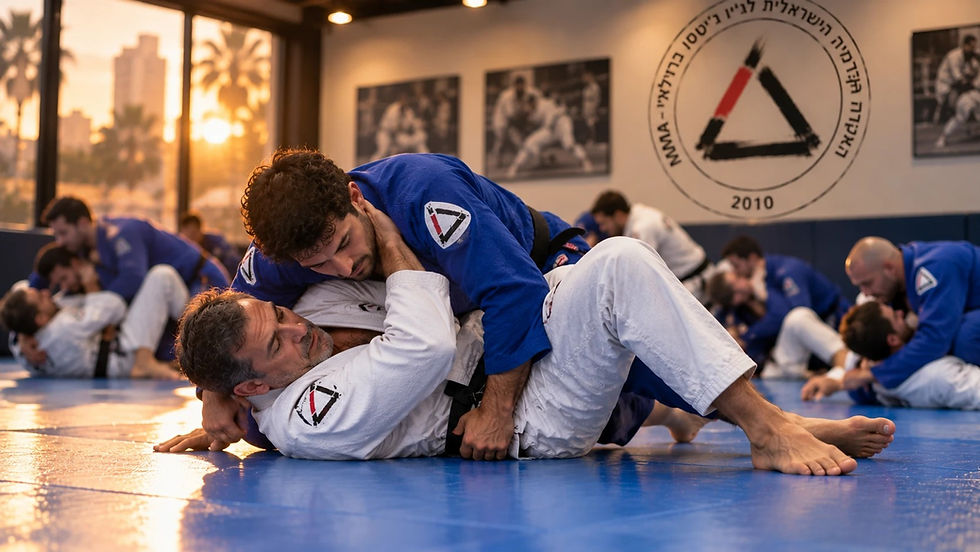
How to Drill Escapes, and Why Your Ego Will Fight You
The best way to improve your escapes is also the least fun: start in the bad position, on purpose.
In class this is called positional sparring. You start with your partner already in mount, side control or on your back, and your job is one thing: get out. Their job: keep you there. Once you're out, you reset. Again and again and again.
It's frustrating. You'll fail a lot, at first almost every time. And you'll want, with every fibre of your being, to ask to start on top. Don't. Every minute under someone in class, when you're safe and can tap at any moment, is a minute you won't spend panicking when it happens for real.
Rickson Gracie, Helio's son and one of the legendary fighters in the history of the art, is credited with a line I think of every time a new student gets stuck under the same mount for the tenth time in one evening: "True strength is not always shown through victory. Stand up, try again and display strength of heart."
To me it's the most accurate thing ever said about escapes, even if it wasn't said about them. Because that's exactly what an escape is: not winning the moment. Getting up from it. And trying again.
And yes, there's an ego side to this. Students who build good escapes look, in their first year, like they're "losing" more. They spend more time on the bottom, they don't chase submissions. And then, somewhere in the second year, something flips: suddenly nobody can hold them. And whoever is hard to hold is hard to beat. That's how it works in jiu jitsu, and that's how it works in life. (On the gap between what you feel you know and what you actually know, I wrote in my post on the Dunning-Kruger effect in jiu jitsu.)
How to Start Learning Escapes in Jiu Jitsu in Tel Aviv
At the Israeli Academy of Brazilian Jiu Jitsu and MMA in Tel Aviv, at Yitzhak Sadeh 29, escapes are a fixed part of the beginner classes, not a one-off topic. You'll do bridges and shrimps in the warm-up of most classes, and drill mount and side control escapes in your first weeks.
You don't need to be in shape, you don't need any experience, and it doesn't matter if you're 25 or 55. What you need is the patience to be on the bottom and the willingness to try again. And yes, from beginner classes to advanced ones, you can tap at any moment, and your partner lets go immediately.
And if you live in the north: the same basics are taught at our adult jiu jitsu branches in Haifa, with Timor Ozlner, and in Hadera and Kiryat Tivon, with Rami Abuhav.
If you want to know what's waiting for you in your first class, I wrote a full guide: what really happens in your first jiu jitsu class. And if you're still not sure what the difference is between Brazilian Jiu Jitsu and everything you've seen on YouTube, start with what Brazilian Jiu Jitsu is.
To book a trial class: send a WhatsApp message to 055-9212-431.
Frequently Asked Questions About Escapes in Jiu Jitsu
What is an escape in jiu jitsu?
An escape is a technique that takes you from a bad position, such as mount, side control or back control, to a better one, usually guard or standing. The escape doesn't win the fight, it puts you back in it. In Gracie Jiu Jitsu, escapes are among the first things you learn.
What is the first escape you learn in BJJ?
In most academies, and in Gracie Jiu Jitsu in particular, the first escape is the mount escape: the bridge and roll (Upa, or Trap and Roll). In the Gracie Combatives program it's lesson one. Later you also learn the elbow-knee escape, which works when the bridge isn't possible.
What is the hardest position to escape?
For most students, back control. Your opponent is behind you, you can't see him, and most chokes are available to him. In the IBJJF it's worth 4 points, the same as mount. The back escape always starts with protecting the neck, and only then with getting your shoulders to the mat.
Why is it hard to escape from under someone heavy?
Because most beginners try to move the opponent instead of moving themselves. Pushing with straight arms tires you out very quickly and invites an armbar. A good escape is built on frames, hip movement (bridge and shrimp) and timing: you wait for him to move, and use that moment.
What is the shrimp, and why does everyone do it in the warm-up?
The shrimp is a hip movement out and away to the side while lying on your back, like a shrimp curling up. It creates space between you and your opponent, and it's the basis of almost every escape from side control, mount and knee on belly. That's why it's drilled in almost every class.
How long does it take to learn to escape bad positions?
You learn the basic techniques in the first weeks. Making them work against an experienced, resisting partner usually takes months of positional sparring. For most students, the first year is the survival year, and the escapes really start working in the second.
Do jiu jitsu escapes work for self-defence?
Yes, and in fact they're among its most important parts. In a real fight, whoever falls and stays down is in danger. Escapes teach you to protect your head, survive under a bigger attacker, get out and get up. At Gracie Jiu Jitsu in Tel Aviv you learn them in the first weeks, exactly for that reason.
Bottom Line: Get Up, and Try Again
The choke is what people see. The escape is what lets you get there.
Every student in the world, including every black belt you admire, spent their first year under someone. The difference between those who stayed on the mat and those who left isn't how quickly they learned to submit people, but that they kept asking one question, hundreds of times: "How do I get out of this?"
And at some point, they stopped asking. Because they knew.
See you on the mat,
Professor Itay Leibovich
The Israeli Academy of Brazilian Jiu Jitsu and MMA, Yitzhak Sadeh 29, Tel Aviv
To book a trial class: send a WhatsApp message to 055-9212-431 (message, not a call).


Comments